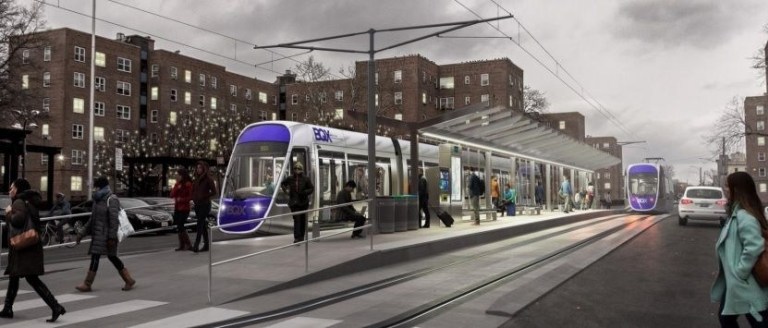
It is no surprise that, due to the financial crisis imposed by COVID-19 upon the municipal budget, Mayor Bill de Blasio is reconsidering advancing his $2.7 billion Brooklyn Queens Connector streetcar project known as BQX. There was never a guarantee that the Federal Transit Administration (FTA) would pay for 50 per cent of the cost. Dreams of Amazon doing the same have come and gone, since they cancelled coming to Long Island City, Queens.
There is no funding for this project in the MTA’s $51 billion 2020-2024 Five Year Capital Plan. There is no commitment to use future Manhattan congestion pricing toll revenues starting in 2021 to help fund this project. It remains to be seen if this project will be included within the MTA’s pending long-range 2020-2040 Capital Needs Assessment Plan. There is no proposed funding to advance this project in either the city or state budgets. No one knows if the next Mayor will support this project and make it a priority.
Mayor de Blasio has yet to request approval to enter the FTA New Starts process for future funding. The project is not included within the February 2020 FTA New Starts report for the federal fiscal year 2021. Don’t count on seeing it in the next FTA New Starts report for the federal fiscal year 2022. Successful completion of this process averages five years before there is an approved Federal Full Funding Grant Agreement in place.
The project has a fatal flaw. It is missing $1.4 billion in federal funding. This has been overlooked by those who champion the project. After five years, there has been no progress in securing federal funding. In 2015, the Friends of the Brooklyn Queens Connector claimed it could be built for $1.7 billion. In 2016, the New York City Economic Development Corporation (EDC) said $2.5 billion. Today, the estimated cost is $2.7 billion. How much more might it cost upon completion? It takes more than a simple planning feasibility study to turn it into a viable capital transportation improvement project. There have been no completed environmental documents or design and engineering efforts to validate the $2.7 billion construction costs.
Awarding a $7.25 million consultant contract to perform environmental work supplemented the previous $7 million feasibility study for a total of $14.25 million. This leaves the project $2.685 billion short of the funding needed for completion. The original completion date slipped five years from 2024 to 2029.
Claims that construction would start in 2019 have come and gone. The environmental review process has been underway since in 2017. Final design and engineering would require several more years.
Mayor de Blasio’s plan to finance this project by taking a percentage of property taxes on new development (value capture) was always robbing Peter to pay Paul. This would reduce the amount of money available for police, fire, sanitation and other essential municipal services. Both the New York City Department of Transportation (DOT) and the EDC have no experience in design, construction or operations of streetcar systems. De Blasio will have to ask the MTA to serve as a project sponsor and future system operator. The MTA, not wanting to use its own funding, would have to enter the project into the FTA New Starts program. The MTA, the DOT, the Port Authority of New York and New Jersey, New Jersey Transit and Amtrak are all attempting to qualify other projects for the same federal New Starts program.
Completion of a planning study is just the first step of any potential capital transportation project improvement. The journey for a project of this scope can easily take 10 to 20 years before becoming a reality.
Given the uncertainties of project financing and growing costs for utility, sewer line and water main relocation, buses would be a better solution. Adding more cars to each train and increasing the frequency of service on the Brooklyn-Queens Crosstown NYC Transit subway G line, which runs in close proximity along the same corridor, could quickly be implemented.
Without a billion or more from Washington, don’t count on riding the Brooklyn Queens Connector in your lifetime. What about simple limited-stop bus service on the same route? The MTA’s ongoing Queens Bus Network Redesign Draft Plan proposes the creation of the new QT 1 bus route. It would cross the Pulaski Bridge to connect Astoria, Long Island City, Greenpoint, Williamsburg, the Brooklyn Navy Yard, and Downtown Brooklyn. This could make for a low-cost easy-to-implement improvement instead of the $2.7 billion Brooklyn Queens Connector.
Larry Penner is a transportation advocate, historian and writer who previously worked 31 years for the Federal Transit Administration Region 2 NY Office. This included the development, review, approval and oversight for grants supporting billions in capital projects and programs on behalf of the MTA NYC Transit bus and subway, the Long Island Rail Road, the Metro-North Railroad, the NYC DOT Staten Island Ferry, and private franchised bus operators, along with 30 other transit agencies in New York and New Jersey.
Author

Discover more from Red Hook Star-Revue
Subscribe to get the latest posts sent to your email.