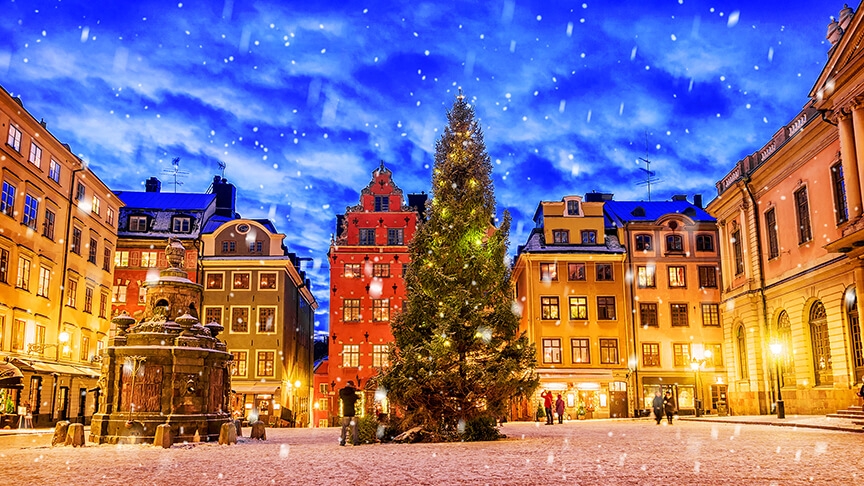
Sweden is a place of plenty of holiday celebrations. My American friends usually say midsummer with the fertility pole and the wacky dances when I tell them about Swedish holidays, but to me — and I’d wager few Swedes would argue against this — no holiday is as anticipated as Christmas. Further, I would argue that Swedish Christmas is unlike any other Christmas in the world.
It all really begins on the first day of December. That’s when Swedish Television 1 (SVT1), the primary public service broadcast channel, airs the first episode of the year’s Christmas serial. Every year, the audience — young children before they’re off for school, for the most part, but adults watch, too — get to follow a new wintery Christmas tale in 24 parts. Sometimes, the story revolves around saving the holiday, or the snow, or Santa Claus, but some of the most popular editions have only been tangentially related to Christmas. The most popular of them all, The Mystery at Greveholm, revolves around a family spending the holidays at the Greveholm castle, which turns out to be haunted. Accompanying the TV series is always a regular advent calendar made of paper.
Fast-forward to Dec. 13, Saint Lucy’s Day. Originally commemorating Lucia of Syracuse, this Christian feast day is most widely celebrated in Italy, the island nation Saint Lucia, and Scandinavia, including, of course, Sweden. We call her “Sankta Lucia,” and on the morning of Dec. 13, many schools, preschools, retirement homes and churches host a procession led by a young woman dressed in a white gown (Lucia of Syracuse, who became a martyr in the early fourth century, was said to have been a virgin), with a crown of burning candles. Every year, there is a national competition — as well as local competitions across the country — where people can vote for the woman they think should be Sankta Lucia in the national procession and in their home municipalities. (This display of religion and patriarchal values may surprise some readers, given that many view Sweden as a bastion of secularity and gender equality.) This quite sexist (and racist, as traditionally, only white, blonde women have been able to take on the role of Lucia) routine has received criticism, and it is now more common that schools have one or multiple Lucias, with no restrictions on ethnicity and hair color (or, in a few rare cases, gender). Accompanying Lucia, are women also dressed in white gowns carrying candle sticks, young men in white gowns and cone-shaped hats called star boys (stjärngossar in Swedish), and sometimes nissar (creatures of Nordic mythology, which, for all intents and purposes, look like gnomes) and gingerbread men (usually boys dressed up in all-brown outfits with white details, like gingerbread cookies with frosting). The procession participants sing Swedish Christmas carols and hand out gingerbread cookies and saffron buns (we call them lussekatter or lussebullar).
But wait! We missed Advent. While the season of Advent is hardly unique for Sweden, it is, I dare say, uncommon for Swedish families not to put up Advent lights at home. A four-part candlestick, the Advent candles are lit one by one, starting on the fourth Sunday before Christmas. The windows of government buildings are usually also adorned with advent candles, bringing light to the dark Swedish winter.
We’re getting close to the main event: Christmas Eve (yes, we celebrate on Dec. 24, not Dec. 25). But, dear reader, we must first make a pit stop on the night before the big day. In Sweden, Dec. 23 is known as dagen före dopparedagen, roughly translated to the day before the dipping day. The word dopparedagen stems from the Christmas Eve practice of dipping bread in broth made from the Christmas ham (which, to be fair, I don’t know if anyone actually does anymore). On the eve of Christmas Eve, Swedes decorate their Christmas trees (if they haven’t already. I’m decidedly in the camp of doing it early, because, after all, a tricked-out tree is fabulous) and eat baked ham on crispbread. Many families also turn on the TV for Stay Up Night; historically, people stayed up the night before Christmas to get the last details ready, but nowadays, many Swedes instead gather to play bingo on TV4 (a sort of quasi-public service channel).
Time for bed. Tomorrow is Christmas Eve.
“We eat Christmas dinner after Kalle. Potatoes, Swedish meatballs, sausages, pickled herring, salads, bread, ham, cured salmon, beer and schnapps aplenty, my family and our close relatives usually sit down around 4 or 4:30 p.m. for a couple of hours of dinner.”
Now, Christmas Eve in Sweden is both a highly individual and highly communal celebration. Let me, therefore, invite you into my family’s home for a moment. The morning begins, just like in many American homes, with Christmas stockings hanging from the mantel. Once the stocking stuffers have been thoroughly examined, my father gets up on the footrest of our couch, which, for a few minutes every Christmas morning, becomes an impromptu stage. Musician and singer all his life, including many years in an all-men’s choir, he possesses an immensely powerful yet flexible and controlled voice. He turns on the Swedish version of “O Holy Night” and sings along (or tries to, as he’s never bothered to learn the lyrics properly — but hey, it’s the effort that counts!).
After breakfast, we make our way to the cemetery to wish our buried relatives a merry Christmas. It is an intimate and emotional tradition, and has grown even more so as I’ve grown older and more of my close relatives have left us.
It is after lunch that individual turns into communal. Because that’s when, at precisely 3:05 p.m. about three million people in Sweden (quite a significant number in a country with a population of just over 10 million) sit down to watch Disney’s From All of Us to All of You on SVT1. Known in Sweden as Donald Duck and His Friends Wish You a Merry Christmas, it is the start of Public Service’s Christmas Eve programming (which, every year, is led by a new Swedish celebrity who sits in a comfortable armchair and welcomes viewers by lighting a lone candle).
From All of Us to All of You originally aired on ABC and is an animated Christmas special featuring some of our most beloved Disney characters, “Santa’s Workshop” and previews of upcoming Disney movies. Jiminy Cricket acts as the host, along with Mickey Mouse and Tinker Bell, and the show is essentially one long compilation of Disney shorts and clips from classic movies like Cinderella, Robin Hood, Lady and the Tramp and The Jungle Book.
The first time it was shown in Sweden was in 1960, during a time when SVT1 was the country’s only television channel. Since then, it has aired without interruption every Christmas Eve and is nowadays one of the most viewed programs of the year. The show has not changed much over the six-and-a-half decades it has aired; in recent years, however, some clips — in particular “Santa’s Workshop” — have been modified so that blatantly racist and antisemitic caricatures no longer are shown to millions of viewers.
I still sit down at 3:05 p.m. to watch Kalle (Donald, for Donald Duck, in Swedish), which it is often called, as do my younger sister; we’re still young enough to be considered children at Christmas, and, therefore, don’t have to help out that much with the food. Admittedly, it isn’t quite as funny now as when I was younger, but there is something uniquely comforting to be greeted by Jiminy Cricket and his magic wand. (And the short of Donald Duck as a photographer in the jungle is still, objectively, hilarious.)
Not all families do this, but we eat Christmas dinner after Kalle. Potatoes, Swedish meatballs, sausages, pickled herring, salads, bread, ham, cured salmon, beer and schnapps aplenty, my family and our close relatives usually sit down around 4 or 4:30 p.m. for a couple of hours of dinner. As someone who’s celebrated a traditional American Thanksgiving dinner, I would say the two are reasonably similar.
After that, at 7 p.m., it’s time for Sagan om Karl-Bertil Jonssons Julafton (in English: The Tale of Karl-Bertil Jonsson’s Christmas Eve), an animated short film about the teenager Karl Bertil Jonsson who, inspired by Robin Hood, steals packages from the wealthy and give out to the poor people of Stockholm’s slum. Karl-Bertil, as most of us call it, is also hugely among all age groups, and quotes from Karl-Bertil and his father (one of the wealthy people from who his son steals a package) make the rounds throughout December in our household.
Conversations continue late into the night, before we enjoy a few days of hefty sales on Christmas Day and Boxing Day.
And there you have it: A very Swedish Christmas. Did I get you in the holiday spirit?
Author

Discover more from Red Hook Star-Revue
Subscribe to get the latest posts sent to your email.