Is it possible for the best film at this year’s New York Film Festival to be an 8-minute short?
There’s a kind of perfect, resonant humanism in South of Tehran, Kleber Mendonça Filho’s brief portrait of Iranian filmmaker Jafar Panahi, that feels unique from so much else at this year’s event. And I say that knowing that NAZA, the Israeli documentary on the atrocities in Gaza, is also here. (More on that film below.)
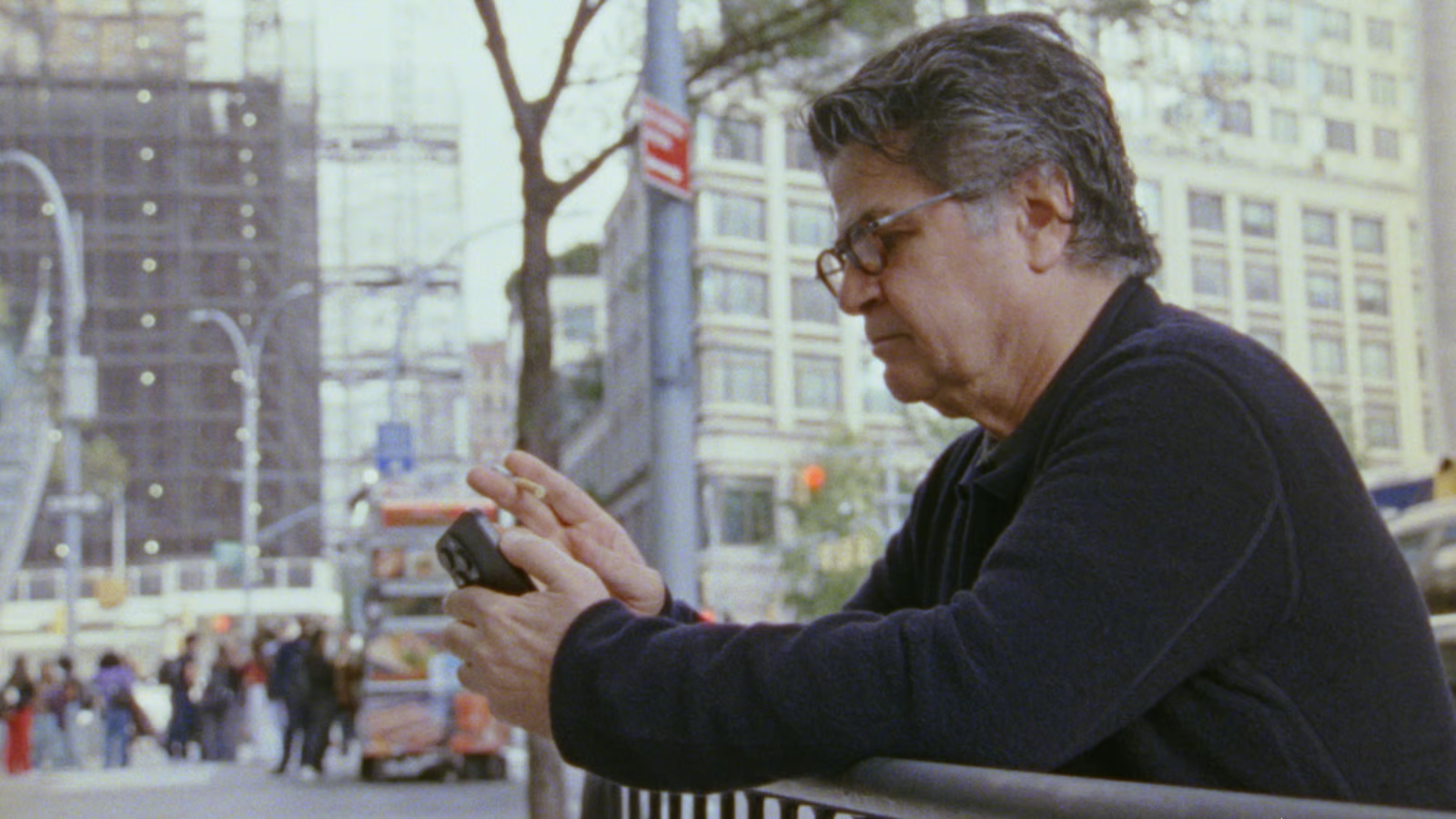
Mendonça and Panahi were both at the 2025 NYFF—the former with The Secret Agent, the latter with It Was Just an Accident—which inspired the festival to commission Mendonça to make the film. It’s deceptively simple, structured around, essentially, two setups—Panahi smoking outside during the 2025 festival and interacting with a (very eager) fan, and Panahi as a passenger in a car driving through Manhattan—and Panahi narration, taken from an interview between the filmmakers, about his days as a young moviegoer in Tehran. It’s what Mendonça does with these materials that is unexpected and affecting.
Once the film moves on from Lincoln Center, literally, putting us in the car with Panahi, footage of movie theaters active and defunct rolls by as Panahi talks about the “sanctity” of going to the movies. Simply the idea of cinema being a sacred thing is moving, especially from the vantage of the United States, where the movies have rarely been treated as more than a commodity, a consumer good to be ingested, collected, discarded. But it also speaks to how out of reach film can be for most people. “Cinema was difficult to reach, and that gave it a certain sanctity,” Panahi said in a June podcast interview with Roger and James Deakins, and in Mendonça’s short he talks at length about he and his friends squirreling away enough money—and time—to travel from the south of Tehran to the cinemas in the north, where the money and opportunity was concentrated. The south was the geography of the poor.
Anyone paying attention will feel the instant connection between Panahi’s Tehran and the Brazil articulated in The Secret Agent. A crucial scene in that film has a slovenly, autocracy-enabling industrialist slap down the younger, more liberal main character by sketching the shape of the nation on a napkin, bisecting it with a line, and declaring that the south is a backwater with a sub-human population beneath consideration. Mendonça’s work had been persecuted by the dictatorial Jair Bolsonaro, Panahi has been imprisoned by Iran’s regime for making films; both come from areas repressed by classism and moral judgment; both have a primal drive toward cinema (see: Mendonça’s documentary Pictures of Ghosts). Their pairing on South of Tehran feels almost fated.
You barely have time to register and catch up with this connective genetic code before Mendonça does something audacious. When we’re with Panahi in the car, he’s in the back seat, looking out the window as Manhattan glides by. And then there’s a cut to the driver, who is also Panahi. It’s footage from his 2015 film Taxi, which he made under the nose of the censors by driving a cab through the city and capturing passengers and interactions through strategically placed (and sometimes hidden) cameras. Mendonça does this move a couple times, just enough to hit and make you feel it.
We hear so much about how Panahi is a hero for defying the Iranian regime to make his movies, often paying steep prices in freedom and threat. And he is. Unquestionably. But those simple cuts gracefully, and graphically, show the toll the campaign against Panahi—and the role we’ve assigned him as martyr and protector of creative freedoms—has taken on him. When the younger, brighter, lighter Panahi from a decade ago looks in the rearview mirror at his passenger, he sees the older, grayer, exhausted Panahi, slumped against the window. The gray hair, deep-etched lines on his face, and spiritual heaviness depict a man who looks considerably more than 10 years older. But this isn’t an act of pity, it’s one of respect and generosity. Panahi is a stoic, steadfast, brave human being, and Mendonça, rather than elevating the pedestal he’s been put on, honors him by guiding him back to earth, revealing his basic, common humanity.
That spirit is found in Mendonça’s edits of the drive through New York, which he interspersed with footage of Tehran. At first, it’s so seamless that it’s easy to confuse the latter for the former. What is treated in the media and by our government as a distant alien locale for a video game-style war is shown as being nearly indistinguishable from a recognizable American metropolis. When you realize where you actually are—not on the Upper West Side but some bustling Iranian district—the distance between Iran and the United States collapses to almost nothing. What a thing to grapple with as we’re told to consider Iran—not simply the Ayatollah, but all of the country and all its people—as an evil begging for destruction.
If Panahi (and Mendonça) stand for anything, it’s that a nation is bigger than its regime, and that is beautifully articulated, multiple times over, in South of Tehran. These eight minutes are humanist filmmaking at its most confident, and audacious.
***
Yuval Abraham and Rachel Szor’s documentary NAZA is an 80-minute, mostly dispassionate prosecution of Israel’s genocidal campaign against Gaza in the wake of Hamas’ Oct. 7, 2023, attack. The filmmakers interviewed a couple dozen members of the IDF’s elite intelligence unit and on-the-ground troops who participated in—and in some cases built the tools to enable—the systematic, algorithmic, and indiscriminate murder of more than 73,000 Palestinians (as of when the film was completed). Those interviews were conducted by Abraham with subjects whose faces and voices were obscured to protect them against government reprisals. (Abraham and Szor haven’t been so lucky. Benjamin Netenyahu has threatened them with deportation and revocation of their citizenship, while their families have been harassed at their homes by zealous defenders of the regime.) Mostly shot on Tel Aviv rooftops at night, the glittering skyline blinking and sparkling in the background, NAZA can feel like a Michael Mann movie, with professionals speaking clinically and detachedly about their jobs and how good they were at them.
Except, here, their jobs were targeting and blowing up apartment buildings and housing blocks with the goal of killing Hamas agents—or “agents” since it’s unclear if targets were high level or low-level flunkies or even members of Hamas at all. And it didn’t matter who was caught in the crossfire. “NAZA” is IDF code for collateral damage—the human kind—and at one point an interviewee says the official decree was that up to 15 NAZA was acceptable. Not that it stopped at 15. In some cases, there were 50, 100, 300 NAZA. And it didn’t matter because, as we hear early on, the government believed that all Palestinians were complicit and responsible for Oct. 7 because all Palestinians had to know of it and its planning. Not sure about you, but I’m always impressed by infants’ capacities for complex geopolitical calculus and asymmetric warfare.
Stripping human beings of their humanity by giving them an acronymical label is just one layer of delegitimizing Palestinians as people that Abraham and Szor document. Another is that, after Israel’s 1967 invasion and occupation of Gaza, it made it illegal for Palestinians to build their own infrastructure. Israel would handle it, because then they could plant all manner of surveillance into everything from phones to homes. And those homes? Every building in Gaza was given a serial number. When the IDF was planning attacks, per multiple interviewees in the film, they would program drones and other autonomous weapons with the numbers and deploy.
All you have to do is see videos and photos from Gaza to know the result has been apocalyptic. It’s something the interviewees talk openly about in the film. Gaza is littered with bodies, one person says, with mass graves everywhere. “What happens to the bodies?” Abraham asks. “The dogs eat them,” comes the reply. The cut-to-the-marrow horror of the statement, said so matter-of-factly, has been hard to shake. (It brought gasps at the screening I attended.) So too has the scene described by other interviewees, of desperate Palestinians lined up on a bridge, where at the other end waits a limited supply of food. If anyone gets out of line, for any reason, they’re immediately shot by Israeli snipers positioned somewhere behind the line. Some try to bypass the line by sneaking under the bridge. They’re also shot. The space down there became filled with their bodies and those murdered on the bridge above. The IDF members sharing this story are asked to diagram the bridge and the experience; they do so, again clinically, a kind of visual schematic of the mechanized and efficient campaign against a people. “We erased history,” one IDF soldier says later.
Are humans still human if they’re stripped of their humanity in life and denied their dignity in death? It’s a question that looms over every second of this film—less a documentary than a record of evidence. And Abraham and Szor are just as brutally efficient as their subjects in sharing it. For more than 70 minutes, they give us unrelenting banality-of-evil nightmares set against the modern metropolis of Tel Aviv, with frequent voyeuristic shots of average Israelis in their homes doing mundane things, like folding laundry and soothing a child, with television news an omnipresent companion. But as dawn breaks, we’re taken to Gaza via cell phone footage. There’s no electricity. There are nearly no buildings. The first moments, at night, have an otherworldly feel, red tail lights the only illumination on endless rubble and darkness. The next images, though, are in daylight as a desperate father calls out for his son and daughter while navigating a mountain of rubble. Needless to say, the children aren’t found. The penultimate shot is of a half dozen pairs of young feet, their bodies invisible under a destroyed building. The last image we see is of a drone, hovering high and bright in a cloudless blue sky.
How much revenge is enough? Why is calling this endless three-year campaign of revenge a genocide verboten when we have no trouble calling so many others just that, from Armenia to the Holocaust to Cambodia to Kosovo to Rwanda to too many others? Why is indiscriminate murder of women and children OK when this group does it but bad when that one does it? Why is one group of people worthy of dignity and another not?
There is almost too much post-apocalyptic imagery and spiritual wasteland conveyed in the interviews. But, as a father, I can’t block out those moments of raw anguish from a man looking for his children. The world said “Never Again” after World War II. For the last 25 years, we’ve slapped “Never Forget” on anything we can. What are these but empty slogans if we’re OK with children being used as human shields—as acceptable human collateral damage—in endless campaigns of revenge and conquest? What good is saying you stand with Gaza or support Palestinians if your online virtue signaling further abstracts and dehumanizes the people who are being systematically eliminated?
I don’t know if NAZA is good—I don’t think the good/bad, or whatever, framework applies here. I do know we rarely get the inside-the-machine view of such crimes against humanity, and for that this is worth protecting. As is Abraham and Szor’s right to make the film. But spending 80 minutes in this space was more than enough—especially because those 80 minutes have led to countless more grappling with the implications this film raises. Not just for Israel and Gaza but for humanity.
News from the neighborhood.
Red Hook & Gowanus
Want more news and features like this straight to your inbox? Subscribe to our newsletter below.
Author

Discover more from Red Hook Star-Revue
Subscribe to get the latest posts sent to your email.