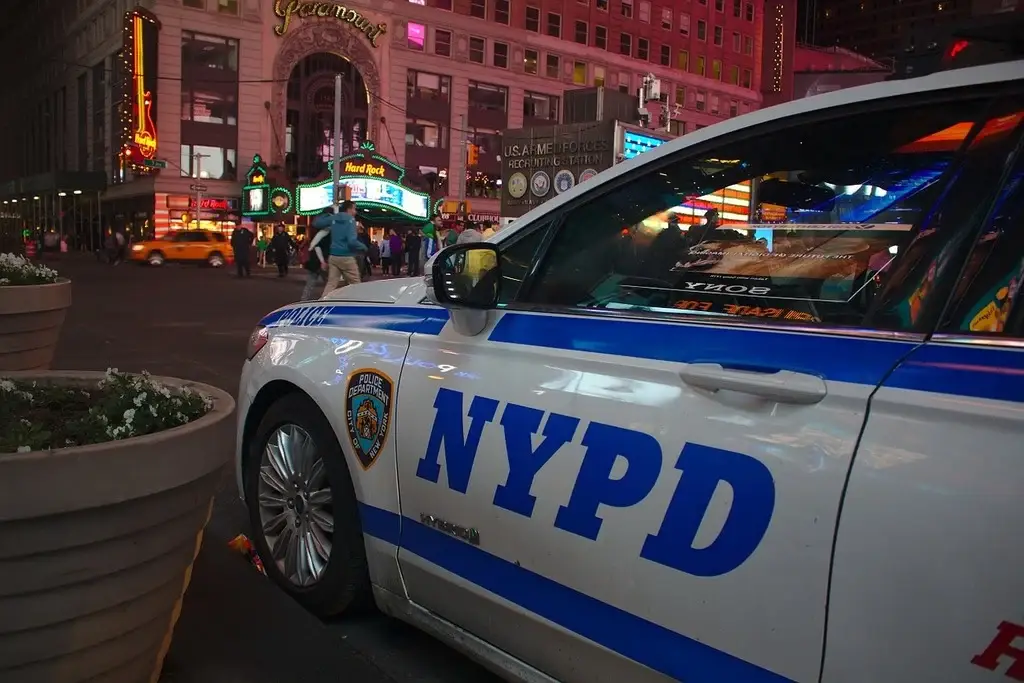
New York’s finest over-police the city’s Black and brown residents, the New York Police Department’s own data shows.
In February, the department released its latest batch of statistics on investigative encounters, which are interactions between a police officer and a civilian “for a law enforcement or investigative purpose.” Since 2003, the NYPD has collected data on so-called “level 3” stops—also known as Terry stops—when an officer has “reasonable suspicion” of criminal activity. But since the How Many Stops Act went into effect in the summer of 2024, the department must also collect and report data on “level 1” and “level 2” stops, which require a lower degree of suspicion (or, in the case of level 1 stops, no degree of suspicion) than level 3 stops.
Now, with the release of statistics from October through December 2025, New Yorkers and lawmakers have for the first time access to a full calendar year’s worth of data on who members of the NYPD stop, and where those stops occur. And the results deserve close attention from new Mayor Zohran Mamdani, criminal justice groups, lawmakers, and experts say.
“New Yorkers fought for and won passage of the How Many Stops Act to help expose the extent of the NYPD’s racist and unconstitutional street stop practices, and that’s what the first year of data does. It confirms through numbers what our communities have always known and experienced: that the NYPD uses investigative encounters to racially profile and criminalize us, rather than keeping us safe,” Samy Feliz, organizer with the grassroots group Justice Committee and brother of Allan Feliz, who was shot and killed by an NYPD officer while detained in 2019, told the Red Hook Star-Revue.
Over 2.4 million investigative encounters occurred last year, with 98% of them level 1. Level 3 stops—the only level for which there is data from before July 2024—increased again last year, to 26,405, up 4% from the year before. Level 3 encounters have increased by 195% since 2021, when 8,947 such stops were recorded (the lowest since data collection began over two decades ago).
In the average precinct, all three levels of encounters are down from the second quarter of 2025, while a few precincts stand out to raise the total number of stops, like the 75th (East New York) and 73rd (Brownsville) in Brooklyn, and 46th (Fordham, University Heights, Morris Heights, and Mount Hope) and 48th (Belmont, East Tremont, and West Farms) in the Bronx.
And across the city, Black and Hispanic New Yorkers are being disproportionately targeted. Comparing population numbers from the most recent census with NYPD data, the Star-Revue found that across the five boroughs, Black and Brown residents are stopped at higher rates than expected given their share of the population.
Even relative to other criminal justice metrics, like arrests or arraignments, the racial disparities in the investigative encounter data stand out, said Michael Rempel, director of the Data Collaborative for Justice at John Jay College, who last year released a research brief on investigative encounters.
“It appears that current practices are leading to especially large disparities in stop, question, and frisk. The spike in absolute numbers, in effect, comes with magnified disparities, because it means that the spike is accompanied by more stops that disproportionately involve Black New Yorkers,” Rempel said.
Over-policing of people of color is not a new issue in New York, and this data is not the first to show it; a number of lawsuits alleging racial profiling have since 2000 forced the NYPD to alter its street stop practices and adopt anti-discrimination policies, and a Federal Monitor report from 2023 showed that 97% of people stopped by the NYPD’s Neighborhood Safety Teams were Black or Hispanic.
Our review further highlights that in white-majority neighborhoods, Black and Hispanic community members are even more likely to be stopped by an officer.
“This indicates the NYPD is not responding to crime, but rather enforcing racial hierarchies by treating the presence of people of color in white communities as inherently suspicious; a threat to be managed, not a community to be served. This is policing as social control,” Feliz said.
The 76th Precinct
In the 76th Precinct, which includes Red Hook, Columbia Waterfront District, and Carroll Gardens, Black residents make up about 12% of the population, but account for 38% of all level 1 stops.
59% of the population in the precinct is white, according to the 2020 Census, but of the 28,308 level 1 investigative encounters recorded there in 2025, only 26% were with white New Yorkers.
The disparities grow as the encounters become more invasive; while the number of level 2 and 3 encounters are low in the precinct (42 level 2 stops and 172 level 3 stops), Black neighbors account for around half of all level 2 and 3 stops, and Hispanic residents for 27% of all level 2 stops and a fifth of all level 3 stops.
“As we have known for a long time, Black and brown people are disproportionately targeted by the police for stops. Our criminal justice system has innumerable inequalities that affect the lives, safety, and dignity of our neighbors,” Council Member Alexa Avilés, who co-sponsored the How Many Stops Act and whose District 38 includes Red Hook, wrote in an email to the Star-Revue.
Black and Hispanic people are not more likely to commit crimes. Rather, racial disparities in law enforcement are largely a product of bias and how police officers are deployed.
“Of course, there are some racist police officers, but that’s the only part of the problem. The other part is that once you’re consistently deployed in black neighborhoods, you start thinking that black neighborhoods have more crimes,” said Dr. Stéphane Leman-Langlois, professor of criminology at Laval University.
“They are directed by their higher-ups to believe that Black people and Latino people are the people they should be stopping,” said Frank Rudy Cooper, professor of law at the University of Nevada, Las Vegas. “You can train people not to be biased in who they stop, but if the norm within the department has been, ’this is who we stop,’ that’ll get passed on to the new officers and the culture will reinforce itself.”
There is no silver bullet for mitigating systemic racism in a police department, Dr. Leman-Langlois said. Many methods have been tested, like sensitivity training and hiring more Black and brown police officers, but neither has been particularly successful.
“One solution that’s really controversial is to restrict massively the number of random stops, because random stops are the perfect opportunity for biases to pop up,” he said.
Cooper argued that data collection and public access to statistics like the NYPD’s investigative encounter reports could also be effective measures. Further, he said, “What hasn’t been monitored as closely and might be helpful is making law enforcement officers always record the reason why they were suspicious of someone, and then enforcing the department’s egalitarian norms about why people are being stopped.”
This would give the department the chance to audit its data, “not just in who gets stopped, but in what reasons are given for the stops of different types of people so that they can identify patterns,” Cooper said.
It’s too early to tell what’s behind the recent downturn in investigative encounters, and whether the trend will continue, Rempel said. The Mamdani administration kept Jessica Tisch as NYPD commissioner, who has been criticized by the Justice Committee and other criminal justice groups.
“We know there is a clear problem; it’s laid out empirically in front of us. We need the city government to take responsibility and start rooting out the systemic racism in our criminal justice system. How do we have a model of care and support, rather than violence and disenfranchisement?” Avilés wrote in her email.
The NYPD did not respond to repeated requests for comment.
Author

Discover more from Red Hook Star-Revue
Subscribe to get the latest posts sent to your email.