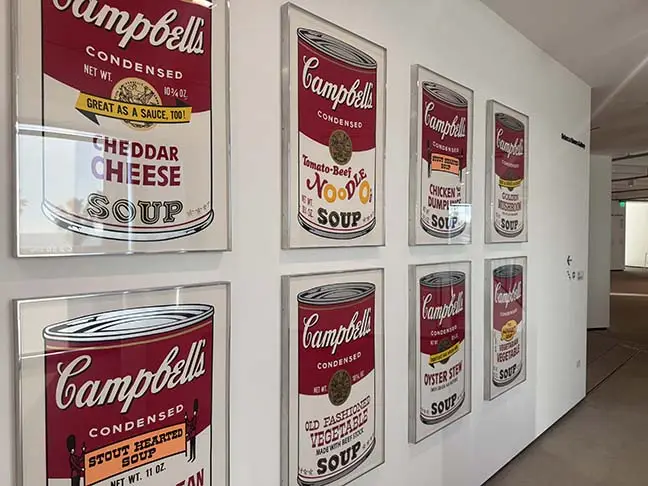
I have a remarkable story to tell you. My story is about a competition between the two hippest new stars in New York in 1966.
At that time, Bob Dylan went from being the iconic Folk Singer to the most exciting new Rock Star. Andy Warhol went from being the most iconic Pop Artist to the most exciting new Underground Film Director.
Now Dylan announced that he was going to make a film. Whenever reporters asked, “Is it going to be a Warhol film?” Dylan snapped, “Who’s Andy Warhol?”
But let us begin by going back in time to the golden summer of 1965 in New York City. Andy Warhol had stopped painting in order to devote all his time to the silver screen. As the Director, Andy was a God who ruled over his own universe of Superstars at the Silver Factory.
He was in the midst of his divine collaboration on eleven movies with his favorite Superstar, Edie Sedgwick. That July, he shot and successfully released perhaps their greatest film, Beauty #2.
When Andy started making movies in which his people talked, he hired a writer named Ronnie Tavel to write his scripts. But when he worked with Edie Sedgwick, he switched his method. He replaced his writer with an interviewer off camera and inaudible on the soundtrack who asked her questions. Thus, the scripts became her answers. On Beauty #2, Edie’s confidant Chuck Wein was the interviewer. He knew her better than anybody. Over the course of the film, his questions probed deeper and deeper into her psyche. As Chuck took Edie apart, stabbing down into the nether regions of her psyche, Andy’s camera recorded her twisting and turning in its grip. By the time the film ended, Edie was reduced to the victim she always saw herself being.
That July, right after Andy released Beauty #2 which was reviewed in The New York Times, Bob Dylan released his greatest song, “Like A Rolling Stone.” The song is aimed at a vulnerable young woman with a series of accusations that criticize her for her relationship with a powerful man she cannot resist.
People have always wondered who these two people were. Now the secret can be revealed: the woman is Edie Sedgwick and the man is Andy Warhol. He is “Napoleon in rags, the mystery tramp and the diplomat with his Siamese cat.” Ironically, while the song accuses Andy of stealing everything Edie had and says, “He really wasn’t where it’s at,” it also contains the first recognition of “the language that he used.”
People were always trying to stop Warhol from doing his work, but until he was shot, no one succeeded as much as Bob Dylan did with “Like A Rolling Stone.” One month after Beauty #2 and “Like A Rolling Stone” were released, Edie had a bad falling out with Andy when she refused to sign a release for a planned Edie Sedgwick Retrospective. At this point, she left the Warhol Factory to join the Dylan entourage where she was having a passionate affair with Bob’s right-hand man, Bobby Neuwirth.
If “Like a Rolling Stone” was an indictment of everything Warhol stood for, taking Andy’s beloved muse Edie away from him at this crucial juncture was a blow from which some of his friends thought Andy never recovered.
Dylan’s hatred for Warhol was launched by his Manager Albert Grossman who had told Edie to, “Get away from that madman Warhol.” If Dylan had hit him with a song, Andy would respond with a trilogy of brilliant works.
During 1966, Dylan was writing a novel, Tarantula, making an album, Blonde on Blonde, and working on his film Eat the Document. In the same year, Andy would create three comparable works. He would write a book called A: a novel, make an album called The Velvet Underground and Nico, and direct his film, Chelsea Girls.
Andy wrote his book A: a novel with the brand-new Phillip’s cassette recorder. Before this, he had to lug around a large reel-to-reel tape recorder. The new hand-held cassette recorder made it much easier to move around and record everywhere he went.
I compared Dylan’s novel Tarantula—a series of hipster riffs that go nowhere—to Warhol’s A: a novel; a hard piece of language, it can blind the reader with its poetry of human friction. Is Andy Warhol a better writer than Bob Dylan? If I had asked that question in 1965, people would have laughed at it. Now in retrospect, even though Dylan’s writing has held up well, he talks too much about it and comes across as trying too hard. Whereas Warhol, who would never be caught talking seriously about anything, was operating in a higher universe. Just as there can be no question today about whose work made more of a contribution to world culture, so there can be no serious comparison of Andy’s writing skills to Bob’s. A: a novel will soon be recognized as one of the ten greatest novels of the 1960s—alongside Naked Lunch.
At the beginning of 1966, Andy found a rock ‘n’ roll group, “The Velvet Underground,” with whom he immediately started working towards making an album. From January to May 1966 Andy rearranged the band, inserting Nico as a part-time lead vocalist, getting Lou Reed to write several songs for her to sing and setting up a month-long residency in the Dom on St. Marks Place in the heart of Manhattan’s Lower East Side.
If we compare Dylan’s masterpiece Blonde on Blonde to Andy’s The Velvet Underground and Nico, the first is a conventional piece of music featuring a set of lyrics that addressed High School and College kids; the second is a groundbreaking tour de force of never before heard music and lyrics which introduce a level of writing more akin to literature than rock ‘n’ roll. When The Velvet Underground and Nico was released, it would be advertised as a Warhol work.
Between June and September, Andy shot some fifteen reels which he combined under the title Chelsea Girls. He showed the three-and-a-half-hour film on two screens at the same time, switching back and forth so that one screen was featured with a soundtrack while the other was played mute. While Dylan’s 1966 film Eat the Document was never released, Chelsea Girls became the first underground film to break above ground. By the summer of 1967 it was playing on college campuses across the country and at film festivals across Europe.
In short, Andy Warhol beat Bob Dylan hands down on all three works. This is of course in retrospect. A: a novel was well reviewed but sold dismally and remained unrecognized for almost fifty years. Tarantula turned out to be a real disappointment for Dylan’s fans. At the time, Blonde on Blonde was a huge hit whereas The Velvet Underground and Nico barely made it into the top hundred. Not only was Eat the Document never released, it was rarely screened. Whereas Chelsea Girls became a sensation.
Both men made outstanding portraits off themselves in 1966: Dylan chose the iconic photograph of himself on the cover of Blonde on Blonde; Andy painted his most iconic self-portrait as a monarch staring out at a world he had made.
By the end of 1966, Dylan had retreated to Woodstock and had the famous motorcycle accident that sidelined him for years. Warhol, though, emerged as not only the King of the New York Underground but also as the ultimate New Yorker.
Author
Discover more from Red Hook Star-Revue
Subscribe to get the latest posts sent to your email.