
That the American, Jewish, lesbian poet Adrienne Rich is the epitome of brilliance is obvious. As a college student in the late 40s to her death in 2012, Rich delivered masterful poems commonly looked at as the work of genius. What may be less obvious but no less surprising to readers in 2018 is just how equally well-crafted and trenchant her prose is. A politically-engaged writer for most of her life, her piercing readings of Jane Eyre and Muriel Rukeyser and Emily Dickinson, her thoughts on the violence of language and her determination to become a “thinking activist” seem like a heaven-sent compass in our increasingly fraught times.
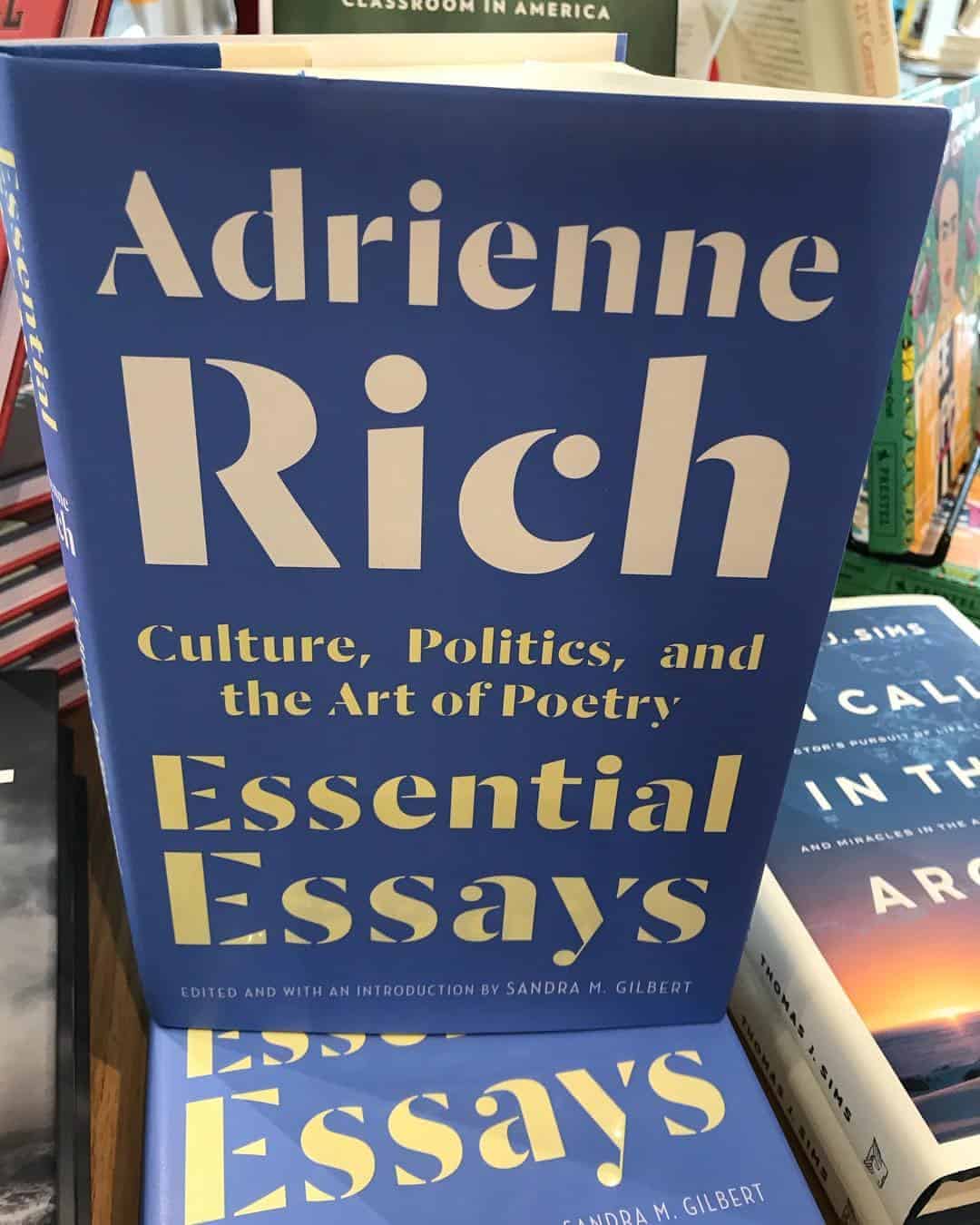 Editor Sandra M. Gilbert chose to title this collection of Rich’s prose as “Essential Essays: Culture, Politics, and the Art of Poetry.” It’s telling that Gilbert didn’t use “selected” or “collected.” Gilbert, a professor emerita at UC Davis and an icon in feminist literature for the 1979 “The Madwoman in the Attic” that she co-wrote with Susan Gubar, carefully gathers from Rich’s wide repertoire of prose for essays that are most essential to the current moment. As Gilbert singles out a line in the introduction that typifies Rich’s eventual stance on politics: a “patriot is one who wrestles for the soul of her country/as she wrestles for her own being.”
Rich lived a privileged life with a father who downplayed his Jewishness and a strict Protestant mother who saw that she’d excel as a student. When she arrived at Radcliffe-Harvard, she had a clear command of lyric and a keen intellect that would earn her the Yale Youngers Poets Prize in 1950, selected by W.H. Auden, who complimented her technical accomplishments while infantilizing the poems that were “neatly and modestly dressed, speak quietly but do not mumble, respect their elders but are not cowed by them.”
By the 60s, she was involved in the early stirrings of second-wave feminism; she was also a minority of white women to understand the need for intersectional feminism. In reviewing journals from this decade in “Anger and Tenderness,” Rich writes with acuity on the ambivalence of motherhood. She vivisects how patriarchy soured the mother-child connection to the point that Rich, a mother of three, felt severed physically and psychically. But in involving herself with the movement, she changed her life: “Slowly I came to understand the paradox contained in ‘my’ experience of motherhood; that, although different from many other women’s experiences it was not unique; and that only in shedding the illusion of my uniqueness could I hope, as a woman, to have any authentic life at all.”
Come the 70s, she was a feminist leader. She’d skewer the poet Robert Lowell over his use of personal letters by Elizabeth Hardwick (his ex-wife) in a collection of his own poetry, “Notebook/History,” which Rich called “language divorced from its breathing.” In a column for “Poetry,” previously uncollected until now, Rich wrote, “Lowell uses real people, versifies and fictionalizes them at will, and thus attempts to reduce or dominate them…. This is bullshit eloquence, a poor excuse for a cruel and shallow book.”
Rich’s stance as a stalwart and compassionate intellectual was solidified in the queer community with her 1980 essay “Compulsory Heterosexuality and Lesbian Existence.” Many university students have encountered it in excerpts and reading it in full points to how relevant the essay is in the Me Too era. Rich adumbrates eight conditions of abusive masculine power, the third of which explains why Yale professor Amy Chua was so keen to advise would-be clerks to be “model-like” for Brett Kavanagh. Rich writes: “Central and intrinsic to the economic realities of women’s lives is the requirement that women will [quoting legal scholar Catherine A. MacKinnon] ‘market sexual attractiveness to men, who tend to hold the economic power and position to enforce their predilections.’”
“Essential Essays” continues with too many astounding essays in form (“The Distance Between Language and Violence”) and insight (“Arts of the Possible”) to discuss here. The latter essay was a lecture delivered in 1997 at UMass Amherst. Rich explores the bond between the arts and social justice: “If we care about the freedom of the word, about language as a liberatory current, if we care about the imagination, we will care about economic justice.”
In dark times, this remarkable collection is a torch on why to carry on. For people living through 2018, it’s undoubtedly an essential read.
Discover more from Red Hook Star-Revue
Subscribe to get the latest posts sent to your email.


One Comment
Pingback: Essential Essays by Adrienne Rich – The Red Hook Star-Revue | Economic Justice