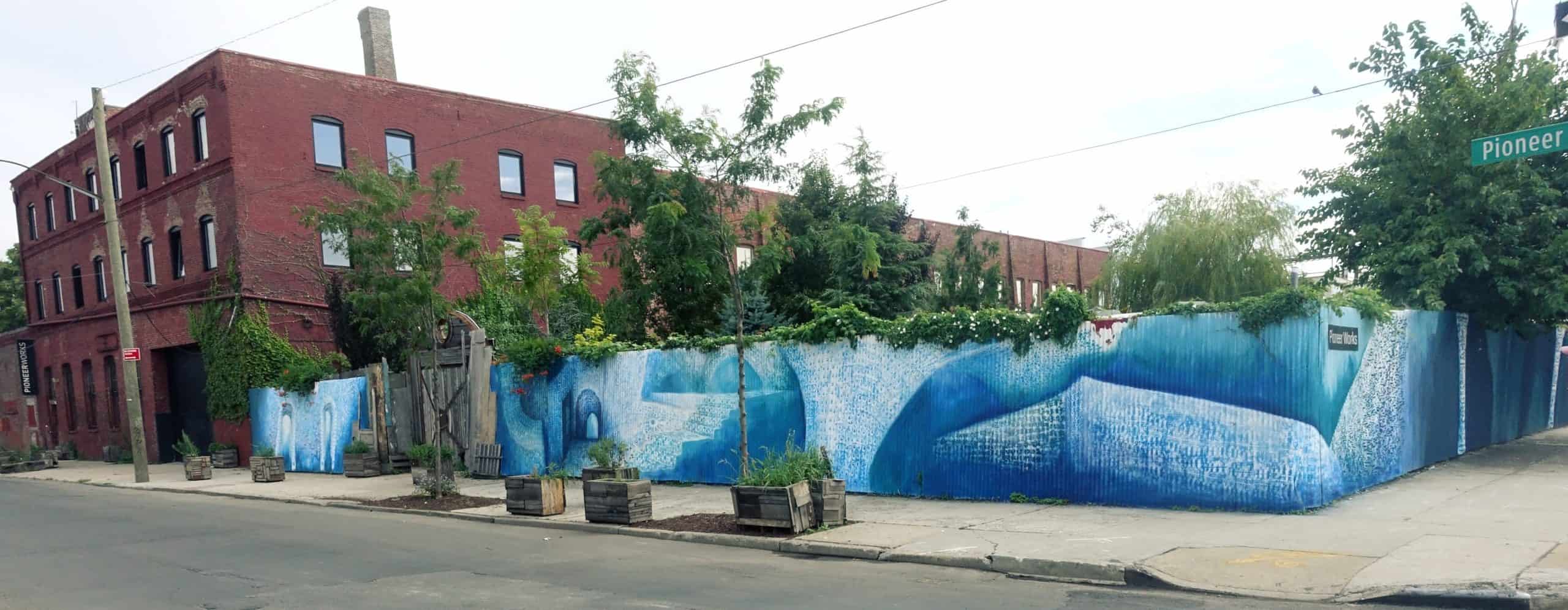
For better or worse, when visitors come to Red Hook’s Pioneer Works, the first work of art they see – before they even enter the building – is the blue and white fence on the west side of the property.
In 2017, Pioneer Works’ tech department invited me to hold a workshop on laser-cut stencils, and I met the organization’s founder, Dustin Yellin. Coincidentally, the big Formula E race at Atlantic Basin was about to take place, and Dustin wanted a new artwork for the yard’s fence, whose paste-ups by the street artist Swoon were deteriorating. After I showed up him my paintings, he asked me for a design, and by the time it was ready to go, I had only five days to execute the project before the event. Happily, like Tom Sawyer, I got lots of assistance from friends and even from Formula E volunteers.
I grew up in Rio de Janeiro, Brazil, where making public art can be extremely dangerous. But if you have a friendly attitude, painting on the street often means long hours working in front of a small crowd of passers-by, with coffee served by the corner resident and probably a good conversation. Someone will stop to tell you about their own life while watching you paint.
In Rio, blue and white tiles decorate many of the old buildings. We call these Portuguese “azulejos.” For a long time, I thought all azulejos should be blue and white, or at least a little blue, because after all, “azulejo” has the Portuguese word for blue as part of its linguistic root. Like many of my fellow countrymen, I found most of the contemporary architecture uglier than the older forms – hence, the tiles represented a certain nostalgia.
In 2011, I saw an artist decorating the background of her mural with a small stencil that mimicked an azulejo. I began to imagine paintings made of stencil-like tiles, but distorted with volume because I never liked flat shapes. But I didn’t have the patience to cut stencils, and for the level of detail I wanted, doing it freehand would be crazy.
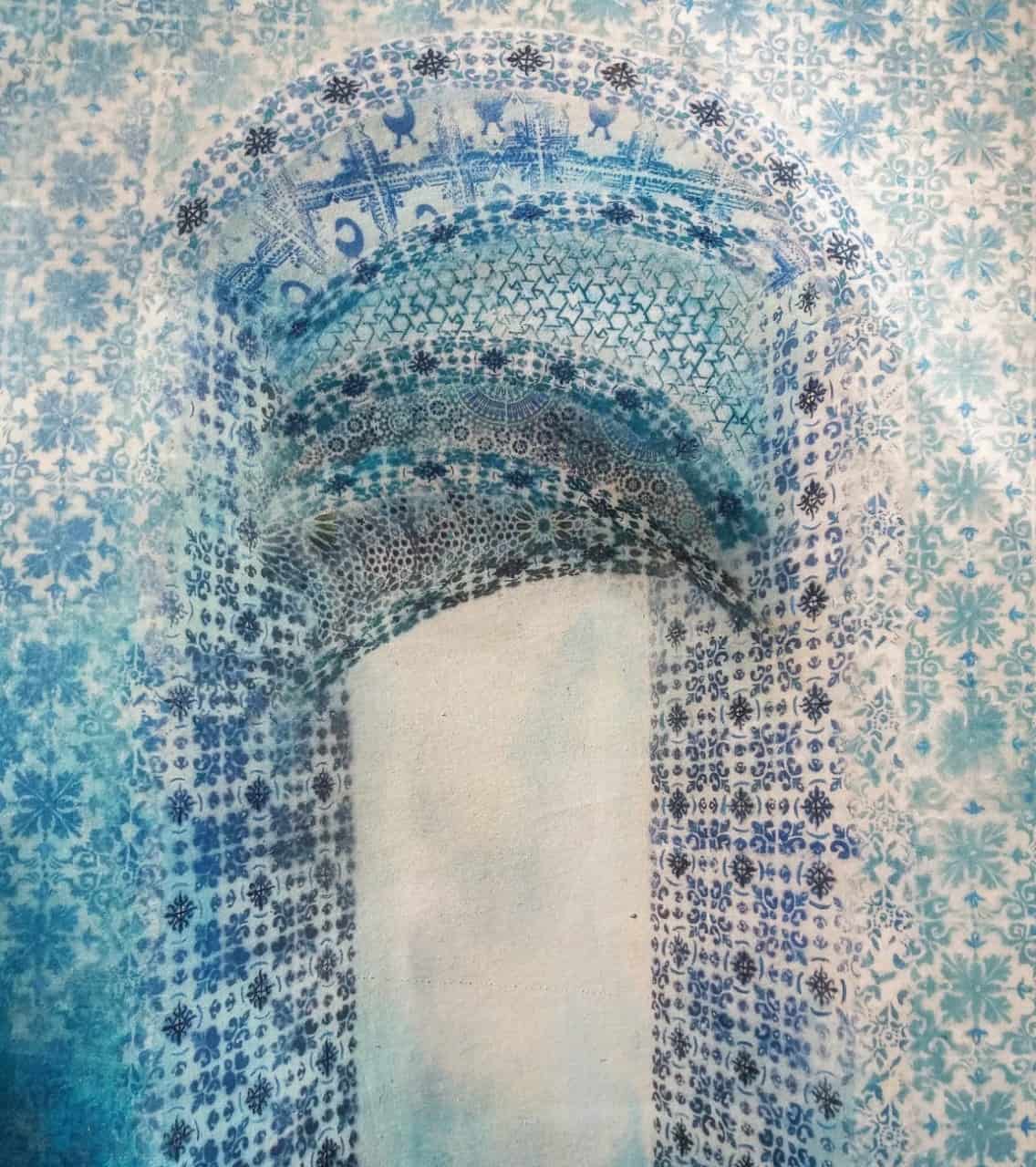
The last few years, I have been jumping between art residencies in Brazil, Chile, Paraguay, Benin, Thailand, China, the United States, and Europe. In 2013, in Berlin, I discovered the technique of laser cutting. More typically used by industrial manufacturers, its machinery provided a way for me to incorporate azulejos into my work. Through computer-aided design, I could combine the stencils in countless ways in order to fool people’s eyes into creating perspectives that are much deeper and more dynamic than the stencil shapes. With shading to add a tridimensional effect, the patterns present too much visual information for the viewer to process, and this allows light and shadow to guide the composition.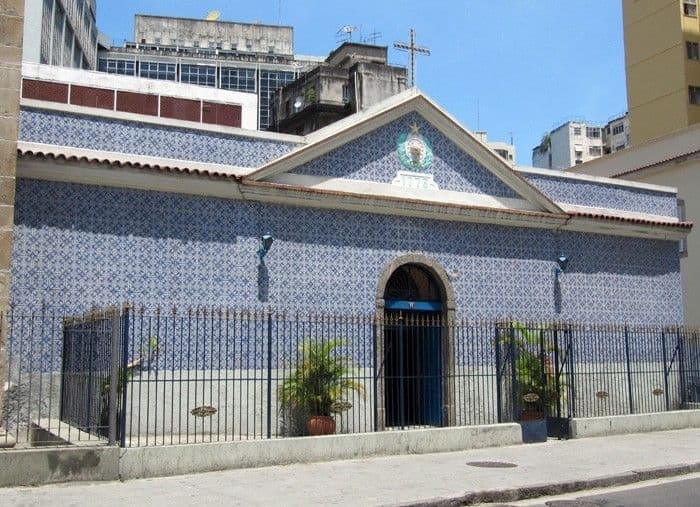
I began to use the technique in 2015 in New York and Lisbon. People in New York looked at my tile-like paintings and asked me about Moorish art, about Morocco, if I was Muslim. And that made a lot of sense, because Portugal historically has a huge aesthetic affinity with the Islamic world. The word “azulejo” has its origin in the Arabic “azzelij” and means “small, polished stone.” Therefore, “azulejo” has nothing to do with the Portuguese word for blue, “azul,” though it looks so much like it does. The blue and white come from China, where artisans have decorated porcelain with cobalt oxide for centuries, and the Portuguese were not even the first to produce similar ceramics in Europe – the Germans and then the Dutch were. These cultural exchanges are no simple subject.
Developing my own “tiles” was a pleasure. It inspired me to study the history of algorithmic design, which in turn brought me into debates about ethnomathematics and generative art. For millennia, many cultures around the world have turned to geometric patterns – instead of illusive figurative images – to capture the harmony and beauty of the divine. It was striking to realize the complexity that these art practices have achieved: for example, the similarity between some Islamic compositions and the atomic structures of quasi-crystals.
For me, the work is also very personal. I started painting tiles after the most important person in my life, my sister, died suddenly. Painting in shades of blue, thinking of passages, patterns, portals, looking at temples around the world for inspiration – all this has become part of my process of accepting mortality, of restructuring when something so fundamental is simply no longer there. And when we paint on the street, the paintings open up unexpected possibilities and new pathways for vitality. My biggest work in the azulejo series, the one at Pioneer Works, was ultimately taken over by the garden plants. Without invitation, life had burst into the midst of all that melancholic blue.
Discover more from Red Hook Star-Revue
Subscribe to get the latest posts sent to your email.