In a time when the City’s Administration seems awash with scandals and resignations, few NYC bureaucrats have been as effective as Jessica Tisch, Commissioner of the NYC Department of Sanitation (DSNY). The citywide composting program, which requires all residents to compost their organic materials, is just one of several sweeping DSNY initiatives implemented during her tenure. The program was rolled out in Brooklyn and Queens in October 2023. As of last month, no matter which borough you live in, apple cores, dinosaur kale stems, and lemon rinds (or more realistically for many, coffee grounds, leftover chinese food, and stale bread) should be put into compost bins, not the trash. Fines for failing to compost organics will begin this spring.
According to DSNY, the agency is “thrilled to report that in the last two years, the amount of compostable material diverted from landfill has increased 23%, to an incredible 260 million pounds.” Looking at DSNY’s most recent monthly curbside collection report, in January 2024, Brooklyn alone diverted about 150,000 pounds of organic waste per day, compared to less than 63,000 pounds per day in each of the boroughs that did not yet have residential composting. Diverting organic material means that, rather than sitting in landfills where it releases methane into the atmosphere, organic materials can be turned into compost or biogas.
DSNY currently sends most of the organics it collects (about 80 percent) to a facility in Newton Creek in Greenpoint, where huge steel eggs (anaerobic digesters) convert the organics into a renewable fuel (biogas) that can be used to power homes. The remaining solids left over from this digestion process create fertilizer. Skeptics were originally concerned that most of the organic material was being used to create biogas rather than compost, while the Adams Administration was simultaneously cutting funding for community composting programs. However, the resulting biogas that the organic material creates is used to heat homes and businesses, taking the place of fossil fuels that would otherwise be fracked to serve the same purpose. Last June, the City Council also restored funding of the community composting programs that had previously been cut from the City budget by the Adams Administration.
The remaining 20 percent of organic material collected via curbside composting is composted, and DSNY has entered into additional contracts that will drastically increase the number of districts whose material is sent to compost facilities, rather than to the digesters in Newtown Creek. Compost facilities in New Jersey and Staten Island produce compost that is either given to residents or sold to landscapers. For the past few years, the compost facility on Staten Island has produced about 42 million pounds of finished compost annually.
“The closest opportunity for residents of Red Hook Houses to compost is at Red Hook Farms.”
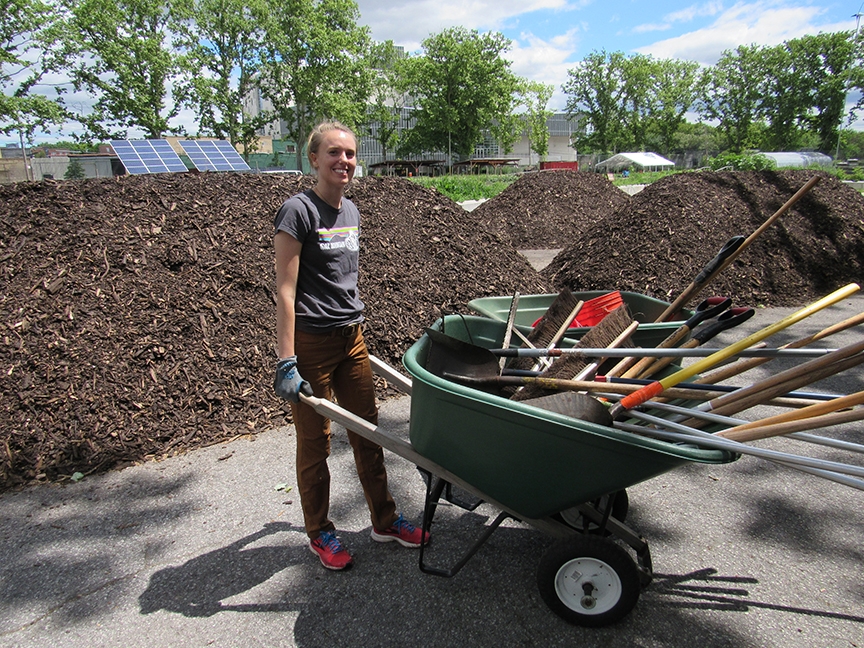
Unfortunately despite these efforts, a significant portion of the Red Hook community (the residents at Red Hook East and West Houses) do not currently have a composting program on site. According to the New York City Housing Authority (NYCHA) who manages the properties, the agency’s goal is to provide all residents with access to organics collection by 2026. All NYCHA properties separate yard waste, and the agency is working with properties to retrofit mowers to mulch leaves in place, increasing efficiency and improving soil quality. A handful of other NYCHA developments throughout the five boroughs also have farm sites with composting programs operated by Green City Force and Compost Power. The closest opportunity for residents of Red Hook Houses to compost is at Red Hook Farms (560 Columbia Street). The farm accepts food scraps (no meat, dairy, or bones) 24/7 in brown bins located near the Farm’s gates at Columbia and Sigourney St. and at Beard and Otsego St. Their compost is used on the farm, and also given away monthly (follow their Instagram account to stay up-to-date).
DSNY attributes the program significant use to the ease of the program, which does not require any sign up or even a specific bin. Although some supers and property managers have voiced opposition to the separate bins, which they believe are smelly and attract pests, all residential buildings are mandated to comply. For Brooklynites who have not begun separating their organic materials, brown bins can be ordered online from DSNY. Alternatively, any bin that holds 55 gallons or less and has a secure lid can be used in its stead, so long as a composting bin decal is attached (available online for free from DSNY). The bins are collected each recycling day. To cut down on clean up, the bins can even be lined with clear plastic, paper, or compostable bags. One final note: try to choose a bin made of a thick material; rats love your leftovers.
Discover more from Red Hook Star-Revue
Subscribe to get the latest posts sent to your email.