
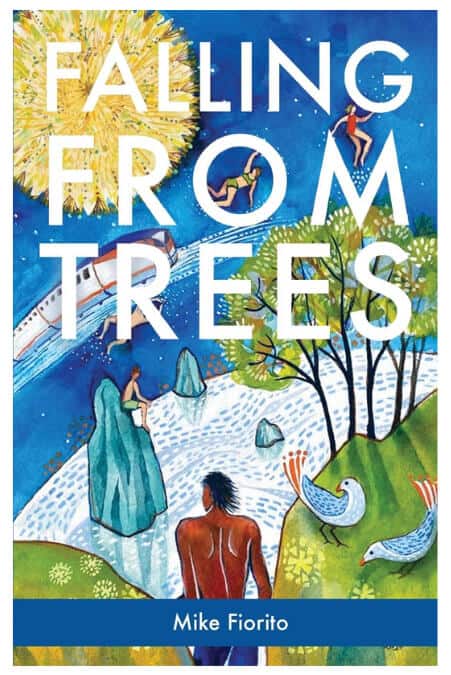
Not interested in science fiction? A longtime argument holds: Look beyond the setting (say, outer space) and the characters (maybe little green men) to find what’s human at its core—and therefore relatable. On their surface, the 21 short stories in “Falling from Trees” by Michael Fiorito are very much concerned with things like aliens and space travel. The characters are frequently scientists—even the children are math whizzes. A kind of post-apocalyptic, environmental destruction on Earth sets most of the plots in motion. Yet there is always a promise of hope to be found, and it comes from our relationships.
Fiorito, an editor at Mad Swirl magazine (and a frequent contributor to this paper), is also a husband and father to two boys. Especially well-conveyed in this collection are the dynamics between parents and small children, and husbands and wives. A recurring theme is the way strangers are forced to confront what we instinctively understand about one another. Salvation lies in the direction of embracing this, yet the enormity of the connection overpowers us, and we withdraw and separate. Suffering comes from the insistence of isolating to emotionally protect ourselves. That’s how we end up feeling alone.
Isolation is on all of our minds in this time of the pandemic, and it’s eerie how Fiorito’s futuristic vision anticipates a reality we’re already living. In “Tomorrow’s Ghost,” a young boy shares with his father the rumor in school that they’ll soon be attending classes virtually. Rather than a disease, it’s the heat that threatens survival here. The characters—father Liddy, an English professor; wife Kate, a scientist; and their son, Torrin—first show up in “Pale Leviathan,” where we learn they’re living in a punishingly-hot version of Arizona, the heat of which requires special goggles and reduces Torrin to tears. Largely confined to the house with the blinds drawn and the air conditioning cranked up, the family fantasizes about going to cold places “where the soil is still frozen,” while the heat forces its way inside, tormenting them from sleeping—a “hot vapor, like a pitiless ghost.”
Smith, a homesick alien, drifts through a number of stories, looking for a place where he fits in. In “The Productions of Time,” he finds a measure of comfort driving to the coast, having discovered that “the ocean reminded him of looking out into space.” He reflects on the complexity of humans, the way they “kill for their prophets and gods,” baffled by their failure to grasp the “vastness” of existence. An outsider in his own race—he sees himself “more compelled by words and music”—he finds a kinship with a small portion of the Earth’s population, those who “had deep feelings and wrote glorified verse.” In “Earth to Earth,” Smith again expresses this preference for “earthlings because they sang and dreamt, even the murderers and thieves.”
Another recurring theme, the importance of music, is introduced in the collection’s opener, “Climbing Time.” The narrator believes it to be “the basis of all complex thinking.” He has Asperger’s.“I act like a robot sometimes,” he is told, looked down upon as one of the “furious idiots, sophisticated yet savage.” When aliens start telepathically communicating “environmentally clean energy solu¬tions, new medical technologies and practices,” only those with Asperger’s are capable of hearing at the deep level required to pick up on the transmissions. “Sometimes the message arrived as music,” the narrator says. Help for humans comes from the outside, but the solution the aliens point to has been with us all along: “It turns out that the universe is made of music. Its secrets are trapped in the melodies of ocean water, in the rushing of waterfalls.”
The stories in Falling from Trees are all very short and enigmatically moody. Each in its way conveys an experience of suffering, as well as a suggestion for what might alleviate it—usually a change in thinking. In “Twilight,” the unnamed narrator wanders a world irrevocably scarred by a terrible explosion (the ocean “like thick petroleum”), mourning the loss of his wife and children, resisting tenuous attachments to other survivors. In “Tiny Blue Oceans,” an astronaut stranded in space reflects on his relationship with his wife, their desire for a child, and how Earth from that distance “looked like a sanctuary.” In “All of the Days,” a father, not recognizing the severity of his son’s illness, casually mentions the boy’s symptoms to a colleague while preoccupied with his email. The colleague’s horrified reaction shocks him into reality—and action.
Author

Discover more from Red Hook Star-Revue
Subscribe to get the latest posts sent to your email.




One Comment
Thank you for the very generous review, Michael Quinn!!