
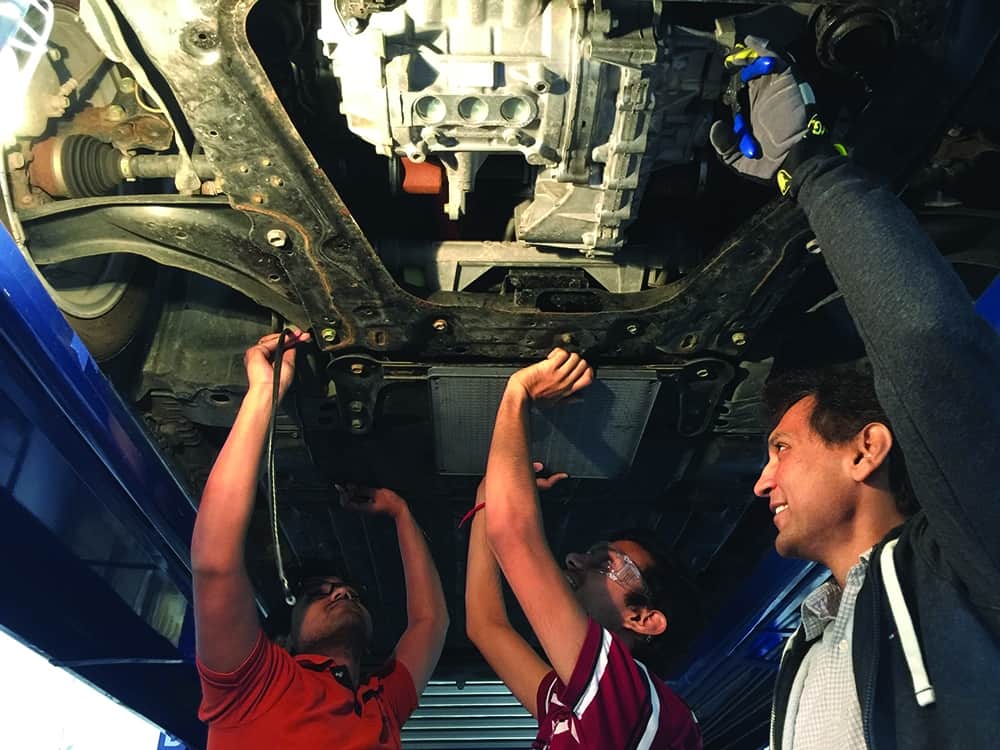
Imagine a world where fueling your car is as easy as riding in the EZ-Pass lane. You stop your car momentarily over a manhole cover-like structure in the road – then, zap! You’re fueled! No pumps, no fumes, and in theory, no hassle.
It sounds like science fiction, but a startup called HEVO, which stands for Hybrid & Electric Vehicle Optimization, has been quietly working on this groundbreaking technology in a Commerce Street space for years. In 2017, wireless charging could become a reality, eliminating the nightmarish obstructions facing electric car drivers today.
HEVO is starting its ventures in Red Hook, where it is also developing an electric car share program for residents. Currently, HEVO is in talks with Red Hook developers regarding pickup points and wireless charging stations for the car share. The Water Taxi drop-off could ultimately be an option, for example.
“Red Hook can be a beacon for this market. It’s an underserved neighborhood, and an electric car share is a way to bring clean transportation to the residents,” said HEVO CEO Jeremy McCool.
The wireless technology works around the interaction between the car and a receiver embedded in the road. A system is connected to the local electric grid and retrofitted to the bottom of the car. When the car links up to the receiver – which may look like a manhole cover – induction takes place in the form of electromagnetic resonance. Through this “handshake,” HEVO aims to charge cars for 5-15 miles for every mile driven. Between drives, users can manage things like location data, settings, and funding through the cloud.
Offices around the world
Aside from Red Hook, HEVO has offices in Silicon Valley and Amsterdam, with additional projects pending throughout New York City and in Jersey City, Georgia, The Netherlands, and more.
To McCool, – an Iraqi war veteran and sustainable development expert – the electric car takeover is imminent – but two things stand in the way. One of them is the notion that electric cars are obscure items for rich people.
“We need to change the perception that electric cars are expensive. They are actually cheaper when it comes to ongoing maintenance and fueling, and the $35,000 Telsa Model 3 is coming in 2017,” McCool says.
However, McCool says the second hindrance – fueling – is very real.
“There’s no curbside fueling for public use in this city,” McCool said. “There are only a few places you can charge, and you really have to know what you’re doing in advance. You’ll see exclusive pay-as-you-go garages where an attendant has to park your vehicle and plug it in…or there are options like Duane Reade or Park Slope CVS charging stations, but you have to be a member of some specific vendor service, and sometimes you have to call the vendor to wake up the system. It’s terrible.”
Though he’s basically a Silicon Valley startup CEO, McCool’s background lends itself more to the blue collar car industry. Hailing from New Mexico, McCool received primary education in Alabama and an undergraduate degree in Oklahoma.
“Many of my friends and mentors are hydrocarbon and natural gas people,” he said. “I never want to come off as condescending to them. We don’t preach. I’m not here to tell people what to do. We care about the American future interest, and hopefully the future interest of our descendants.”
To that end, McCool says an integration plan is necessary to avoid excluding millions of combustion engine workers from the rising tide of electric.
“Everyone knows the electric car is imminent, and it’s going to galvanize those who are afraid for their jobs,” he said. “Roughneckers in places like Texas and Oklahoma need to be given training and job opportunities. It can be done. It’s not like they don’t want to, it’s just that they’re not being given the opportunity.”
Product to launch this year
McCool’s interest in sustainable energy came from the military, where he served as an infantry platoon leader in Baghdad. He led forces into combat during the 2007 Iraq surge, where his perception on global energy completely changed.
“I got to see firsthand how much oil had to do with our time there,” he said. “I was willing to do anything possible to reduce reliance on fossil fuels. It became my purpose.”
McCool returned to the U.S. to study urban policy and sustainable development at Columbia University, where he learned about the burgeoning world of electric cars. After graduating, he secured a spot for HEVO in the ACRE program at NYU’s Tandon School of Engineering, which provides services and staffing to blossoming startups.
Eventually, the company had a growing need for a large experimental headquarters, which landed them at the 1,800-sq ft garage and office space at 102 Commerce Street. There, HEVO has been testing its technology for two years. They plan to hit the market in 2017.
To learn more about HEVO, visit www.hevopower.com
Author

Discover more from Red Hook Star-Revue
Subscribe to get the latest posts sent to your email.


One Comment
Pingback: A call to remove the ban, by Jeremy McCool - Red Hook Star-Revue