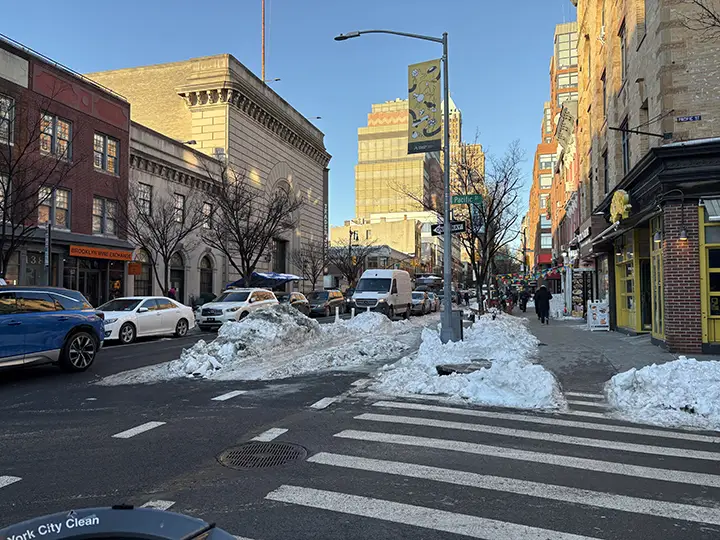
In the battle of Court Street, common arguments around the thoroughfare in its former and current conditions include double parking, traffic safety concerns, deliveries and modes of access to the corridor. We were able to obtain a copy of the survey commissioned by Mayor Adams. The survey was part of a report issued by the Deptartment of Transportation.
The 81-page presentation states exactly why the DOT chose to survey Court Street: alongside 200 injuries and two deaths occurring on the corridor in recent years, the department wanted to collect “firsthand data about traffic safety concerns, priorities, and suggestions from community members.” The department also wanted feedback from businesses on delivery volumes and curbside use.
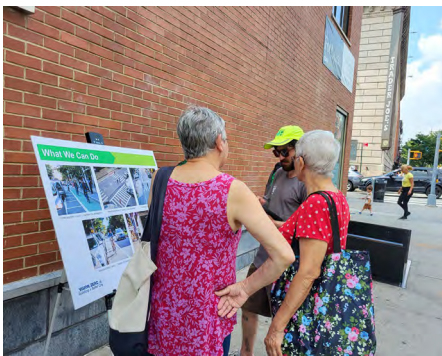
The survey was split into two phases: a merchant survey, in which businesses were visited, and an “intercept” survey, in which the DOT collected input from passersby. For five weeks in July of 2024, DOT ambassadors were deployed to two Court Street intersections per day to survey passersby. The merchant survey took place over seven days in February and March of 2025.
Ambassadors revisited the corridor before the afternoon and also later in the day to accommodate businesses that close early or open late. The remaining businesses received phone calls on March 13.
The survey doesn’t provide a full list of the merchants engaged, but it does provide photos of ambassadors visiting businesses and identifies where photos were taken. It also lists anecdotes with the names of some of the businesses they spoke with.
Common Feedback
Among the intercept survey’s 450 claimed interactions, the most common feedback revolved around cyclists and bike infrastructure: concerns about bikes on sidewalks, a need for cyclists to yield to pedestrians, bike lanes “as another risk to older adults,” and improving the bike network in the area. The study states that most people the DOT interacted with were “pedestrians of retirement age” who were decades-long residents.
Common feedback in the merchant survey, unsurprisingly, revolved around parking: complaints about frequent double parking, a need for more short-term parking for customers, Citi Bike stations reducing parking and delivery vehicles hindering street cleaning. Among business owners, the most concentrated areas of double-parking were between Atlantic Avenue and President Street.
Deliveries
The DOT asked 196 businesses along Court (a number that’s been frequently contested) about their delivery operations.
Those businesses reported the bulk of incoming deliveries happening on weekdays, most frequently between 11 a.m. and 1 p.m. The west side of Court between Kane and Degraw Street reported the highest number of deliveries, with almost half of the merchants being restaurant or food retail businesses.
About 40% of the surveyed Court businesses reported making outgoing deliveries. For these deliveries, 80% use e-bikes and 23% use cargo vans. (Survey totals went above 100% because participants could select multiple options for a particular question.)
Accessing Court Street
Most people surveyed said they walk to Court Street, as “73% reported walking, 64% take public transit, and about a quarter (28%) use a bike or other micromobility devices—such as an e-scooter” to travel there.
When comparing the use of cars and bikes, the difference isn’t stark. A total of 18% used a car to get to Court Street, with 7% who used a for-hire vehicle, another 7% who drove on their own and the remaining 4% carpooled. A total of 22% biked—15% rode a personal bike and 7% Citi Bike.
Over half of the respondents lived in the area that Court Street spans, from Brooklyn Heights to Red Hook.
Traffic Safety Concerns
Pedestrian survey participants noted speeding vehicles (61%), vehicles illegally parking (50%) and vehicles failing to yield (49%) as their top three safety concerns. For cyclists, their top three were split evenly – speeding, illegal parking and unpredictable vehicle movements, all 20%. Drivers said illegal parking (17%), speeding (14%) and truck activity (14%) were their top three.
Most people said they’d welcome changes on the street. Almost 60% supported a protected bike lane, 43% wanted truck loading zones and about half expressed a desire for bus lanes. Despite this magnitude of support for bus lanes, there weren’t any implemented on Court nor nearby the corridor.
The transportation department also offered options on how street space could be redistributed:
When it came to divvying up road space, input was split with 44% supporting removal of curbside parking, while 35% did not agree with any of DOT’s options. The top three preferred street improvements were protected bike lanes, truck loading zones and sidewalk extensions, all of which were implemented in the redesign.
Star-Revue observations
In the aforementioned paragraph, we noted a 44% support for removing curbside parking. However, a bar graph displaying survey results showed 33% of participants wanted to remove “some curbside parking.”
The study also spanned the area where the redesign wasn’t implemented, north of Schermerhorn Street. The study reached as far as Tillary Street, after Court becomes Cadman Plaza West. Court turns into Cadman starting at Montague Street.
The presentation doesn’t provide a full list of the merchants engaged, but it does provide photos of ambassadors visiting businesses and identifies where those photos were taken. It also lists anecdotes with the names of some of the businesses they spoke with.
In the intercept survey, the question “What type of change would most encourage you to get on a bike or bike more often in this neighborhood?” is mentioned twice. It’s not clear whether this is an error and if participants answered it twice.
Discover more from Red Hook Star-Revue
Subscribe to get the latest posts sent to your email.