New York environmental officials are now in their third round of testing for chemicals rising from underground to the air inside buildings, but local activists say they don’t trust the findings.
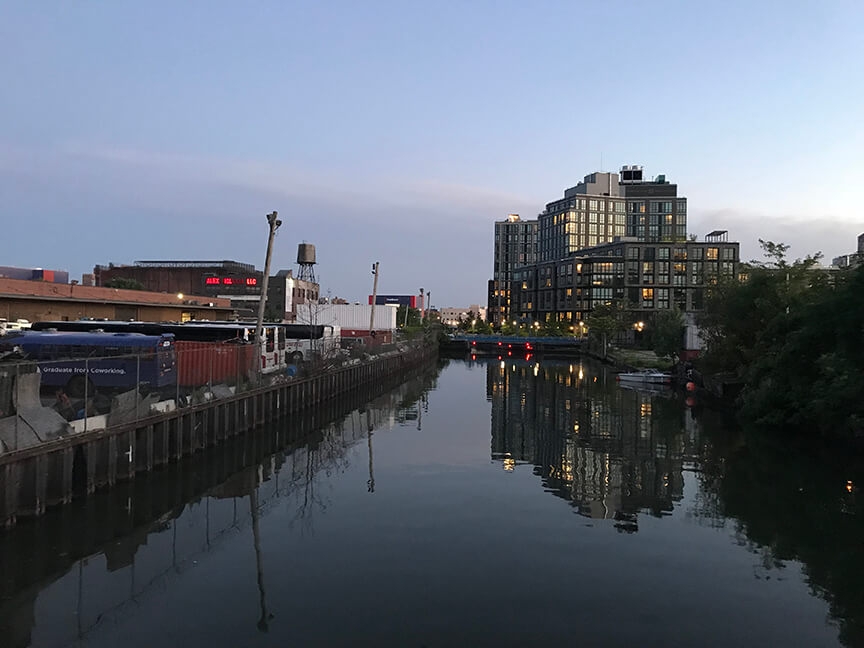
Due to Gowanus’ industrial past, several volatile organic compounds have been found in its soil. The New York State Department of Environmental Conservation has been testing the area for three rounds now, since 2023, looking for soil vapor intrusion, when chemicals move from underground to the air inside buildings. All testing is done during the city’s winter heating season, which run from the fall to the spring. (Testing is done during the heating season as heating systems can create a negative pressure that draws soil vapor into the building.)
The DEC told the Red Hook Star-Revue in early January that it had not, to date, identified “an area-wide soil vapor intrusion trend impacting the wider Gowanus neighborhood.” It had sampled 23 properties in the Gowanus Canal area during the 2025-26 winter heating season, as of Dec. 31, 2025.
During the 2024-25 winter, the DEC sampled 258 buildings, two of which were resampled after already being tested in 2023. 2024-25’s sampling found 16 properties in need of some form of mitigation, one more than the year prior when 113 buildings were tested, as reported previously by the Star-Revue. As of Dec. 31, a total of 392 properties have been tested.
Testing is set to end soon. The department anticipates that its Gowanus-wide soil vapor intrusion investigation will conclude after the 2026-27 sampling season. However, it added that if “sampling results suggest that additional sampling is warranted,” the department will “evaluate and determine the need for further sampling on a site-by-site basis.”
Residents remain concerned about TCE
But, even with the investigation, locals don’t trust the department. Katia Kelly, a Gowanus resident for decades and a member of the local advocacy group Voice of Gowanus, said that “DEC has shown that they are not an agency that can be trusted by the community.”
One of Kelly’s primary problems with the department is that she said it does not tell residents where it finds chemicals, such as the volatile organic compound trichloroethylene (TCE), which is associated with numerous types of cancers in humans.
Exposure to the chemical, which can occur through breathing, has been strongly linked to certain types of cancers—kidney and liver cancer and non-Hodgkin’s Lymphoma—as well as autoimmune disorders, according to Dr. Paige Lawrence, professor and chair of the Department of Environmental Medicine at the University of Rochester who spoke to the Star-Revue for a previous article.
Further, Dr. Lawrence said at the time, “There have been, especially in animal models, but also in some human epidemiological studies, some associations between exposure to TCE and neurodegenerative diseases like Parkinson’s disease.”
The DEC said it discloses sampling results to property owners and tenants, but Kelly said the department does not tell the wider community about where it finds chemicals on private property and owners can refuse to allow testing on their land. She wants more availability and transparency.
“We’re being asked to blindly trust the DEC when we know that a lot of homeowners haven’t even allowed them to come into their homes,” Kelly said.
The DEC has said it “remains committed to keeping the community informed about its efforts” and said tenants residing within the study area can reach out to the DEC and New York State Department of Health to “discuss options for sampling their living space.”
A history of mistrust between government officials and Gowanus residents
Locals were outraged in 2023 when they learned that the DEC had known about alarming levels of toxic vapors in the air of a Gowanus shuffleboard club and waited almost two years to alert the public of the findings. The wider public heard of the findings after Voice of Gowanus hired an environmental database firm that uncovered them.
Kelly said that the revelation made residents realize the dangers in their soil and groundwater. She said she’s happy the DEC is testing the Gowanus area, but that it “should have been done decades ago.” Kelly and others don’t trust the department, but it’s their only choice for learning about possible toxins in their area.
“We have to rely on DEC,” Kelly said. “I don’t trust them because of years and years of engagement, but we don’t really have an alternative.”
She urged the department to disclose the findings from groundwater monitoring wells installed across the neighborhood, which look for chemicals like TCE, and where in the area they found chemicals.
Kelly added she understands the DEC can’t disclose findings from private homes, but doesn’t understand the lack of transparency around findings on public land. She and others want to know more about what’s in their air and under their feet.
“The only thing that we can do is to continue to advocate for a better outcome by challenging DEC and by holding them to account,” Kelly said.
Discover more from Red Hook Star-Revue
Subscribe to get the latest posts sent to your email.