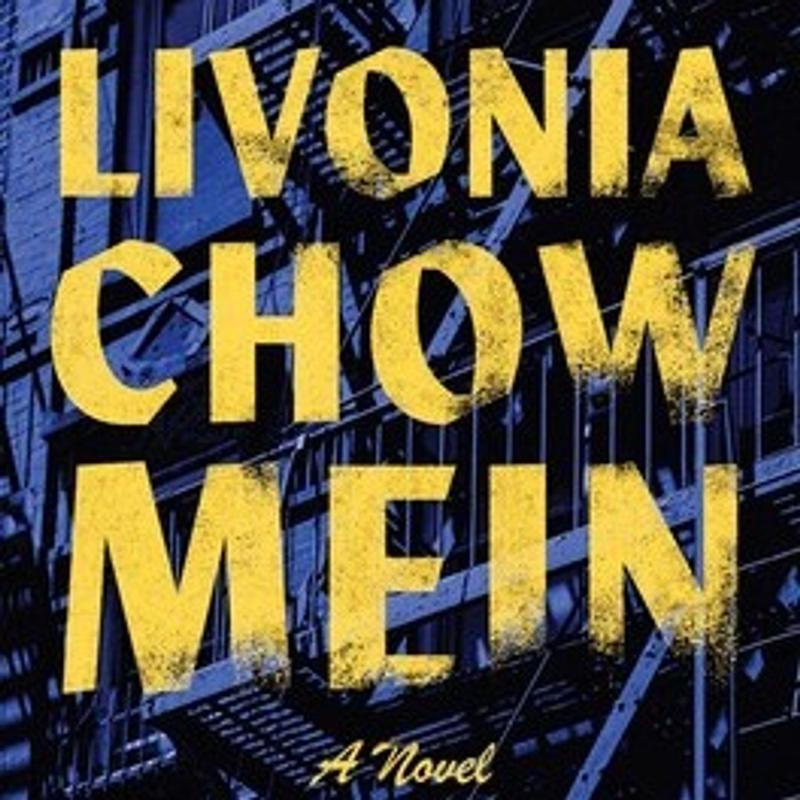
Review of “Livonia Chow Mein,” by Abigail Savitch-Lew
Is it true what people say—you can’t go home again? My partner once remarked, “The Germany I left isn’t the same Germany I’d return to.” I’ve never left New York, and I feel just as disoriented.
Abigail Savitch-Lew’s debut, “Livonia Chow Mein,” is a novel about belonging. Set in Brownsville, Brooklyn, it traces generations of Black, Chinese, and Jewish families and the ways their lives intersect and become entangled. It’s deeply researched and vividly cinematic. You don’t just read what happens, you can see it.
The story begins in 1978, when two tenement buildings burn to the ground in the middle of the night. One person dies. Many are displaced. The neighborhood’s Black residents blame their Chinese landlord, Richard Wong, suspecting he torched the buildings for the insurance money. Nothing is ever proven. When the police and press lose interest, the accusation hardens into fact—and resentment.
Thirty-six years later, recent Yale graduate Sadie Chin gets a job at a community newspaper covering Brownsville (“One could say she’d never gotten over that kindergarten phase of poking her nose into everything.”). She emphasizes her connection to the neighborhood to get the job, but she’s had a comfortable Park Slope upbringing. When she asks her grandmother, Foon Wah, what Brownsville was like when she lived there, the old woman replies: “Very different! No Chinese people. All Jewish people. Then all Black people.”
Sadie, we soon learn, is Richard Wong’s granddaughter. When she learns about the fire, there’s only one thing she wants to know: Did her grandfather really do it? That question sits at the heart of the novel. To uncover what happened, Sadie interviews people who lived through the fire—concealing her connection to the number one suspect on everyone’s list.
Operating a restaurant on Livonia Avenue
The novel’s richest sections follow the Wong family across generations. Sadie’s great-grandfather emigrates from China and winds up running a restaurant on Livonia Avenue, sending money home to a family that has no idea how poor he really is. Sadie’s grandfather Richard grows up ashamed of that poverty and determined to do better. He brings his own bride, Foon Wah, over from China; they move in alongside his father and “five other farting Chinese bachelors in a twelve-by-twelve storage room” in the back of the restaurant.
Foon Wah is bewildered by everything about her new home: “What was her use here? What was anybody’s use in America?” Years later, visiting China as an old woman, she finds herself missing her morning bowl of cornflakes and tiring of squatting over a trench for a toilet. She has become, despite herself, American.
Again and again, “Livonia Chow Mein” returns to a central idea: home is less a place than an idea, and that idea shifts beneath you whether you move or stay. We shape the places we live, and they, in turn, shape who we become.
Lina Rodriguez Armstrong, a community organizer, is the novel’s moral center. We first see her as a young woman jostling up the tenement stairs with a suitcase, moving into what was once the Chinese restaurant, the old “Chow Mein Here” sign still hanging out front. It’s the kind of moment Savitch-Lew renders so well: specific, visual, and grounded in a sense of place.
Lina was there the night of the fire—and she’s still there in 2014. Locals call her grandma. Even in old age, she never loses the spark to make the neighborhood better for the people who live there. She fights predatory developers, transforms a garbage-strewn lot into a community garden, and pushes the city for a community center with resources the neighborhood actually needs. As a lesbian, Lina also advocates for LGBTQ services.
She encourages her neighbors to take pride in their surroundings. Pointing to a colorful mural on her apartment wall, she says, “I always tell this to the young people: when you can’t do anything about the outside, you care for the inside.”
Lina is the most fully realized character in the novel—and also the woman Sadie is most afraid of revealing herself to.
Community journalism
Savitch-Lew shares more than a little with her protagonist: both are mixed-race, Ivy League–educated, and drawn to community journalism. That proximity may be why Sadie feels so alive as a sensibility and underdeveloped as a character.
Sadie leaves the comfortable Park Slope apartment she shares with her parents to head into Brownsville, but no one from Brownsville ever sees how she lives. She crosses into the neighborhood; no one crosses back. Her privilege opens doors; she keeps hers shut.
Brownsville is the novel’s focus, but the pressures it undergoes will be familiar to anyone living in the city: the churn of development, the failures of the city to respond to what residents need, and the slow, bewildering sense of dislocation in a place you call home.
And yet “Livonia Chow Mein” is, at its core, a novel shaped by its ideals. Savitch-Lew makes a persuasive case that community and solidarity are the forces that hold a neighborhood together—and the only ones that can keep it from falling apart.
Among her other achievements, Abigail Savitch-Lew covered the education beat for the Red Hook Star-Revue in 2012
Discover more from Red Hook Star-Revue
Subscribe to get the latest posts sent to your email.