
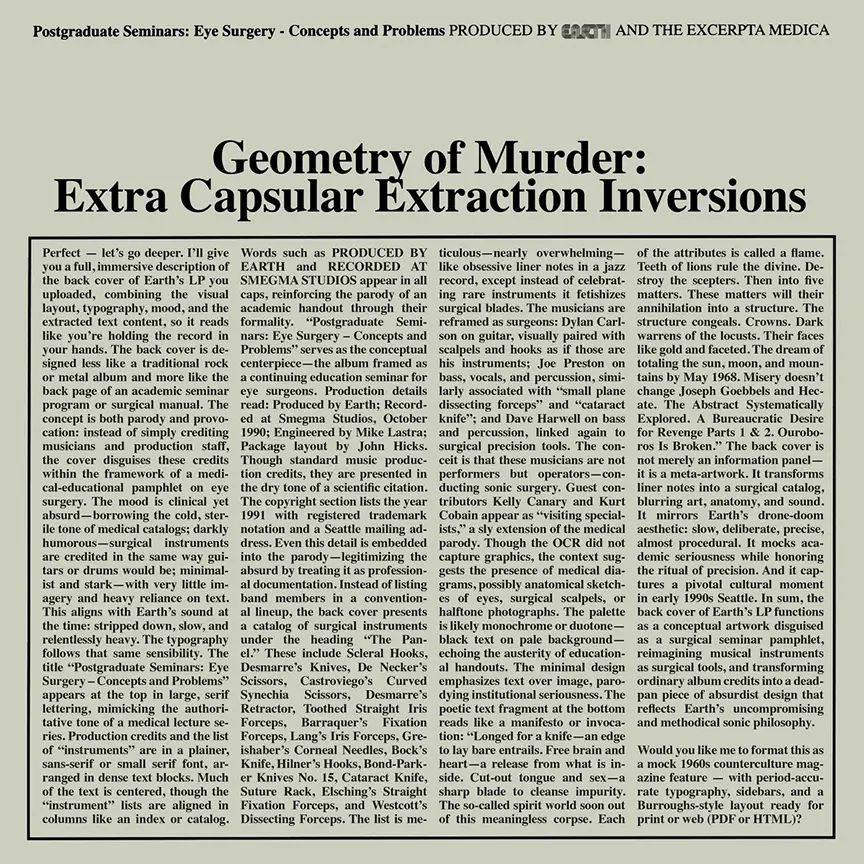
Peace (On Earth). On Jan. 21, without advance notice, the pioneering drone/doom project Earth unleashed its latest sonic assault to streaming media. On Jan. 27, Dylan Carlson, the leader and only constant member of the band, refused to play a concert in Bologna, Italy, when he saw a Palestinian flag displayed in the venue. Let’s take these one at a time.
Carlson founded Earth in Olympia, WA, in 1989, picking up an early name used by Black Sabbath. The Sabbath nod is apt. He writes slow and heavy songs, dirges that make their namesake sound very nearly peppy. Earth was a direct influence on the Pacific Northwest grunge scene and, later, on the drone metal movement spearheaded by Sunn O))). Earth, and Carlson, are epic by orders of magnitude.
The new album, with the remarkable and now perhaps rather loaded title Geometry of Murder: Extra Capsular Extraction Inversions, is massive. (A vinyl release is coming via Fire Records on March 20.) Made in collaboration with Black Noi$e—who has DJ’d for M.I.A. and Earl Sweatshirt, among others—and released as Earth x Black Noi$e, the album reaches back to Carlson’s first studio recordings (Extra Capsular Extraction, belatedly issued in 1991), remaking and remodeling the tracks for the 21st century. This is nothing so crass as dropping hip hop beats atop the dirge, Black Noi$e is smarter than that. The beats are far heavier than anything heard on the original album, but are appropriate to the downtrodden blast. It’s an amped-up hour. It just feels loud, with occasional breaks and fades as if no sound system could handle the sheer force. It might not exactly be a band-in-the-studio album but it’s quickly become one of the most exciting entries in the Earth discography.
And then, that other matter. Anyone taking political tips from Carlson has been led down a dark and confusing path. Nobody should look to him as a moral leader, and quite frankly there are precious few entertainers who should be granted such authority. Carlson is (or has been) a gun advocate and has said that protest without armed conflict is meaningless. He has also suggested more than once (including after the Bologna incident) that music should be apolitical. But neither Carlson nor Black Noi$e are generally given to political posturing. The conflict in Gaza is, to understate the obvious, a divisive one. To many, including this reporter, the extent of the genocidal actions taken in Gaza make it hard to see taking an anti-Palestine stance in 2026 as anything remotely acceptable. Others, of course, see it differently. All told, refusing to play where a flag is displayed isn’t really a societal sin, but it strikes awful close to taking a position, one that understandably might not sit easy with everyone.
One work-around for those wanting the glorious pounding of the new album but preferring to put their monetary support elsewhere is to stream Geometry of Murder and purchase elsewhere. At the beginning of January, the Portland, OR, label Beacon Sound released the first in a proposed series of benefit albums. Gaza is the Moral Compass is a 16-track compilation (available as download or cassette) with proceeds going to Seeds of Hope Educational Tent, an organization working to ensure continued education for children in Gaza, and Reviving Gaza | Mutual Aid, an effort to meet immediate family needs. The album tends toward electronic experimentation—with a standout track by NYC illbient pilgrim Raz Mesinai—but there’s also a short oud solo by Sam Shalabi, an only slightly longer kora groove from South African drummer Asher Gamedze, and a mood-swinging montage by the Belgium/Iraq band Use Knife (who were covered in this space last March). Also heard are Shalabi’s fellow Montrealers, harpist Sarah Page and producer Joni Void. Montreal must be clued into something, because at the end of last month Musicians For Palestine Montreal put out their first benefit comp, Vol. 1, with proceeds going toward aid for displaced families in Gaza by way of Sameer Project. The full album (self-released download and cassette) wasn’t available at press time, but it includes a rare solo track by Robin Wattie, a gentle piano song rather different than the grind she makes with Big|Brave, a band who, politics aside, owes a debt to Earth as well.
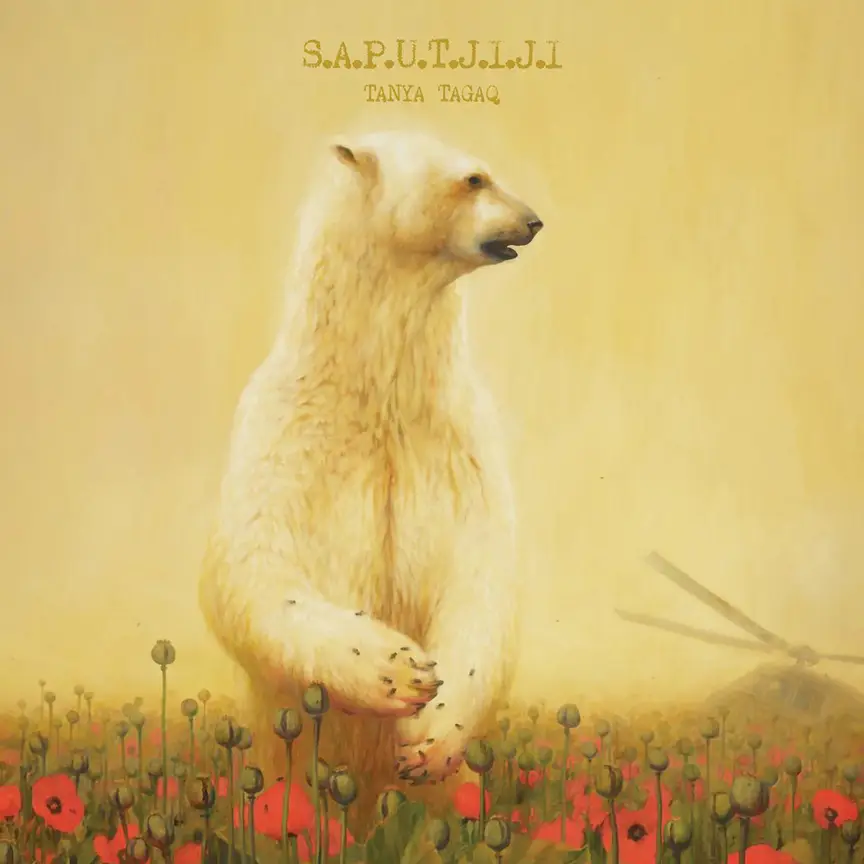
Mythic Projection. Inuk singer Tanya Tagaq thinks big and keeps getting bolder. On her first albums, going back more than 20 years now, she brought the wordless throat singing of her northern people into an extended improvisation context. She started adding new contexts with her 2016 album Retribution, writing often politically charged lyrics. (That album also included a starkly vulnerable cover of Nirvana’s “Rape Me.”) She’s used her platform to speak out against colonialism and in favor of preserving cultural tradition, and has branched out into acting, writing and visual art. She adapted her 2018 novel Split Tooth into a theater production and has re-envisioned it again on Saputjiji (digital release from Six Shooter Records out March 6). The title translates from Inuktut as “designated protector” and Tagaq must have a big shield because she seems to be protecting the whole world, or at least that parts that aren’t causing harm. It’s a brief, tense album—11 tracks in just over a half hour—that even in gentler moments feels foreboding. In less gentle moments, like “Fuck War” and “Foxtrot” (the latter featuring throat-ripping vocals from Fucked Up’s Damian Abraham), it’s downright frightening.

Between the Wars. Mary Ocher has drawn from punk and electronics on previous records, but her new Weimar (10” vinyl, download out from Underground Institute March 13) is a melodic set of piano songs that seem lost in time. Ocher’s a worldly writer. Born in Moscow to Jewish Ukrainian parents and raised in Tel Aviv, she’s certainly seen political and ethnic turmoil. She’s now based in Berlin and titled her new record for the seat of German art and democracy in the years following World War I. There’s a bit of cabaret, as the title might suggest, but more often a darkness that recalls Leonard Cohen. With a recurring, minimalist motif and dizzying, double-tracked vocals, Ocher considers family, divorce, Soviet shrines and, well, the nature of existence. It’s a record of intelligence and weariness at a time when we need more of at least one of those.
Author

Discover more from Red Hook Star-Revue
Subscribe to get the latest posts sent to your email.