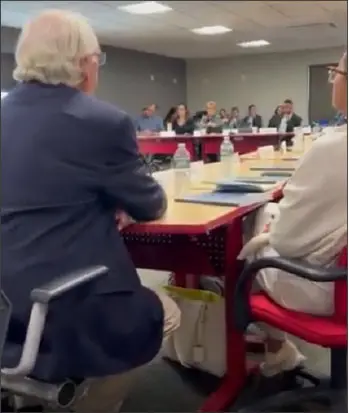
Gathered inside a conference room inside the Brooklyn Marine Terminal on Monday, Sept. 22, were 25 task force members in charge of the future of New York City’s last working waterfront. The room was packed: In addition to the task force members and in some cases their staff, were also dozens of Economic Development Corporation staff, including President Andrew Kimball. (The meeting was closed to the public in potential violation of New York open meetings law, as reported by the Red Hook Star-Revue in our October issue.)
Through the walls, chants from community members outside can be heard; they’re there to make their voices heard one last time before the task force was to vote on the Brooklyn Marine Terminal vision plan.
By that point, though, the outcome was already decided; the week before, two task force members who for months had been holdouts, City Councilmember Shahana Hanif and Brooklyn Borough President Antonio Reynoso, announced they would vote yes to the widely criticized vision plan, meaning that EDC had the votes they needed to reach two-thirds approval.
That didn’t mean that the meeting lacked tension: Videos recorded by individuals in the room show heated exchanges between US Rep. Dan Goldman and opponents of the plan, including former New York City Traffic Commissioner Hank Gutman and State Assemblymembers Jo Anne Simon and Marcela Mitaynes.
The vote was announced only days prior, interfering with some task force members’ schedules, and giving little time to discuss the revised vision plan. It also came unexpectedly for those on the outside, as no task force meetings had been held and no further public engagement efforts had been made since the vote was postponed a fifth time at the end of July.
“There had always been a promise, including by task force leadership, that there would not be a vote on anything without it going back to the public in final form,” said Carly Baker-Rice of Red Hook Business Alliance.
Originally, the rules for advancing recommendations also stated that the task force was to vote separately for each recommendation, and if there was not consensus on a recommendation, members could ask the EDC and its consultants to bring alternatives to a subsequent meeting. Instead, at some point this spring, the vote became a one-time, yes-or-no, all-or-nothing affair.
After the July postponement, many of the task force members expressed exhaustion after months of negotiations that often included significant pressure from EDC officials, the mayor’s office, and members in support of the plan.
Shortly after the delay of the vote, a group of 10 task force members—which at the time included Councilmember Hanif and Borough President Reynoso—released a statement, writing that they would have voted no to the vision plan, and intended to “work with the community and our colleagues to develop a clear set of changes we will need to move forward come this autumn.”
The goal, Baker-Rice explained, was to improve the process, as fundamentals like community engagement and due diligence had to that point not been satisfactory.
But it seems like this was more difficult than expected. Although none of the task force members who spoke to the Star-Revue wanted to go on record with details of how conversations within the no-caucus went, three people noted that even within that group, which so far had resisted backroom deals, self interests complicated matters.
“It was the challenge of the group that we had 10 different reasons,” said City Councilmember Alexa Avilés. “It’s not like this no-group had one singular reason that could hold them together cohesively. So that was a strategic challenge.”
Jim Tampakis told the Star-Revue that a lot of discussions were had, but different agendas clashed and they weren’t able to accomplish much.
“Most of us got into this process wanting to get to yes, so we didn’t want to shut it down and get nowhere,” Assemblymember Simon said. “And the plan has things in it that I like, but it also has some fundamental flaws that for me were the sticking points. For some other people, their sticking points were different things.”
At some point, some members of the no-caucus began to have separate conversations with the EDC, Avilés said. “Ultimately, this is a collection of people with various interests,” she said.
Avilés does not blame the two task force members who flipped their votes at the last hour; they did what they believed was right for their constituents, she argued. Anger about the outcome of the vote should instead be directed toward the leaders of this process, in particular the chair, the EDC and Mayor Eric Adams.
“The people who made sure that this process continued forward with all its problems and the full disregard of the community, was the chair of the task force, Congressman Dan Goldman , it was the EDC, and it was the mayor’s office, and those are the ones that I’m most upset with and hold singularly responsible for this.”
Now the vision plan moves into the environmental review process. One scoping meeting has already been held to set the parameters for the environmental review—the scope of which has already been criticized for being too narrow—and another one is coming up later this year.
Assemblymember Marcela Mitaynes, who also was on the task force and voted no to the plan, argued that the community must be better involved in this part of the process. The plans that are made and decided on now won’t become reality for years, long after current elected and government officials have left office, but the community members are the ones who will remain.
“They don’t want opposition, but what they fail to recognize is they need community support to usher this through,” Mitaynes said.
Following a year of contention, she added, “I hope the EDC will want to move forward on a positive note with good faith and community involvement.”
Author

Discover more from Red Hook Star-Revue
Subscribe to get the latest posts sent to your email.