“Come here, I show you some carpets” – “Where are you from? Spain? Italy? France?”….”Best Moroccan Quality!”
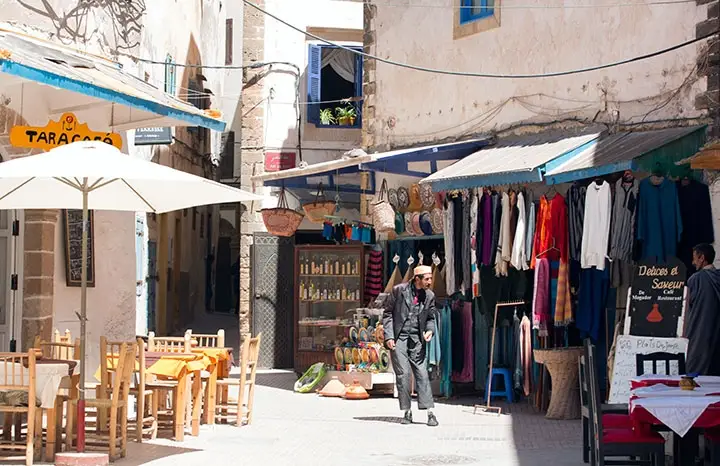
As you start walking through the alleys and streets of the Marrakech city center, the wave of vendors trying to get your attention will hit you harder than the heat, which does not joke around in Africa’s July.
Marrakech, the fourth largest city of Morocco with more than 900 thousand citizens, is the country’s main tourist spot. From Spring to Fall, floods of Europeans and Americans invade the Bazar, with the bravest (and arguably craziest) ones even enduring the 106 degree summer sun.
The heat never stops, it stays with you throughout all your tours. Indeed, most life here starts after sunset, when the great square Jemaa el-Fnaa becomes crowded as an ants nest, a huge and wide market place at the center of a net of alleys coming from the surrounding suks without any sidewalk or pedestrian area. Autos, taxis or motorbikes constantly brush by you. The only vehicles not giving a headache are the mule-drawn carts, a testament to the country’s poverty.
Many in the Jemaa el-Fnaa and the Bazar live hand-to-mouth. Tourists are constantly asked for tips by locals after offering to guide them through the confusing map of the city center.
Tourism in Marrakech can be stressful if you have a deficit of social skills.
A relaxing moment is when the Imams call for prayers, more loudly on Friday — Muslims’ sacred day. Although non-Muslims are forbidden to enter any religious building, the sight of a minaret means peace, since great mosques are usually located away from the chaos, surrounded by parks, as if their founders wanted to draw a line between the earthly and spiritual world.
It is indeed striking to visit the exterior of the Koutubia Mosque, just a few hundred meters away from Jemaa el-Fnaa, and relaxing while admiring the examples of Almohad architecture dating back to the twelfth century.
A walk in the main gardens of the city can be a great way to cool off under the relief of a tree’s shadow.
Jardin Majorelle, known for its colorful architecture and exotic plants, is the former villa of the French fashion designer Yves Saint Laurent and houses a collection of paintings and artifacts such as jewelry and ceramics coming from all different parts of the country.
Different from other cities, tourism in Marrakech lives in harmony with the daily life of the town, and it doesn’t hide the reality of a developing country growing at a fast pace but still facing many basic problems. While you eat your couscous or drink your tea, it takes a purposeful ignorance not to see what unfolds right in front of your eyes.
It makes tourism there somewhat questionable, not completely unethical but maybe hypocrite, elitist, inspired by an idea of well-being that many people who live there cannot afford at all.
Author

Discover more from Red Hook Star-Revue
Subscribe to get the latest posts sent to your email.