
Robert Moses’ legacy is evident across New York City. The “power broker” left his fingerprints on virtually every kind of public infrastructure that exists in the city today: parks, bridges, public housing developments—and yes, highways.
That includes the Brooklyn-Queens Expressway, or BQE, and particularly the triple cantilever that forms the highway’s bend around Brooklyn Heights.
Opened in 1954, the now infamous cantilever is one of few sections along the BQE to remain largely unchanged, and as carrier of that inglorious epithet it has been the center of drama and debate for years. The problem? It serves about 150,000 vehicles daily, more than three times what it was designed for.
The accumulated wear and tear has for a long time caused the triple cantilever to deteriorate, deterioration that has accelerated in recent years. Today, the design of this three-level structure is causing congestion and accidents, issues that are exacerbated by degradation.
The risk—both immediate and prolonged—associated with the triple cantilever has spurred a trove of ideas and plans for the 1.5-mile section of the BQE, including from former Mayor Bill de Blasio, then-Comptroller Scott Stringer, and, most recently, Mayor Eric Adams. The City’s Department of Transportation (DOT) has convened at least three panels in the last 20 years to evaluate triple cantilever projects, including in 2006, 2015, and 2019.
Deep bore tunnel
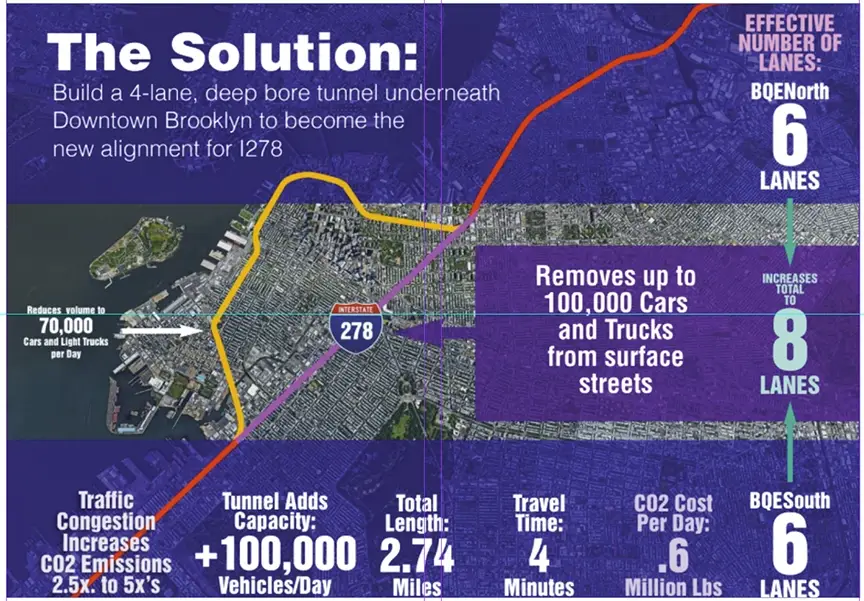
But perhaps no plan put forth is as bold as the one proposed by Roy Sloane, community advocate and longtime leader of the Cobble Hill Association: a 2.5-mile-long, deep-bore tunnel going underneath Downtown Brooklyn. As it leaves behind Sunset Park, the I-278 would, instead of turning west into Gowanus, continue on its northeastern path and travel underground until it emerges in South Williamsburg and merges again with the BQE.
The concept originally came out of a multi-stakeholder process conducted by DOT between 2006 and 2010. At the time, it was unanimously endorsed by all participating community leaders and technical advisors.
“We engaged in a very thorough process that was informed by consultants and experts,” Sloane said.
“It was basically impossible to achieve consensus until the tunnel emerged.”
Since then, the idea of a tunnel has returned to the table on a few occasions, including in a 2016 feasibility study conducted by New York State, and then four years later in a City Council report titled “The Future of the BQE,” but it has never gotten further than that.
But Sloane still believes it would be the best way to deal with the many problems related to BQE Central, as this highway-section is called.
Precedent
The idea might seem crazy. But there is precedent: In February 2019, a similar tunnel opened in Seattle, replacing the Alaskan Way Viaduct. “Bertha,” a 57.5-foot-wide tunnel boring machine—the largest at the time—was used to drill a 2-mile, double-decked tunnel with two lanes in each direction.
Tunnel boring technology has advanced significantly over the past 20 years. At a hearing on the “Future of the BQE” report, members of Arup, a multinational engineering and design firm that helped with the City Council’s report, noted that deep boring machines today are safe and cause minimal impact above the surface.
A tunnel would come with numerous benefits, argues Sloane. It could save drivers up to 30 minutes each trip, thus saving thousands of dollars in gas and diesel. Tunnels are also easier and cheaper to maintain than bridges, and have a significantly longer lifespan.
Under Sloane’s plan, the tunnel would become the new alignment for the I-278, as well as the new truck route. This would allow the current BQE central to become a road primarily for connecting neighborhoods in south and central Brooklyn, instead of a throughway for traffic going north or out to Long Island. Sloane suggested that as part of a broader reimagining of the BQE, parts of BQE Central could be upgraded similar to the Sheridan Expressway in the Bronx, which in 2019 became the Sheridan Boulevard.
Removing up to two-thirds of the roughly 155,000 vehicles that daily uses BQE Central would also have cascading effects.
“It would make an immense difference on the residential streets parallel to the highway, really all through the district, because it would keep cars on the highway, and it would keep moving and moving at an efficient speed,” Sloane said.
Solving multiple issues
Today, traffic spilling over from a hyper-congested BQE is a daily problem in neighborhoods like the Columbia Street Waterfront District, Cobble Hill and Downtown Brooklyn. A tunnel crossing under Downtown Brooklyn would alleviate the load on residential streets in the area, thus improving pedestrian safety and air pollution.
With fewer vehicles, air quality would improve broadly along the highway’s current path, in particular as traffic congestion is a multiplier of car emissions.
Sloane’s proposal also addresses urgent resiliency needs. By 2050, the BQE trench would be breached should Superstorm Sandy-level flooding occur, according to FEMA flood maps. If that happens, one of the busiest throughways in the U.S. would be made impassable for days, potentially weeks.
In 2020, Arup estimated that just constructing the tunnel would cost about $3.5 billion. And while significant capital funds would be needed, the project could eventually pay for itself over time.
“The tunnel has another really powerful advantage, and that is it would be funded by tolls. It would be funded by the roadway users themselves,” Sloane said. By his calculations, tolls could rake in up to $50 million a year.
In total, Arup’s report found that a tunnel could improve residential quality for up to 450,000 Brooklyners.
While the City has been reluctant to revisit a tunnel solution, with further deterioration of the triple cantilever, along with the potential addition of over 10,000 new residents if the Brooklyn Marine Terminal vision plan comes to fruition, the next administration might take another look at it.
“Nobody’s come up with a downside to it, other than that it’s just a large, daunting project,” Sloane said
Discover more from Red Hook Star-Revue
Subscribe to get the latest posts sent to your email.


One Comment
I notice you leave the toll to the last few sentences. Nobody has a problem except the people that have to pay.