It’s around 11 pm in the warehouse on 481 Van Brunt St., and Ethan Cornell is getting the last details ready for his show the next day. He is tired, having worked late the night before, as well. A podcast is playing in his headphones when he hears a harsh, squealing noise from the studio on the floor above. Not necessarily out of the ordinary as that studio houses a cabinetry shop, but Cornell is still surprised given the hour.
Then popping noises start, like acorns dropping. He walks around his studio for a bit, searching for the source of the sound. He questions if the tiredness is getting to him. That’s when he smells the smoke. Moments later, a curl of dark particles enters his studio through the ceiling.
Cornell only has the presence of mind to grab his keys to the space, and his phone. Smoke is now pouring into the studio. He runs out, yelling “fire.” At 11:25 pm, he calls the fire department. For a moment, the smoke abates; Cornell has time to ponder if he called the fire department over nothing.
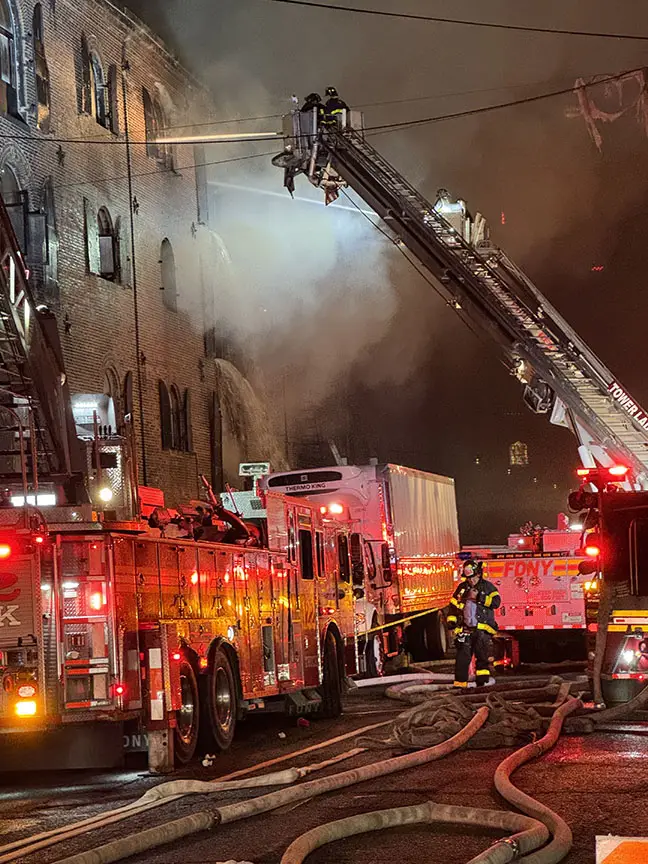
Quickly at the scene, the firefighters—250 in total—begin their battle with the flames. Four more alarms will come in that night, at 11:57 pm, 12:13 am, 1:48 am, and 2:31 am. Through the night the fire department sprays the warehouse with water, first from trucks, then also from fire boats. The windows turn into portals for waterfalls.
By five minutes to six the next morning, the fire marshal determines the fire to be under control, but it continues to burn a while longer.
The five-alarm fire rocked Red Hook, a neighborhood that has seen its fair share of disasters already in the 21st century. The 155-year-old warehouse was the workplace of dozens of tenants and subtenants—artists, sculptors, musicians, woodworkers, and others—many who are now in limbo as they await the opportunity to go back in and assess the damage.
It was a night and morning of shock and terror. Some rooms were destroyed by the fire, but most of the damage was done by the smoke and the brackish harbor water the fire boats used to douse the flames. Lost inside the building are decades of artwork and sculptures.
We spoke to some of the artists about the night of the fire and the morning after. Some carried a particular burden, like Megan Suttles, the founder of the collaborative art space Hot Wood Arts, as not just victims but messengers.
Hot Wood Arts rented studio space to over a dozen artists, and when she learned about the fire, Suttles knew she was the one who had to tell them.
“I didn’t want my resident artists to find out about the fire through social media or through the news, so I wrote them at four o’clock in the morning to let them know,” she said.
In the email, simply titled “Please read,” Suttles told them what she was seeing, and just said, “I’m afraid it’s all gone. I’m so sorry. “It was the worst email I’ve ever written.”
One of her resident artists, 72-year-old Paola Borgatta, was in Italy visiting her cousin when she got the news. As they were driving toward Milan, she saw the email from Suttles.
“I got quiet, and my cousin asked, ’What happened? What’s going on?’ And I told her. Then immediately I started to get videos, and I was just dumbfounded. I really couldn’t respond with anything,” Borgatta said.
Many tenants have yet to be allowed to go back into their studios, as the fire department, city officials, and the landlord—the O’Connell Organization—work to make sure the warehouse is structurally safe to enter. This work could take some time, cautioned Master Fire Restorer Russell Vent, vice president of Paul Davis Restoration. Without being familiar with the building, he said that it may take a month or two before access is more freely given. (So far, tenants have been let inside by appointment, but only in small groups and with significant security measures.)
The enormous amount of water that was used to extinguish the fire has led to significant mold growth. The dirty harbor water has also mixed with melted plastics, soot, and other harmful substances, making it even more of a hazard. Anything covered by water must probably be be thrown out unless you can completely clean it, Vent said. The warehouse is a bad place to be right now.
More problems than mold
“Of all these things, mold is the least concerning to me, because you have all the smoke and soot and the carcinogens in the air. Then you have lead and asbestos that needs to be identified if it’s there,” said Vent.
Gregory T. O’Connell, CEO of O’Connell Organization, said they’re working hard with demolition and remediation experts to make the warehouse safe. Sections nine and ten have both largely been cleared of debris.
“We’re trying to move forward as quickly as possible and gain certainty on on what we could do to make it better, and how quickly we could turn it around and hopefully get activity back into the building,” O’Connell said.
What caused the fire remains unknown as an investigation continues.
On Thursday, Nov. 6, the Duckworth Gallery on 169 Coffey St. in Red Hook are hosted a fundraiser for Hot Wood Arts and Friends of Firefighters.
Author

Discover more from Red Hook Star-Revue
Subscribe to get the latest posts sent to your email.