In our last issue, I wrote about how we (many of us, at least) celebrate Christmas in Sweden. I went through it all, from Dec. 1 and Swedish Public Service’s advent calendar TV show, through the celebration of St. Lucy and bingo on the night before Christmas Eve, to the sales on Boxing Day. And while these are all key parts of the Swedish Christmas, nothing beats Dec. 24, Christmas Eve. So, dear reader, to really get a feel for how we Swedes celebrate the high point of yuletide, I invite you now to enjoy this deep dive into on my family’s Christmas Eve celebration.
Except for two Christmases in 2021 and 2022, every Christmas Eve of my 26-year-old life has been celebrated with my parents in their home, along with my sister and varying constellations of relatives.
The morning begins with Christmas stockings hanging from the mantel. My little sister and I, even as adults, have usually decided to stay over the night before, so we can get the big day going early. When we were kids, it was in anticipation of all the gifts that lay under the tree (I did grow up with the privilege of receiving multiple gifts for Christmas, and I’m aware that that’s certainly not the case for everyone, in Sweden or elsewhere); nowadays, it’s a long, relaxed breakfast we’re looking forward to. For meat-eating Swedes, it’s common to eat slices of cured ham/ham covered in a breaded glaze on toast with some mustard. (Getting a good ham for Swedish Christmas is sort of like getting a good turkey for American Thanksgiving: It takes multiple days to prepare and you better buy it early if you want a good specimen.)
When breakfast winds down around 9 or 10 a.m., those of us in the kitchen will start hearing the first tones of “O Holy Night.” Every year — and this is a tradition unique to my family — my dad sings — at least the words he knows — for my mom, sister and I, the Swedish version of “O Holy Night,” titled “O Helga Natt.” He has quite the voice, being a musician all his life (including many years in an all-mens choir).
After breakfast, we make our way to the city’s biggest cemetery. We convene with my maternal aunt and uncle, and together we go to wish a merry Christmas to relatives and close friends who are no longer with us. We usually bring a few candles and flowers to out by the grave stones, as a way to show them they’re still in our thoughts, It has become one of my favorite parts of Christmas Eve: visiting the grave of a passed relative is a very personal experience and we all do it in different ways, but I find it beautiful to watch everyone’s personal way to greet those we are visiting and honoring the moment.
After an unceremonious and informal lunch, the real Christmas-y part of the day begins. Because at 3:05 p.m., about 3 million people in Sweden — nearly a third of the population — watch Disney’s From All of Us to All of You on SVT1 (the primary Public Service channel). Known in Sweden as Donald Duck and His Friends Wish You a Merry Christmas, it is the start of Public Service’s Christmas Eve programming (which, every year, is led by a new Swedish celebrity who welcomes viewers by lighting a lone candle).
From All of Us to All of You is an animated Christmas special hosted by Jiminy Cricket and Tinker Bell. The show is one long compilation of Disney shorts featuring Donald Duck, Mickey Mouse and Goofy, and clips from classic movies like Cinderella, Robin Hood, Lady and the Tramp and The Jungle Book. (My favorite is the scene shown from Robin Hood, where the cartoon fox is stealing bags of coins from a sleeping Prince John.)
The show has aired every year since 1960 and is one of the most views tv programs of the year. It has not changed much over the six-and-a-half decades it has aired; in recent years, however, some clips — in particular “Santa’s Workshop” — have been modified to remove some racist and antisemitic caricatures (though not all, weirdly).
My parents no longer watch all of it — they’re usually busy preparing Christmas dinner — but I still do. I have realized that my feelings toward it has changed over the years. When I was young, it obviously was hilarious and I was of prime age to enjoy the Disney classics; then came a time, when I was a teenager, where I was preoccupied with being “cool” and Donald Duck and Disney were decidedly not cool; but, now, as I’ve grown past my “cool” phase, I both find it fun and nostalgic.
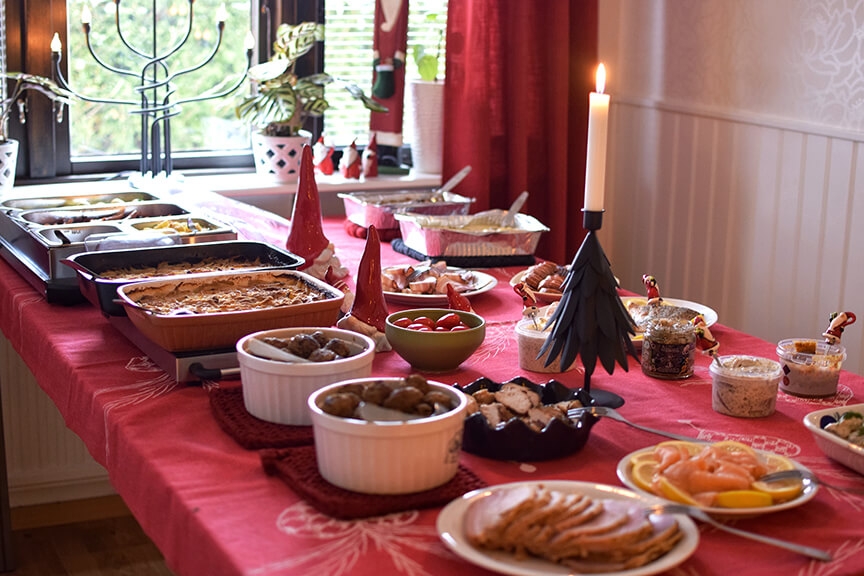
We eat Christmas dinner after Donald Duck. Potatoes, Swedish meatballs, sausages, pickled herring in odd flavors, salads, bread, Christmas ham, cured salmon, beer and schnapps aplenty, my family and our close relatives usually sit down around 4:30 p.m. for a couple of hours of dinner. As someone who’s celebrated a traditional American Thanksgiving dinner, I would say the two are reasonably similar in the way the food is served and how people come together.
After that, at 7 p.m., it’s time for Sagan om Karl-Bertil Jonssons Julafton (in English: The Tale of Karl-Bertil Jonsson’s Christmas Eve), an animated short film about the teenager Karl Bertil Jonsson who, inspired by Robin Hood, steals packages from the wealthy and give out to the poor people of Stockholm’s slum.
If we have finished dinner on time, we usually open as many gifts as we can before Karl-Bertil Jonsson’s Julafton. After the show, we finish up the gifts, eat Christmas candies, maybe drink some glögg (mulled wine) and play board games. Although when I was younger, I’m sure I was too busy playing with my new toys!
Author

Discover more from Red Hook Star-Revue
Subscribe to get the latest posts sent to your email.