Here the journey to Venice begins not with a flight to Marco Polo Airport, but with a memory. A quote from Evelyn Waugh’s Brideshead for this viewer came back in full to begin the Brooklyn Museum’s dazzling new exhibition, “Monet in Venice,” setting the stage for what is less a traditional art show and more a sensory immersion into La Serenissima herself.
Charles Ryder (really Waugh in effigy) later in the aforemtiioned novel recalls “a confused memory of fierce sunlight on the sands and cool, marble interiors; of water everywhere, lapping on smooth stone, reflected in a dapple of light on painted ceilings.” It is this very feeling—the shimmering, liquid essence of Venice—that the curators have masterfully captured.
From the start, visitors are plunged into an octagonal enclosure of panoramic screens, where wavering shadows dance on the floor as if cast by the sun over the lagoon. This is Venice stripped to its fundamental elements: light and water. It’s a brilliant prelude, preparing the eye and spirit for the artistic wonders that follow, offering a sublime staycation for the soul without ever leaving Eastern Parkway.
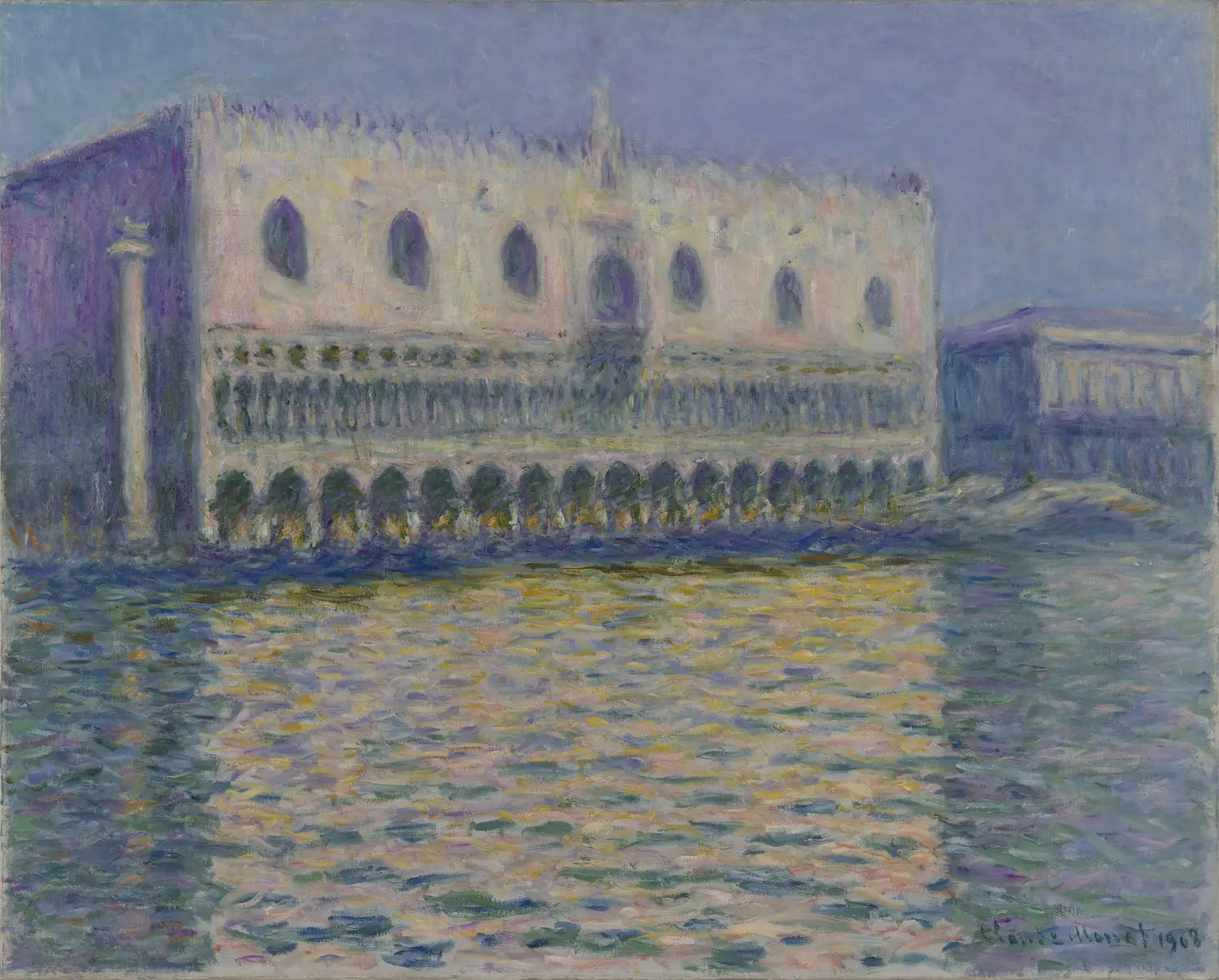
At the heart of the exhibition is the museum’s own masterpiece, Monet’s The Doge’s Palace (1908), one of the first of his Venetian works to enter a public collection in 1920. Here, Monet proves he was less interested in architecture than in light, shadow, reflection, and refraction . The famed palace becomes a catalyst for painting the atmosphere. The solid stone dissolves into a dance of rose pink, sea-foam green, and violet, its reflection on the water’s surface a mesmerizing dive into a sea of pure, swimming color.
The exhibition creates a visual resonance by placing multiple views of the Palazzo Ducale together, allowing the colors to vibrate and play off one another. One can see how Monet’s loose, vibrant brushwork seems to presage the bold colors of Henri Matisse.
The exhibition wisely contextualizes Monet with a stunning interlude from John Singer Sargent. His painting, “An Interior in Venice” (1899), is a showstopper. Depicting his cousins in their Palazzo Barbaro home, Sargent works a magic of darkness and light. A shaft of Venetian sunshine ignites gilded, carved wood and a Murano glass chandelier, while the cream-white clothes of the sitters glow against the deep shadows. Though fellow artist James McNeill Whistler dismissed it as “smudges everywhere,” the effect is masterful—a symphony of color and light that is nothing short of astonishing.
The ultimate success of “Monet and Venice” is its synthesis of art and experience. It creates a powerful illusion: the real palace, reflected in the water, is reflected in Monet’s painting, and is then re-reflected in the museum’s immersive environment and the mind of the viewer.
It is a breathtaking vacation for the eyes, a shimmering trip that doesn’t just show you Venice—it makes one feel, for a glorious moment, that one is there, immersed in its eternal, meditative light.
“Monet and Venice”
@ The Brooklyn Museum
October 11, 2025 – February 1, 2026
Author

Discover more from Red Hook Star-Revue
Subscribe to get the latest posts sent to your email.