
A lot happened in Gowanus in 2025. The development boom promised by the rezoning kicked off in earnest along both sides of the Gowanus Canal, but new neighbors still wake up many a rainy morning smelling the aftermath of a combined sewer overflow.
The Environmental Protection Agency continues to dredge the canal, but some local residents and experts are worried that upland contamination (from land near the canal) will leach into the water, nullifying the work done so far.
One particular site, the heavily polluted Public Place, saw increased action in 2025, at least at the planning table, and what is decided for the property in 2026 will have long-lasting effects on the neighborhood at large.
Here is our recap of this year, in Gowanus.
The Gowanus Canal
In its work to clean up the canal, EPA has divided it into three sections: Remediation Target Areas 1, Two, and Three. Work on RTA One, the section between the top of the canal and the Third Street bridge, was completed in July 2024. Since then, the federal agency has constructed bulkheads along the canal’s walls to support them during the dredging of RTA Two (Third Street to Hamilton Avenue). In December of 2025, a community update was sent out announcing that plans for the cleanup of RTA Two had been finalized. Once the bulkhead system—which has been criticized for shrinking the width of the canal—is complete, dredging will commence. This portion of the canal is the most polluted, and it will take years to complete the remediation of it, according to EPA.
The federal agency also released its first five-year review for the Gowanus Canal superfund site last year. The review notes that the full cleanup project—which includes dredging and capping the canal, building two combined sewer overflow (CSO) tanks, and other upland work—will ensure a clean(er) canal.
But the canal is getting cleaner. In October, the New York State Department of Environmental Conservation reclassified 30 waterways, including the Gowanus Canal, to limit what contaminants can be released into them. The Gowanus Canal now holds an SC classification, meaning that cleanup efforts must continue until the canal is safe for swimming and boating.
A key part of this is eliminating the aforementioned CSO events. To this end, the New York City Department of Environmental Protection (under EPA oversight) is building two underground tanks, which, once completed, are designed to be able to hold eight million gallons and four million gallons, respectively, of sewage. At the site of the larger of the two tanks, at the top of the canal, soil removal was completed in March 2025, and work is now underway to install the tank’s foundation and concrete base; this portion of the project is expected to be completed in 2026. The smaller tank—called the Owls Head Facility—is not as far along, and contractors finished the perimeter wall in late 2025.
Construction frenzy
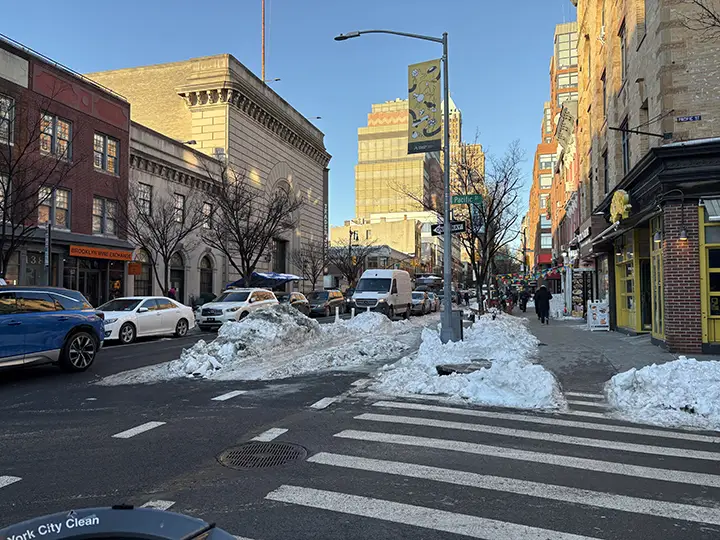
It’s not only local, state, and federal agencies that are busy as bees in Gowanus, however. Since the Gowanus rezoning was passed in 2021, real estate developers have filed permit applications en masse all along the canal and surrounding streets. Some buildings have already opened to tenants, like 420 Carroll (which, according to the developer, offers “timeless river views” of the man-made, polluted canal) on the canal’s east side, and thousands of apartments are under construction.
Although many of the new homes will be rented at market rates, some are also considered “affordable.” These include 23 units at 556 Baltic St., where a lottery for said apartments was launched in early December. Residents making between 40 and 100 percent of the Area Median Income (in dollars, that is $40,595 to $175,000) are eligible to join the lottery.
Upland contamination
But even as the new behemoths seemingly rise up weekly, concerns about contaminated soil remain. Since the fall of 2023, DEC has conducted a soil vapor intrusion (SVI) investigation across Gowanus, and while the data for the 2025-2026 heating season is not publicly available yet, results from the 2024-2025 winter showed that 16 more buildings than previously known require some sort of mitigation. That is one more than the season prior, but with more than twice the number of buildings tested.
The state is also still ironing out how it wants Public Place to be remediated. The site, where the plan is to build affordable housing, green space, and a school, is one of the most polluted in Gowanus (the Citizens manufactured gas plant used to operate there), and has sat desolate for decades.
Over the summer, DEC announced that there was a proposal on the table for how to clean up a chunk of the site. The environmental department had previously divided Public Place into four parcels, three of which are in the state brownfield program (the fourth is a state superfund site), and the new proposal was for Parcel three, the southernmost of the four. The proposal received criticism from the community and some environmental experts for being too lax.
Then, in November, DEC received an application to split one of the parcels into two. Why remains uncertain, but it “is a substantive action that alters cleanup obligations, eligibility for subsidies and tax benefits, enforcement authority, and long-term protections for the surrounding community,” according to a letter sent to DEC by the Pace Environmental Litigation Clinic. The final day for the public to submit comments was Jan. 4, 2026; the Red Hook Star-Revue will continue to monitor the situation and report on future developments.
Author

Discover more from Red Hook Star-Revue
Subscribe to get the latest posts sent to your email.