
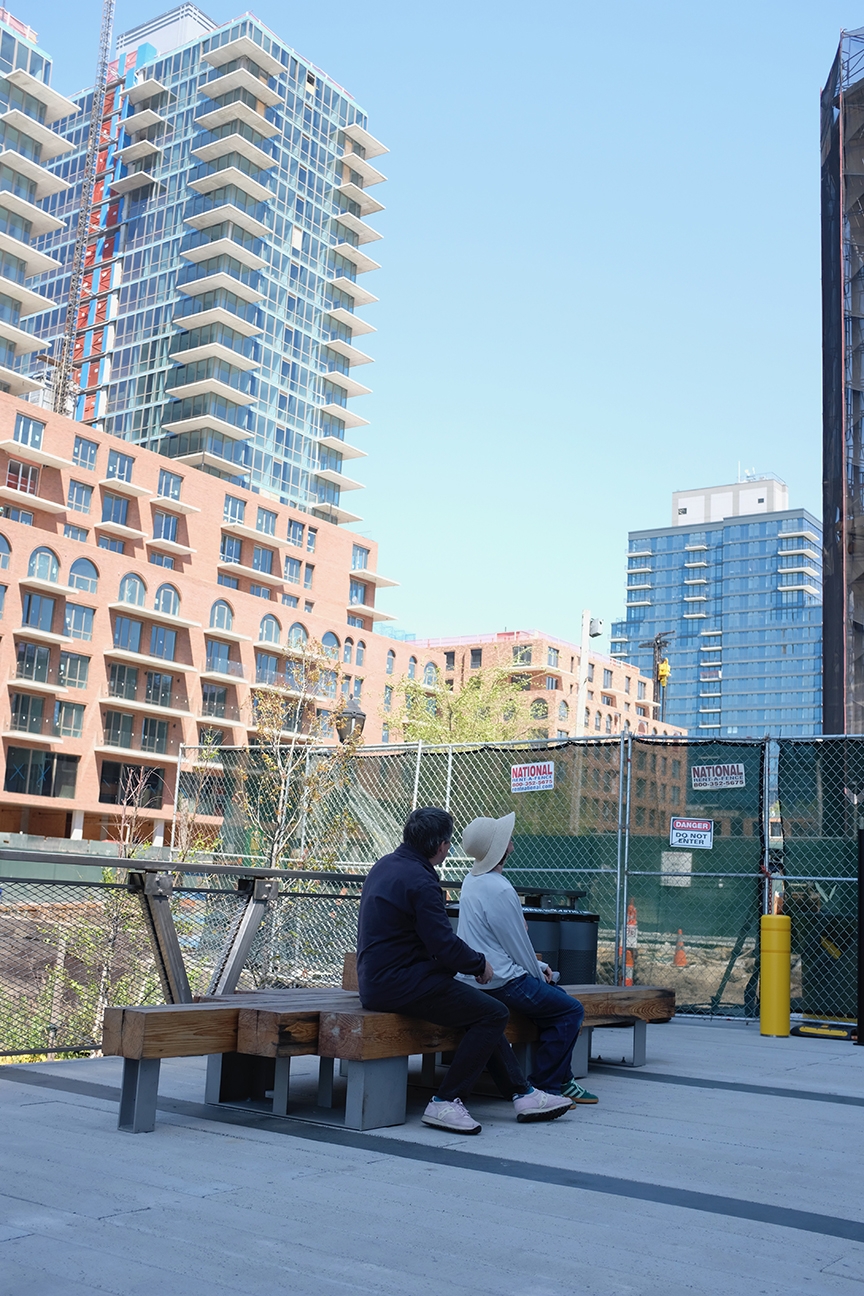
“More affordable housing in New York City!” is a universal rallying cry and political platform. You could almost imagine there’s consensus behind the words, a shared vision of what constitutes “affordable housing” and how to bring more of it into existence. But you’d be wrong.
Due to the Charter Revision Commission appointed by Mayor Adams last December, there will be three affordable housing proposals on the ballot in November, each presented as removing existing red tape that prevents developers from obtaining the zoning changes they need to build much-needed, below-market-rate housing.
Support from developers
The Real Estate Board of New York fully endorses these measures. REBNY President James Whelan says the proposals “offer an opportunity to streamline approval processes that have contributed to New York City’s housing supply crisis. We support the proposals, which are the sound result of considerations taken over 12 meetings across all five boroughs from a wide range of subject matter experts and thousands of residents.”
Other real estate-allied groups are campaigning for the proposals. According to Crain’s, the Partnership for New York, a business lobby, launched a $750,000 television ad campaign via a nonprofit it created, (The Coalition for New York City’s Future),” and “vote yes” campaigns are soon forthcoming from the pro-development group Open New York and the Charter Revision Commission itself.
By contrast, City Council leaders have slammed the three proposals as a mayoral power grab, drastically reducing the council’s say on land use. City Council Speaker Adrienne Adams, together with Deputy Speaker Diana Ayala, Majority Leader Amanda Farias, Majority Whip Selvena N. Brooks-Powers and others issued the following statement:
“Since 2022, the council has approved over 120,000 units of housing and secured more than $8 billion of additional investments to make housing more affordable and better support neighborhoods. This progress for our city would not have been possible without the council’s role in the land use process. Mayor Eric Adams’ Charter Revision Commission conveniently ignored these facts to advance a self-serving narrative in support of expanded mayoral power…. This commission’s misguided proposals would undermine the ability to deliver more affordable housing, homeownership opportunities, good-paying union jobs, and neighborhood investments for New Yorkers across the five boroughs.”
The statement condemned Mayor Adams’ “hypocrisy,” citing his last-minute halt to a planned senior housing development, “approved years ago by the council,” that would have replaced the Elizabeth Street Garden.
Ironically, the council’s statement overlooked the leading role played by Lower Manhattan Council Member Christopher Marte, a staunch supporter of the Elizabeth Street Garden. Marte was arguably key to brokering the deal that saved the garden and provided alternative space for senior housing—more than originally planned—within his district.
Unpacking AMI and the proposals
So what are the ballot proposals and what exactly would they do? What would change? Neither the Charter Revision Commission, nor the council, nor any civic organization has yet offered real analysis. And New York City land use policy, notoriously obscure, is not for the faint of heart.
We turned to Council Member Marte, whose commitment to equitable land use policy extends to having a full-time land use expert on staff. Marte unpacked and explained each proposal, Questions 2, 3 and 4 on the November ballot.
But before we get into his account of the specifics of each proposal, let’s pause to consider the meaning of the term “affordable housing,” which is probably not what you think it is. It is a technical term, based on a region’s “area median income” (AMI) and can encompass housing for renters whom some might consider upper-middle class.
For AMI purposes, the New York City “area” includes Westchester, Putnam, and Rockland Counties—and the 2025 area median income for a family of three is $145,000, significantly more than the median income of renters in New York City (The most recent 2023 study found that the median income of New York City renters was $70,000). If you were a family of three applying to the “affordable housing” lottery at 360 West 43rd Street, you would need a household income of 130 percent AMI, which, for a one-bedroom apartment renting at $2,900 a month, translates to a minimum household income of $99,429 and a maximum household income of $181,740. This is why some housing activists advocate for “deeply-affordable housing” as opposed to “affordable housing.”
Question 2
Okay, pause over. Question 2 is entitled “Fast Track Affordable Housing to Build More Affordable Housing Across the City.” It has two parts. The first part would allow developers of publicly-financed affordable housing to bypass the existing public review process, the Uniform Land Use Review Procedure or ULURP, which is triggered only when a developer seeks a zoning change.
ULURP starts first with certification by the Department of City Planning. Community Board and then borough president review, after which the City Planning Commission (CPC) votes on the proposal.
Approved proposals then go to the city council for a vote. Traditionally, the council—and especially the local council member—have considerable leverage to negotiate change and even halt a project. This is called “member deference.”
For example, Julie Won, representing Astoria, used her ULURP clout to compel the developer of Innovation QNS not only to more than double the promised number of affordable units, from 711 to 1,436, but to designate more than 600 as deeply-affordable apartments for the formerly unhoused.
Under ULURP, the council currently votes to approve or disapprove zoning changes. The mayor can veto the council’s action, and the council can override the mayor’s veto with a two-thirds majority.
Rarely has the mayor exercised veto power over land use. DeBlasio never did. In July, Adams exercised the first land use veto of his term to override the council’s rejection of Bally’s casino application in the Bronx.
Were Question 2 to be approved, affordable housing developers who seek zoning changes would be able to circumvent ULURP and instead apply for a zoning variance from the Board of Standards and Appeals (BSA), whose members are all appointed by the mayor.
Just how much “affordable housing” a development project would have to have in order to qualify for this fast-track treatment is not specified. Marte observed that, “As we understand it, Question 2 would allow any development that included even one affordable unit to go to the BSA instead of to the community board and the city council. BSA does not involve the city council at all and is a very opaque body with very little community input and a very high approval rate.”
The measure, he contended, would “set a dangerous precedent for the manipulation of affordable housing to circumvent zoning on any private site.”
The second part of Question 2 would establish a separate fast-track process for certain housing proposals going before the twelve community boards deemed to have produced the least affordable housing according to a city report that is to be produced every five years, starting in 2026. That second fast-track process, circumventing ULURP, would involve concurrent community board and borough president review periods, and final approval by the CPC, once again bypassing the city council. The CPC is arguably an instrument of the mayor, who appoints seven of the thirteen members, including the chair.
This means that twelve of 59 community districts would lose the chance to have the city council and their council member negotiate on their behalf—just because of “a single data point” that reflects factors beyond any community district’s control.
Marte argued that targeting twelve community districts in this way—and disempowering a significant number of city council members—is “unjust, excessive, and illogical,” a wrong way to advance the collective responsibility of New York City neighborhoods to promote housing equity: “Rather than encouraging zoning or funding policies that better distribute affordable housing across the five boroughs, this specifically restricts the ability of certain communities to weigh in on development in their neighborhoods,” an approach that seems not only “poorly conceived and vindictive,” but potentially illegal.
Question 3
Question 3 is entitled “Simplify Review of Modest Housing and Infrastructure Projects.” It would establish an Expedited Land Use Review Procedure (ELURP) as an alternative to ULURP for land use changes the Charter Revision Commission deems relatively uncontroversial or “modest.” These land use changes include increases of residential capacity by up to 30%, housing proposals up to 45 feet in height, and actions related to smaller infrastructure and resiliency projects, such as street grade changes or clean energy systems on public land. ELURP would involve concurrent community board and borough president review, with final approval by the CPC; once again, the expedited process would bypass the city council.
The devil is in the details. According to Marte, ELURP would entirely eliminate city council oversight of the mayor’s real estate dealings. And while the height and bulk (density) qualifications for ELURP “seem minimal,” they can in fact be significant when the lot in question is large: “In the case of a 10,000 square foot lot, this would mean an overall square footage increase of 30,000 square feet,” or an estimated increase of three to ten additional stories.
Question 4
Question 4 is entitled “Establish an Affordable Housing Appeals Board, with Council, Borough, and Citywide Representation.”
This proposal would replace the mayor’s veto power within the existing ULURP process with an appeals board consisting of the relevant borough president, the council speaker, and the mayor. With two of those three votes in agreement, the board would have the power to reverse city council actions and modifications with regard to land use. The council’s ability to override a veto with a two-thirds majority would also be removed, making the new appeals board the absolute decision-making body for all ULURP actions.
Marte characterized this proposal as the “most dangerous,” suggesting that a mayor could “buy out” the council speaker or borough president to get their way.
Weakening Democracy
Marte condemned all three ballot proposals as a means to “fundamentally weaken New York City’s democracy…and hand even more influence to private real estate interests.”
He continued, “At a time when the majority of New Yorkers are rent-burdened and displacement is at historic levels, it is unacceptable to scapegoat community oversight as the cause of the affordability crisis. The reality is that the vast majority of projects already bypass public review, and only those seeking special privileges go through ULURP. Stripping away these last safeguards would take us backwards to the days of the Board of Estimate and Tammany Hall–style politics, when decisions were made behind closed doors and entire neighborhoods were displaced in the name of so-called ‘better planning.’”
He declared that rather than go backwards, “Our city needs real solutions: holding developers accountable to their promises, strengthening tenant protections, and fully funding affordable housing—not dismantling democratic checks and balances. I urge New Yorkers to reject Proposals 1 through 3 this November.”
Author

Discover more from Red Hook Star-Revue
Subscribe to get the latest posts sent to your email.


One Comment
Thank you for your very comprehensive analysis of this important issue to all NYers