In some cultures, there’s a belief that death comes not when your heart stops beating, but when you’re forgotten. To remember something is to keep it alive, even if only in your heart.
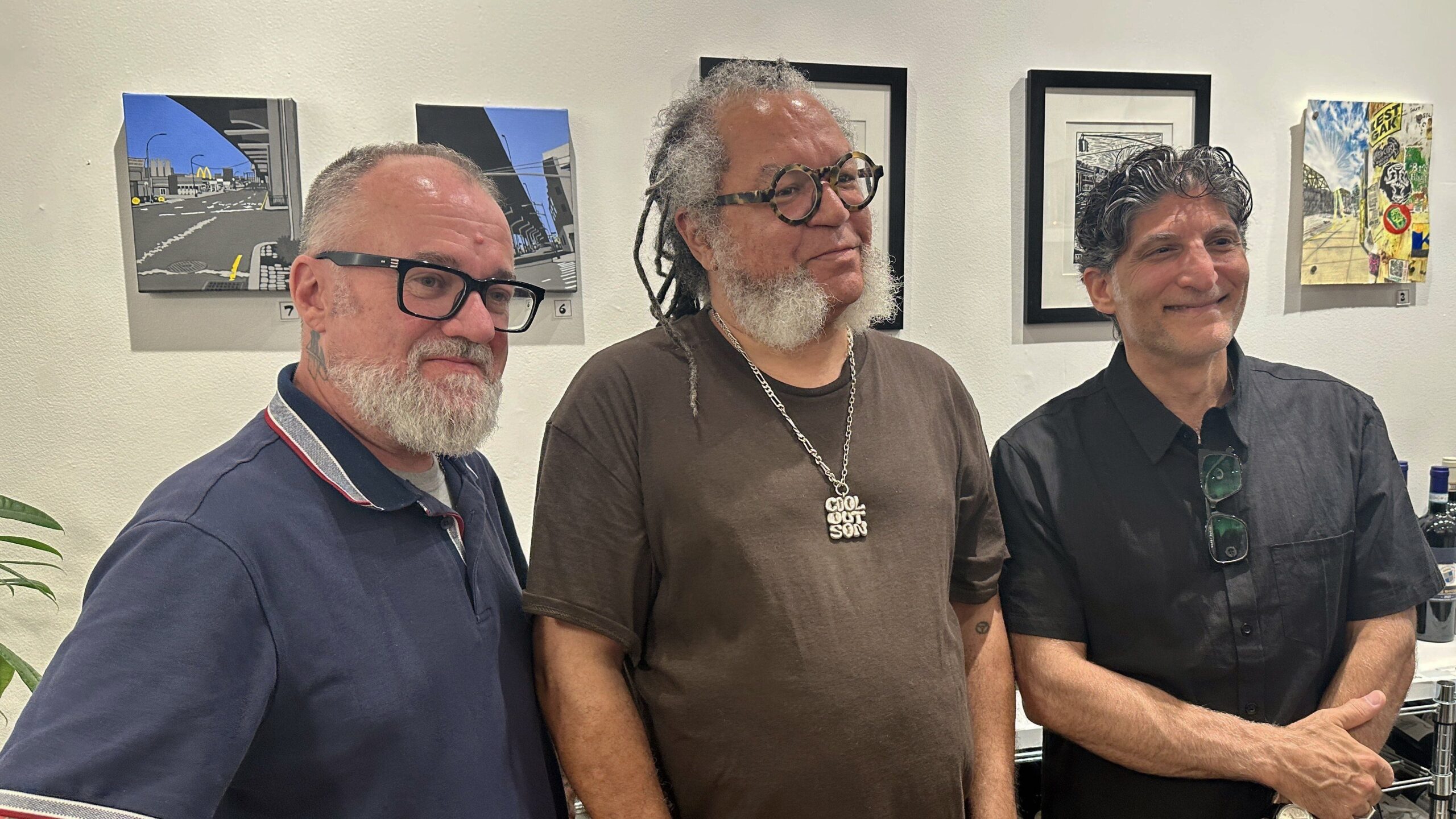
That idea is the key to A Few of Each, the collection of cityscape art currently on display at Gowanus Wine Studio on 3rd Avenue. The exhibition features work from three members of the local Urban Folk Art studio, and every piece depicts a specific location in Brooklyn. It’s a tribute to the area, as well as an invitation to remember how the neighborhood has changed over the last few years.
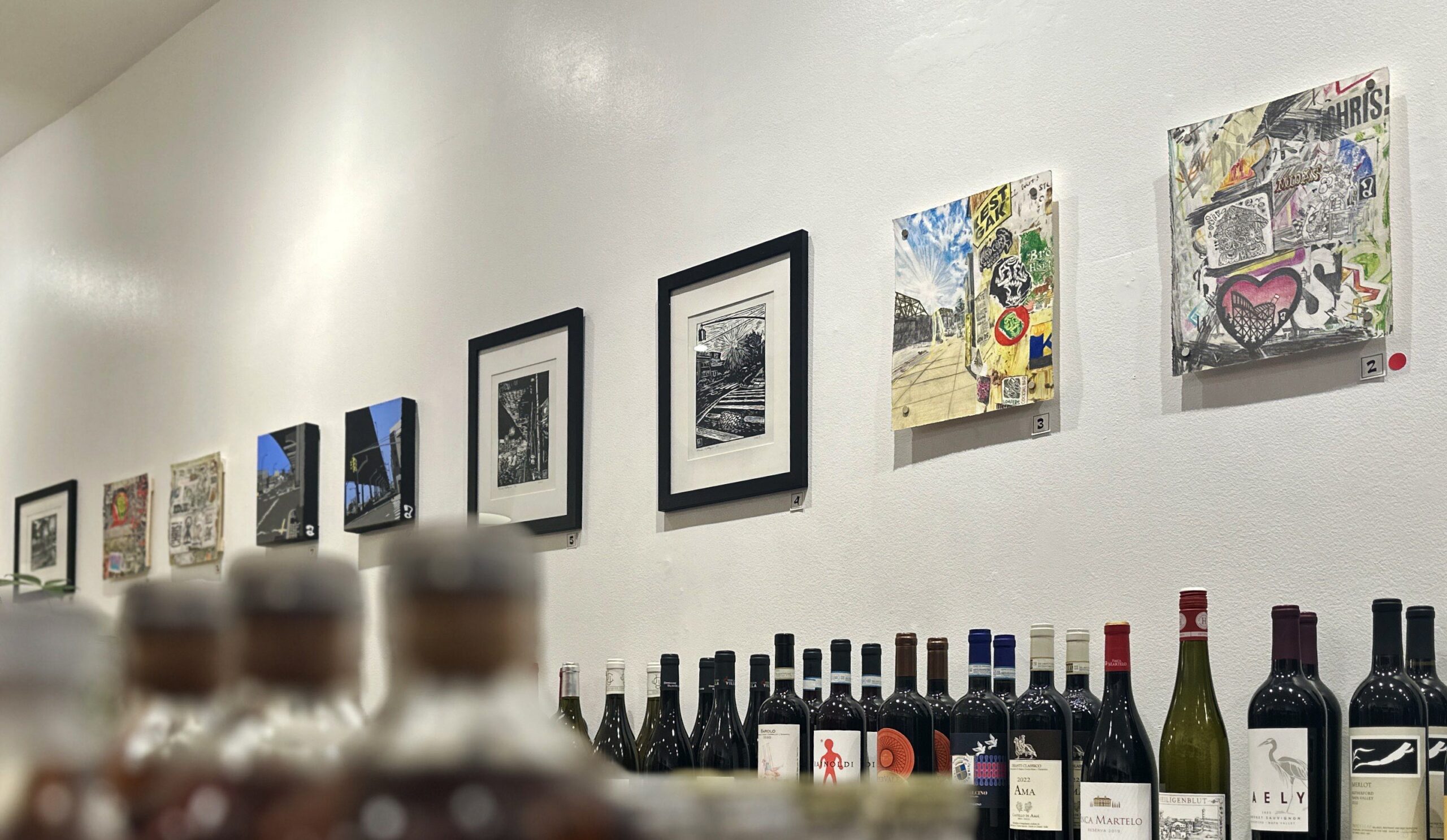
But while these three artists—Adam Suerte, Jason Mitchell, and Mark Pellegrino—might be focusing on the same broad subject, their work is anything but similar. Moving from one piece to another often feels like putting on a new set of eyes, as each artist experiments with color, scale, and technique. It’s a Rashōmon tale, with each man offering up his own memory of the streets they’ve all walked on.
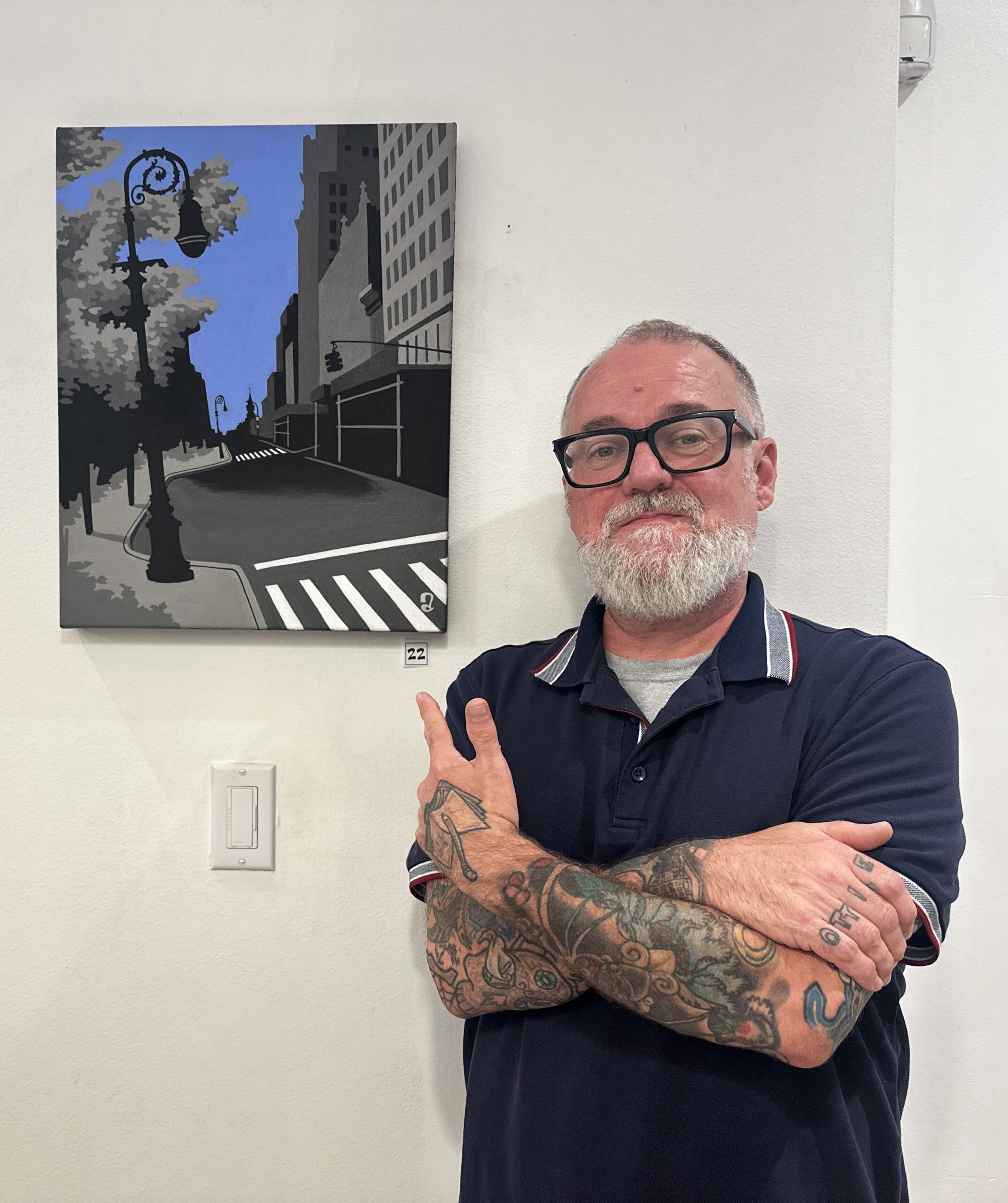
In Adam Suerte’s paintings, for instance, grey-and-black buildings cut across cloudless blue skies. Sharp angles and contrasting colors give each piece a striking quality, even from across the room.
Of the three artists, his work hews closest to reality. Yet, one detail gives it an air of unreality: His streets are totally devoid of people. He told the Star-Revue, “My interest isn’t capturing the guy walking across the street, in a scene that I’ve walked through a million times. I want the scene that I’ve walked through a million times.”
His goal, he said, is to capture a neighborhood’s character, especially as its architecture changes. “I’ll take some photos and paint [a building], then I’ll go back a month later and it’s changed. The building’s been demolished, or has been built over. … It makes me happy that I was able to capture it in live form before it’s gone.”
While Suerte depicts long streets and massive buildings, Jason Mitchell’s work shrinks down to the micro level. Mitchell prints stickers, slaps them up across town on walls and in bar bathrooms, then returns weeks later, after the stickers have started to erode, to paint the scene. In the process, he captures not only his own stickers, but the graffiti put up by his fellow artists.
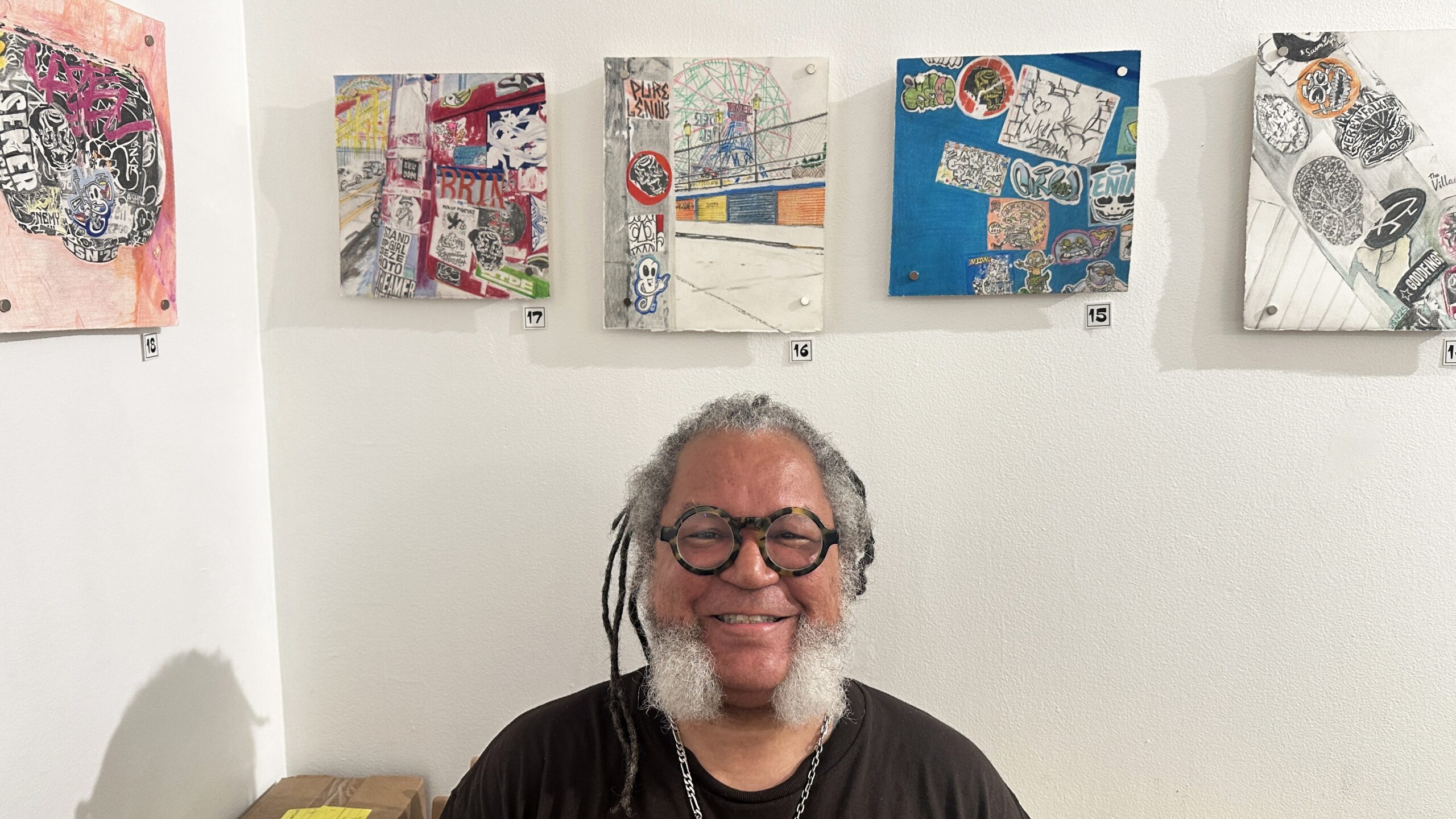
“It’s a memory that I’ve made physical,” he said. “It’s proving I was here. This is my legacy.”
His work emphasizes color. Reds, blues, and golds pop on the canvas. In the corner of his piece ‘Coney Island 1,’ white sunlight glints off a car so brightly that the vehicle’s outlines disappear. It feels like walking the streets with your senses dialed up to 11.
On the flip side, Mark Pellegrino’s work—which is carved into linoleum rather than painted on canvas—is entirely black-and-white. They stick out in the gallery, drawing your eye.
That lack of color doesn’t limit him. In the shadows, his street lamps radiate with thick rays of white light. In nighttime scenes, the pitch black sky feels like a thick blanket, while the white skies in his daytime scenes seem burning hot. Crosshatching shadows give each surface a distinct texture.
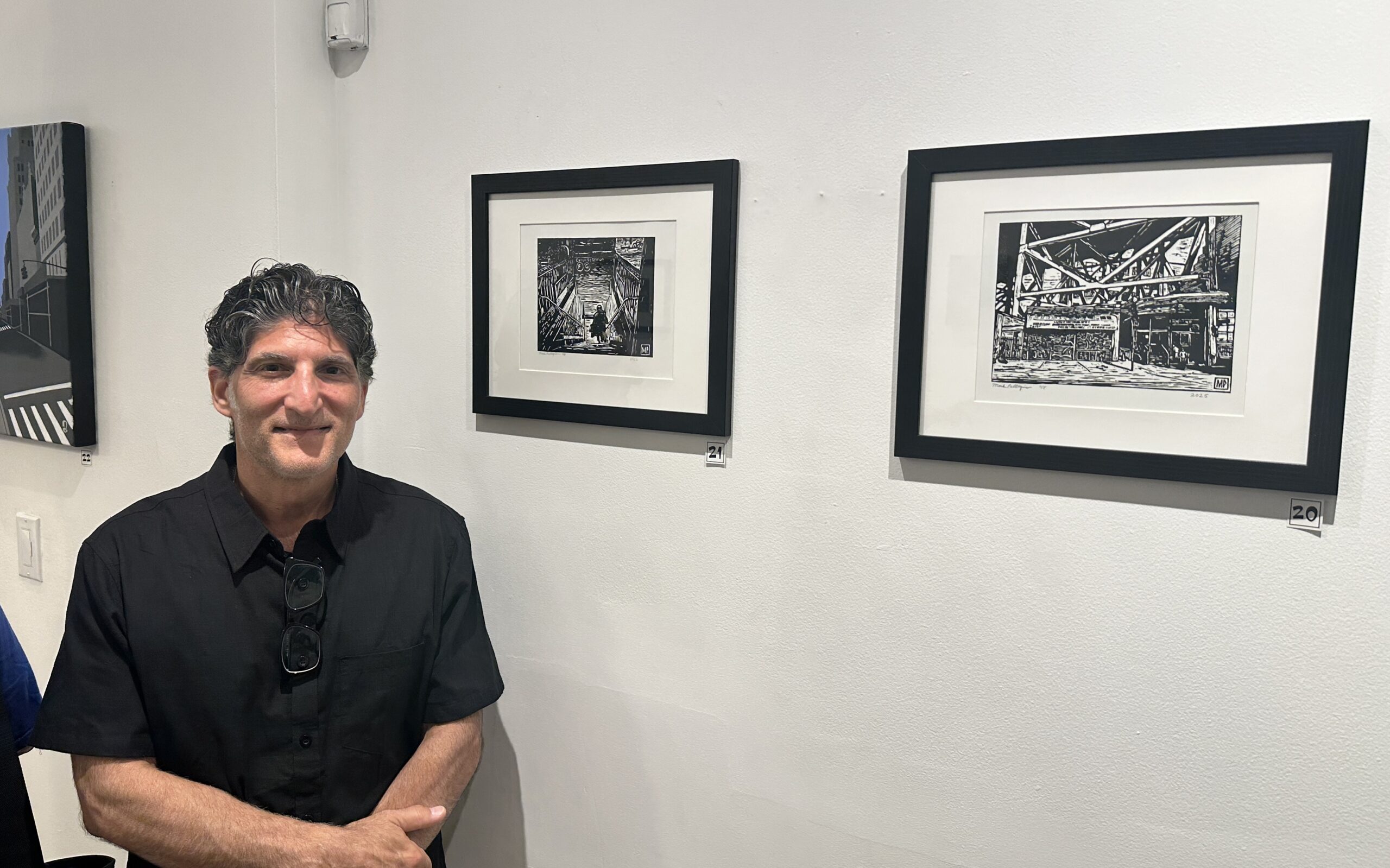
Like the others, he sees himself as a witness to a disappearing landscape. He mentioned that he’s working on a picture of Caputo’s Bakery, which he frequented as a kid and which recently closed. “I’m going to capture the essence of what Caputo’s was when I was growing up,” he said. “The old charm of the neighborhood is slowly going away. So I’m hoping that my work can … put it under glass for at least my time and my kids.”
All three artists are trying to preserve a memory of the neighborhood they’ve lived in for decades. But, speaking to them, none hint at any resentment for how things have changed, or suggest wanting to go back in time. These artists are ready to embrace the future; they just want to make sure no one forgets what came before. They’re keeping the memory alive.
Pam Wong, the art curator at Gowanus Wine Studios, said that she hopes the show will encourage visitors “to support local artists and the local arts community.” She added that as new people move to Gowanus, the goal of shows like this is to let those new residents know right away that Gowanus is a neighborhood for artists.
In other words, even as the neighborhood changes, one thing should remain constant: Its passion for art. And that’s a trait that can survive no matter what the buildings look like.
News from the neighborhood.
Red Hook & Gowanus
Want more news and features like this straight to your inbox? Subscribe to our newsletter below.
Discover more from Red Hook Star-Revue
Subscribe to get the latest posts sent to your email.