In June 2015, the NYC Economic Development Corporation (EDC) announced plans for a new commuter ferry connecting Red Hook with other parts of Manhattan, Brooklyn and Queens at a comparable rate to subway fare.
Improving Red Hook’s transportation connections has been an issue for the greater part of a century. But EDC’s choice of a landing at the very end of Van Brunt Street was met with utter disbelief, as it presented a very long walk for the bulk of Red Hook residents. When asked why the obvious landing wasn’t considered – the little used Atlantic Basin – an EDC representative looked uncomfortable as she told the group that the Basin could in no way be used.
The Atlantic Basin dates back to 1841 when Colonel Daniel Richards created a bustling port. By 1884, it held 40 acres of water with a 200-foot-wide entrance. The port took an economic downturn a few years after WWII because of the more efficient process of containerization.
In 2006, the Port Authority opened the Cruise Terminal. The renewed Red Hook community proposed a re-purposing of the basin, but for unknown reasons, every idea was rejected. The seemingly logical idea of using the basin for a community ferry terminal was also rejected.
EDC cleared up the mystery in their most recent study. They will be building the new launching area at the Henry Street Basin, on property owned by the Gowanus GBX. This so-called compromise makes it inconvenient to both the front and the back of Red Hook, in what might be called an “equal-opportunity” inconvenience.
However, the report revealed something else.
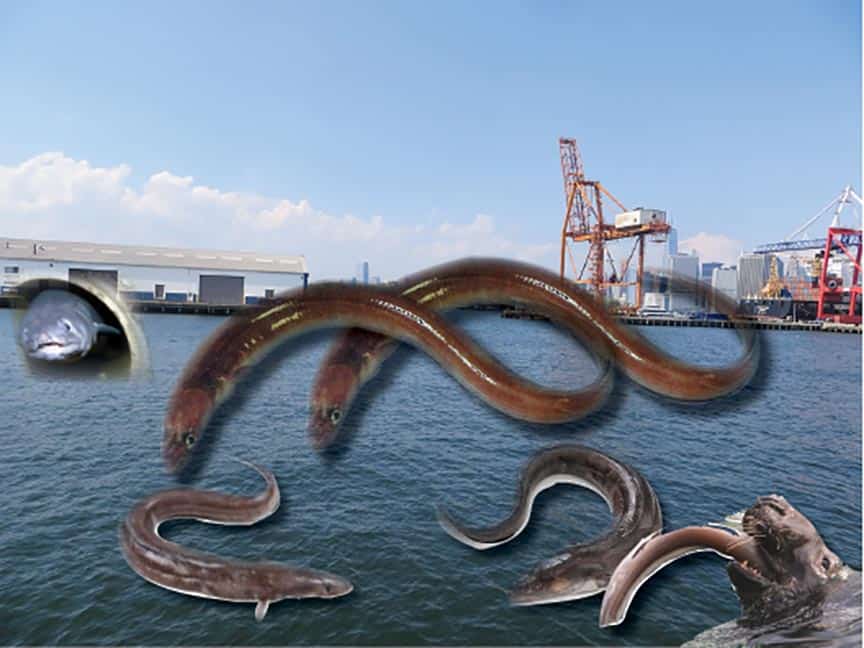
During their century-long operation, transatlantic ships brought cargo to Red Hook. They also brought something else – giant Conger eels.
It has been hypothesized by evolutionary marine biologists that the giant Conger Eel, which is capable of growing to 20 feet long, have a capacity for higher thought due to their oversized cranial capacity.
The eels originate from the Sargasso Sea, which lies in the middle of the Atlantic Ocean and is the only sea on earth with no coastline. Instead, it is bordered by the Gulf Stream and other currents.
Its water differs from surrounding the ocean in ways that have not yet been fully discovered.
Conger eel eggs latched themselves onto the hulls of the cargo ships in the Sargasso Sea and hatched off of the ships docked in Red Hook. They slowly formed colonies in the middle of the Atlantic Basin, just doing regular things that eels do – like slithering.
When the Gowanus Canal flushing tunnel was built in 1911, waste from factories was flushed into the Atlantic Basin. A “trigger chemical” was deposited along with coal tar, sewage and other contaminants. Years of the trigger chemical invading the waters of the Atlantic Basin caused the eels brain to activate.
During EDC’s study of the appropriateness of the Atlantic Basin for maritime use, they first discovered a sign that read, “All eels are equal, but some animals are more equal than others.”
When the government agency took a closer look, they thought they had uncovered the lost city of Atlantis. Inky areas that appeared on aerial photographs were actually underwater sliver buildings. The structures were laid in in a grid, with well-defined streets. Commercial and residential areas were also apparent.
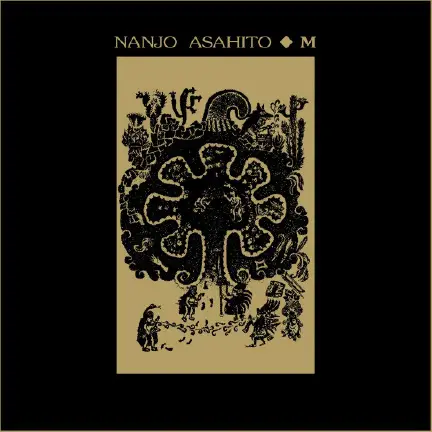
When the eels first began building evolving into sophisticated creatures, their structures were rudimentary. Their earliest renditions resembled teepees and hogans.
Scientists believe that conger eels’ cognizance developed quickly spurred on by chemicals found in Red Hook. Researchers report that by the mid-1960s, the eels lived in a modern and bustling cities built in the shallow depths of the Atlantic Basin.
As the eels continued to evolve, they began to develop socio-economic classes. Older eels less capable of defending their territories were forced to the outskirts of the communities. Smaller, feeble eels were forced to live among the bottom feeders and cater to the corrupt highest ranking of the species. Younger, more virile adults – predominantly males – took over and built luxury condos and penthouses with exquisite views from the top of their illustrious domain.
EDC quietly reported their findings to the FBI and CIA in 2007. To protect the secret, the EDC was required to issue RFPs several times a year to conceal detection. The security organizations also demanded that EDC reject all RFPs from that point forward. The Conger eel colony was classified as top-secret information.
Charles Darwin held back publication of On the Origin of the Species – his work on evolution – because he was afraid the world would not accept his premise that man was descended form apes.
The book was published in 1859, receiving backlash from the religious communities.
Top government officials believed that EDC’s discovery would further incite religious organizations. Darwin’s theories were controversial, sparking much debate; it was difficult for some people to accept human evolution. The FBI and CIA agreed that it would be very difficult for society to accept these Conger eels as their equals.
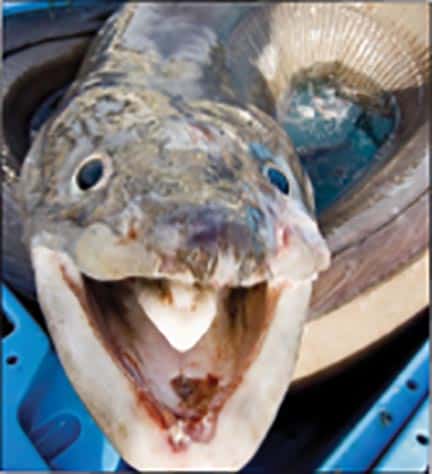
After intense pressure from the Red Hook community to put a ferry stop in the Atlantic Basin, EDC was ordered to conduct a mock study of the area as part of the rouse. While exploring the exact depths of the basin, an instrument harpooned a high-ranking Conger eel. A local community journalist from the Red Hook Star-Revue captured the flailing animal being resuscitated by crew members with her smartphone.
This is the situation that the EDC now faces. They are an organization meant to support economic activity and accompanying real estate development. An executive decision was made to expand their role from simply human economic development to ANY economic development.
EDC has applied to the NYC Landmarks Preservation Society to have Erie Basin designated a historic district, in order to disturb the still evolving eels.
Author

Discover more from Red Hook Star-Revue
Subscribe to get the latest posts sent to your email.

One Comment
Too bad we must return them.