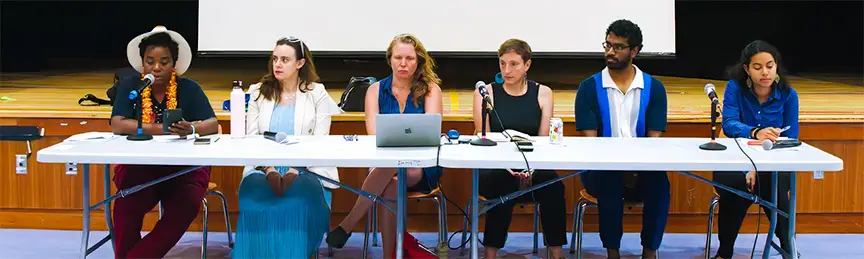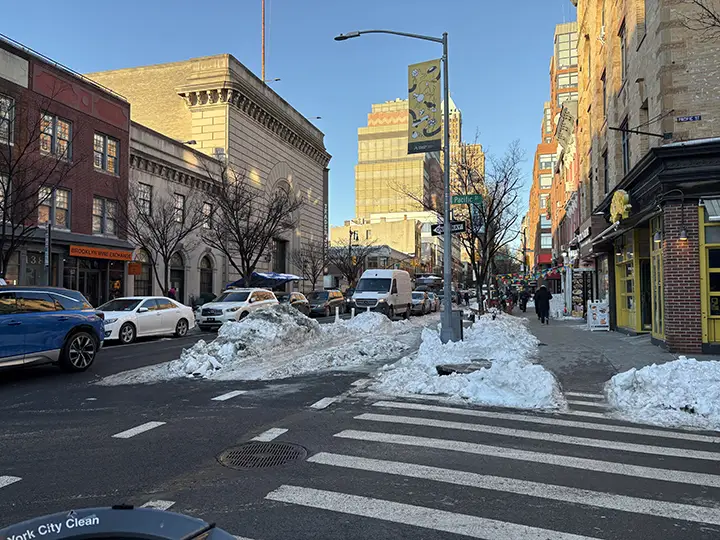
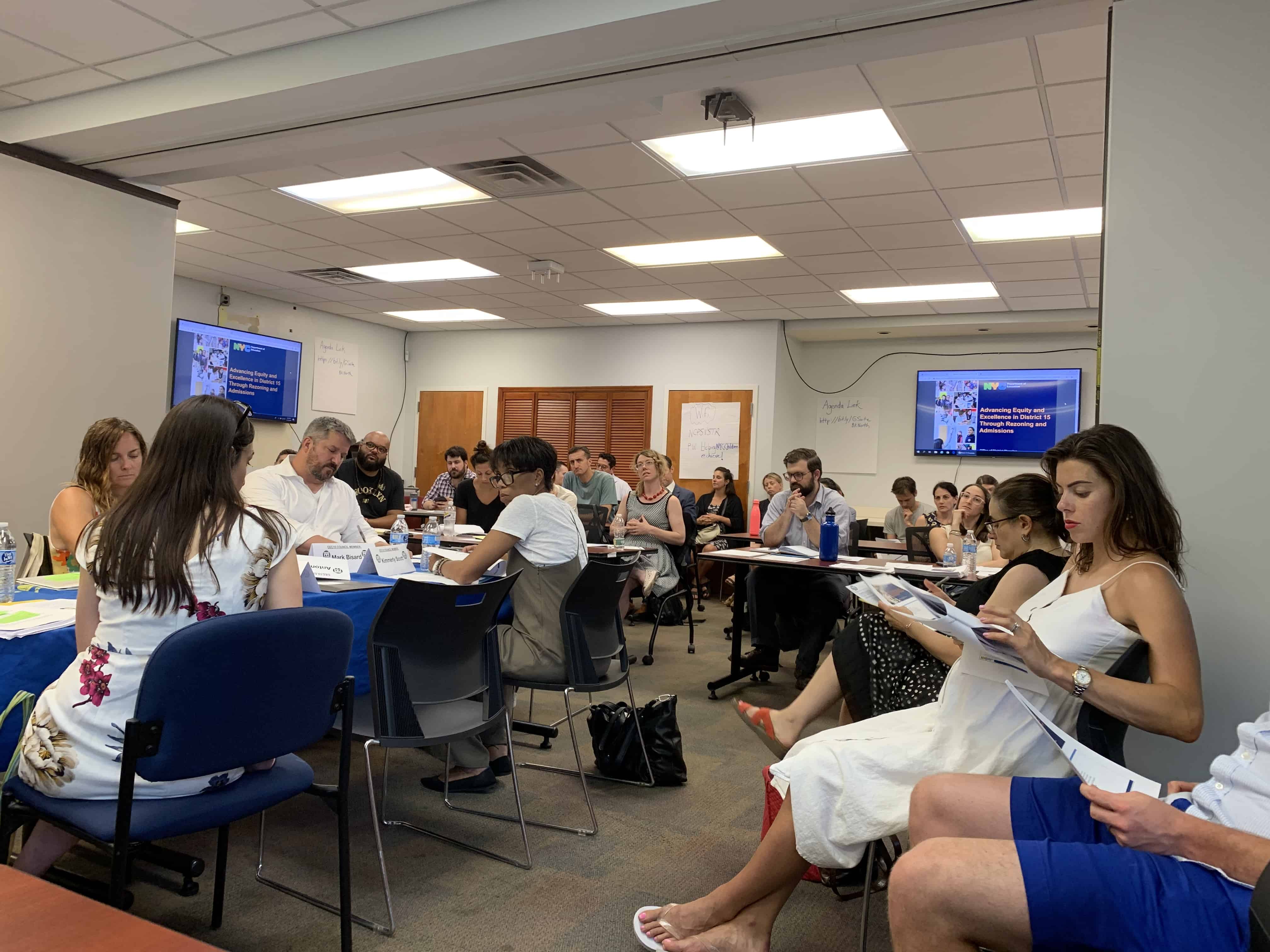
A new school building is about to open in Gowanus, and District 15 is figuring out how best to make use of it.
PS 32 (317 Hoyt St.) will have 436 new seats, early childhood and special education classrooms, a rooftop playground, and a new cafeteria and library come September 2020.
The goal is to reduce overcrowding and waitlists at PS 32 and surrounding schools in the northern portion of District 15. Twenty-two of 26 District 15 schools serving elementary school students were overutilized, according to the district’s 2019-2020 Planning Presentation from the Department of Education’s Office of District Planning (ODP) last year.
According to ODP’s “Advancing Equity and Excellence in District 15 Through Rezoning and Admissions” presentation from June, the current percentages for school utilizations, based on the 2018-2019 Audited Register, at the following schools are:
- 83% at PS 15
- 125% at PS 29
- 76% at PS 32
- 93% at PS 38
- 132% at PS 58
- 109% at PS 261
- 28% at PS 676
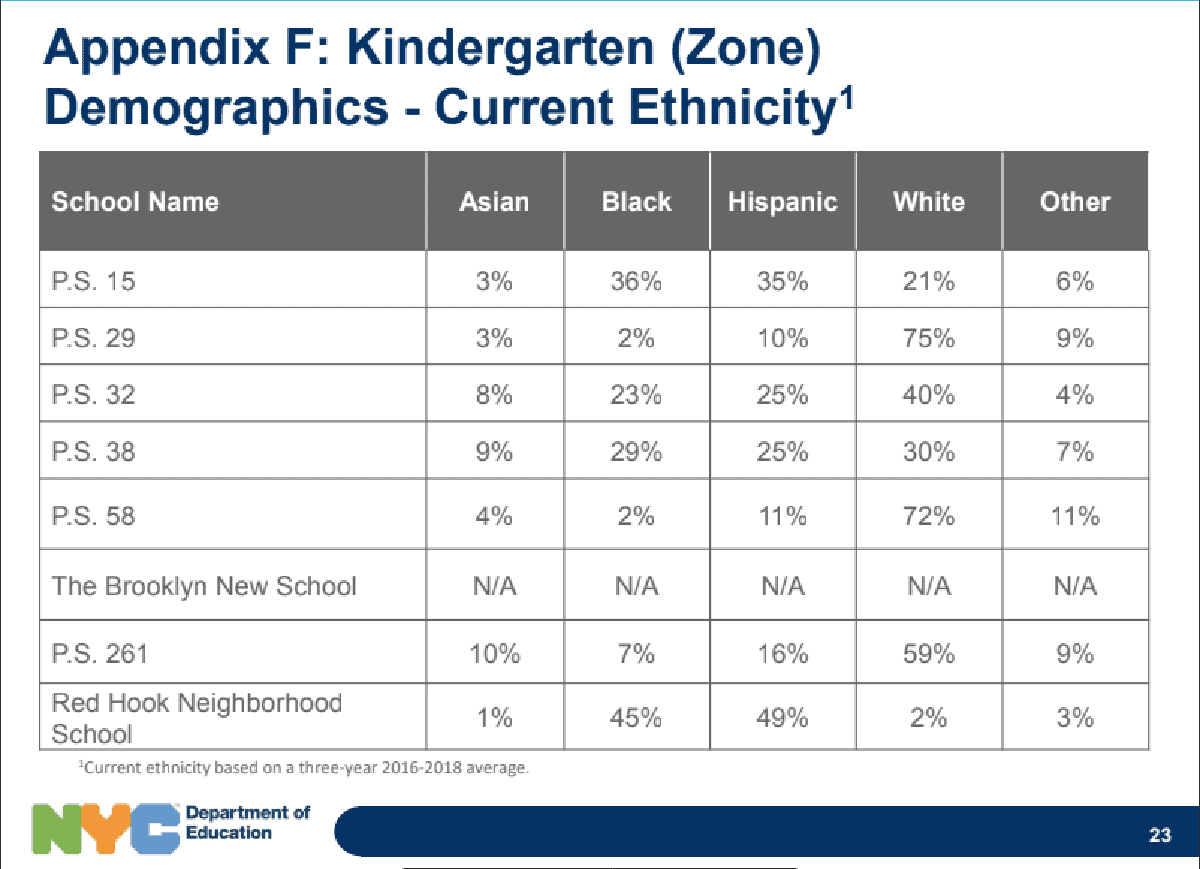
ODP’s come up with two potential rezoning approaches to address imbalances. Both include changing zone lines and implementing admissions priorities for students in temporary housing (STH), multilingual learners (MLL) and students who are income-eligible for free and reduced-price lunch (FRL) – the latter as a means to reduce demographic disparities across schools and increase equity and diversity in the segregated district. For example, 75 percent and 72 percent of students at PS 58 and PS 29, respectively, are white. But, at PS 676, all the students are either black or Hispanic.
The current percentages for STH, MLL and students income-eligible for FRL at the following schools are:
- 69% at PS 15
- 11% at PS 29
- 37% at PS 32
- 44% at PS 38
- 12% at PS 58
- 28% at PS 261
- 100% at PS 676
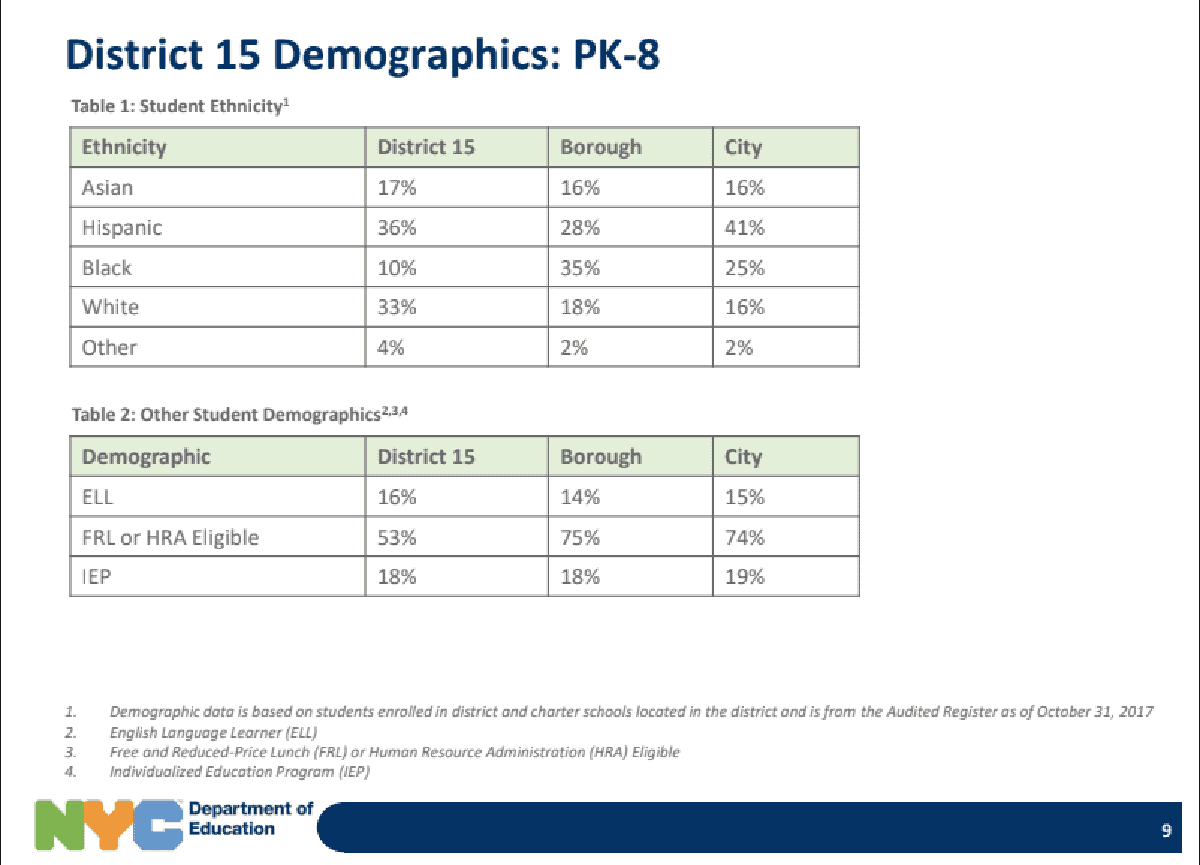
Proposed rezoning changes would mainly impact pre-Kers, kindergartners, and students new to the district in the 2020-2021 school year. However, sibling grandfathering will be a priority, meaning if students (entering pre-K or kindergarten) have an older sibling at a school that changes its zoning, they will be grandfathered into that same school.
It’s important to note that this proposal comes after recent changes in District 15’s middle school admissions process – eliminating screens (i.e. report card grades, state test scores and interviews), so that families can apply to schools of their choice instead. Admissions are determined by a lottery, with preference for 52% of seats given to STH, MLL and students income-eligible for FRL.
Approach One
The seven schools that’ll be impacted in the sub-district are PS 15, 29, 32, 38, 58, 261 and 676. Approach One is about individual zones – where, if you live in that geographic area of the district, you have priority to that specific school.
A unique aspect of Approach One is that, for some schools, zones would be drawn such that the school could accommodate out-of-zone students who meet the aforementioned admissions priority. In order to meet the 25 to 35 percent target, they need to have space available for out-of-zone students.
According to one of the maps from the June presentation, some schools would have their zone size increase; others would decrease and some would remain the same. For example, PS 15’s zone would increase to leverage existing capacity and promote diversity; PS 676’s zone would stay the same; and PS 29’s zone would decrease to address overcrowding and promote diversity.
In PS 15’s case, the estimated kindergarten zone size would be between 105 and 115 students –their current size is 69. PS 676 would stay virtually unchanged as their target kindergarten zone size is 65 to 75, and their current size is 70. PS 58 would see their zone size decrease from their current 193 to about 110.
Approach Two
Approach Two concerns a potential shared zone. In ODP’s extensive community engagement process so far, they’ve heard from people who want to maintain zones and those who are interested in a system that totally eliminates zone lines.
In Approach Two, students would be entitled to a seat at one of the seven schools, but not at any one individual school within the area. The admissions process would be similar to what happens at the middle school level, with families applying to schools of their choice (and being placed in a lottery if that school receives more applications than it has open seats).
“Under Approach One, there is one school you are zoned to, and, in Approach Two, you are prioritized for a seat in one of the seven schools – but not a particular one,” Max Familian, director of planning, explained at the June meeting.
Parents’ feedback
ODP’s been doing a lot of community engagement in recent months as they’ve presented information and listened to the feedback they receive. They’ve decided to get much more input from community members than in previous rezonings.
“The feedback [from public comments] is very hopeful towards creating a more inclusive environment. People are asking questions about, ‘What does that look like in PTA funding, in curriculum, in culturally responsive engagement, in terms of staff support?’” said Camille Casaretti, CEC15 president and CEC rep for PS 676, at the July meeting. “We’re moving in the right direction, certainly.”
Two concerns that have been consistently brought up at the meetings and via email are transportation and longer travel times. Other parents’ concerns mentioned last month included
ODP not providing clearer definitions of what diversity means and how that’d be implemented. Some also noted that ODP should do more to inform Red Hook families about the rezoning strategies.
NEXT STEPS
The DOE will present a draft proposal for zone line changes to the Community Education Council (CEC) at a public meeting in the fall. Factors that’ll be taken into consideration when developing those proposed zone lines are new residential construction, geographic barriers and travel distance. The CEC will vote on the framework within 45 days of that proposal submission.
Parents and community members are encouraged to email the CEC ([email protected]), District 15 Community Superintendent Anita Skop ([email protected]) and ODP ([email protected]) – with the Brooklyn zoning address – with feedback. Comments will be collected on a rolling basis.
The next CEC meeting will be on August 8 at 131 Livingston St. at 6:30 pm. ODP will do a quick overview of the latest zoning information and will take comments from the public.
-by Erin DeGregorio and Nathan Weiser
Author

Discover more from Red Hook Star-Revue
Subscribe to get the latest posts sent to your email.