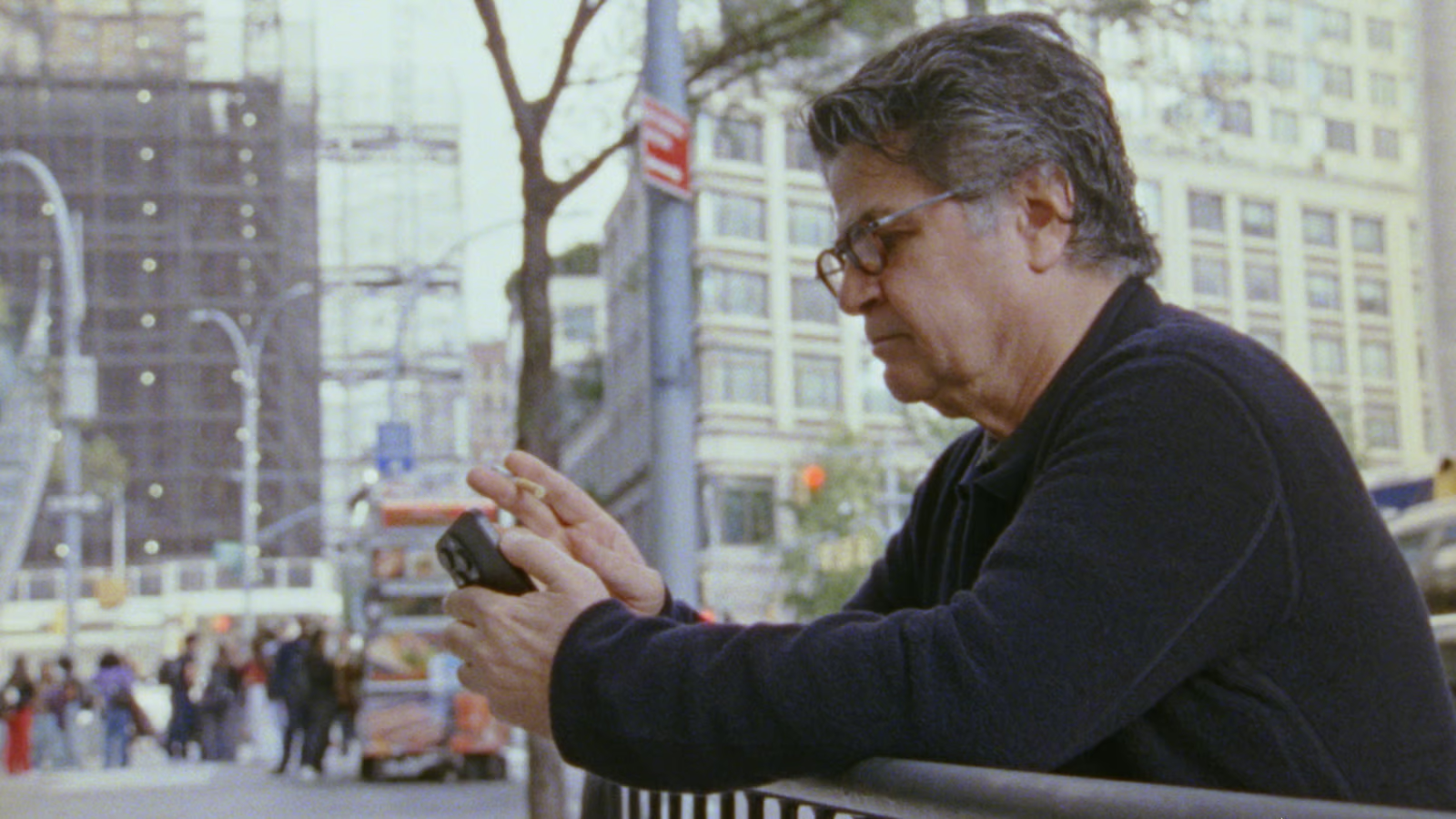

A commercial real estate broker in his mid 30s, Jerry has been taking ketamine—a so-called psychedelic drug popularly more associated with club kids than businessmen—therapeutically to treat his persistent depression. And according to him, it’s working better than anything else Jerry’s tried.
In cognitive behavioral therapy for some time he had been also introduced to Lexapro, an anti-depressant SSRI drug like Prozac and Zoloft. It worked to some extent, but wasn’t happy with it. “While it was mellowing me out, the side effect was to take my edge away, my ability, my desire to do creative work, which I need for my songwriting, my music” said Jerry who aspires to produce music,” Instead, it softened me, made me settle for relaxation. I was happier , yeah, but the ability to push myself and to concentrate on getting onto the next level, just wasn’t there.”
Many of those seeking treatment to relieve persistent depression find the popular meds largely ineffective.
They speak of their stalling out, taking them to a neutral space while they fight off their depression. And so some choose a short cut—ketamine therapy —to speed up the healing process.
What Jerry is seeing is part of a blossoming new wave of psychotherapy; repositioning anesthetic and psychedelic drugs to treat depression, post traumatic stress disorder ( PTSD ) and similar mental ills.
But while clinical trials of LSD, psilocybin and other hallucinogens is underway for the treatment of such conditions, they haven’t been approved yet.
But Ketamine, a little understood drug that is standard protocol anesthetic in hospital emergency rooms, is already here, with medical treatment centers sprouting up from Long Island to Los Angeles. The American Society of Ketamine Physicians, Psychotherapists and Practicioners now represents some 400 members.
Yet you’re asking yourself, wait a minute, isn’t Ketamine also an animal tranquilizer a so-called “club drug?”
Well yeah, somewhat guilty as charged but, as it turns out, its ability to create dissociative and sometimes hallucinogenic altered states can also set the table for some significant personal behavior changes. Ketamine induces dissociative anesthesia—a trance-like state providing pain relief, sedation, and amnesia
Experts believe ketamine treatment can temporarily alter the psyche of those patients stalled in depression and lead to transformative change.
“Since the 1970’s, Ketamine has been a standard of care treating patients in operating rooms and emergency departments around the country”, says Dr. Nicolas Grundmann, an Emergency Medicine trained physician based in Brooklyn.
He is the co-founder and chief medical officer of Ember Health, a mental health treatment center located on Court Street that administers IV (intervenous) ketamine for depression.
He describes ketamine as “a well understood drug” in the medical community, “More than 300 randomized control clinical trials conducted over the past 20 years have demonstrated the efficacy of IV ketamine for depression.”
Grundmann emphasized that ketamine’s use for depression is not a “Hail Mary” approach because “clinical trials have been conclusive, showing efficacy 75% of patients with treatment resistant depression.
Indeed, he claims, “83% of our clients at Ember Health succeed in alleviating their depression.”
Given its positive results, IV ketamine has been endorsed as a treatment by the American Psychiatric Association of America.
“The current debate isn’t around ‘does this work?’ but rather how do we best use this tool to help people?” explains Grundmann, “When administered in a safe, medically monitored environment, IV ketamine allows people with depression to reset their emotional reward system.
While traditional antidepressants numb their feelings, patients describe ketamine as helping them feel more like themselves.“
How is this change possible? Let’s take a quick look at psychedelics and ketamine for starters.
Psychedelics induce a state of stimulatory as well as perceptual over-saturation of the senses.
Conversely, ketamine is dissociative, a chemical substance that brings about a state of under-saturation of the senses and the perception thereof, and within this vacuum clients can reach a mystical state of insight.
While psychedelics work by relaxing the brain’s inhibitory architecture, flooding the senses. Ketamine shuts this down.
Jerry describes his ketamine sessions as a “very introverted experience, but also like your mind is taking off, flying around, It’s hard to describe.”
But he also feels continued conventional therapy is still necessary because “a lot of the gains are the result of your taking advantage of the relative elasticity in the brain after a ketamine infusion to create new neural pathways. You want to grow on that.”
Dr. Grundman refers to this elasticity as “adaptive learning, purposely trying to change your thoughts, and to work this out with your therapist. “
The therapy to be worked on is among the network of some 500 professionals throughout NYC area connected to Ember Health. Dr. Grundmann stresses that ketamine treatment doesn’t replace conventional psychiatric therapy or the therapist but rather enhances the opportunity for healing.
Ember sessions are 90 minutes long – Drug treatment itself on 40 minutes, with 15-20 minute prep, leaving 30 minutes for “tea and a debrief.”
Patients lie prone on a couch blindfolded to enhance the effect. Clients may record verbally their thoughts or write them down after in the debriefing.
The treatment can involve aromatherapy, music therapy ( with headphones) to contribute to the infusion’s “altered state” entrance. Most Ember patients will experience insight, perspective “shifts” reflecting the altered state situation brought on by ketamine, says Dr. Grundmann,
“Most of our patients have a dream-like take on the experience not so much out of body or hallucinogenic.
The actual effect is how a person feels, making them more introspective, meditational.”
Ember Health is located at 26 Court Street, downtown Brooklyn.
Author
Discover more from Red Hook Star-Revue
Subscribe to get the latest posts sent to your email.