A major part of the EPA’s plan to clean up the Gowanus Canal is the prevention of future contamination. In addition to chemical toxins that have leached into the canal as a byproduct of the 19th century gas plants that abutted the canal, organic poisons from sewage overflows continue to contaminate. Overflows happen during rain events when the sewers become inundated with rainwater. When that happens, the excess, which includes raw sewage, is shunted directly into the canal. The retention tanks are designed to end that. The sewage/rainwater mix is shunted into large tanks, and held there until the waters subside and the sewers can continue their normal job of taking sewage to the treatment plants.
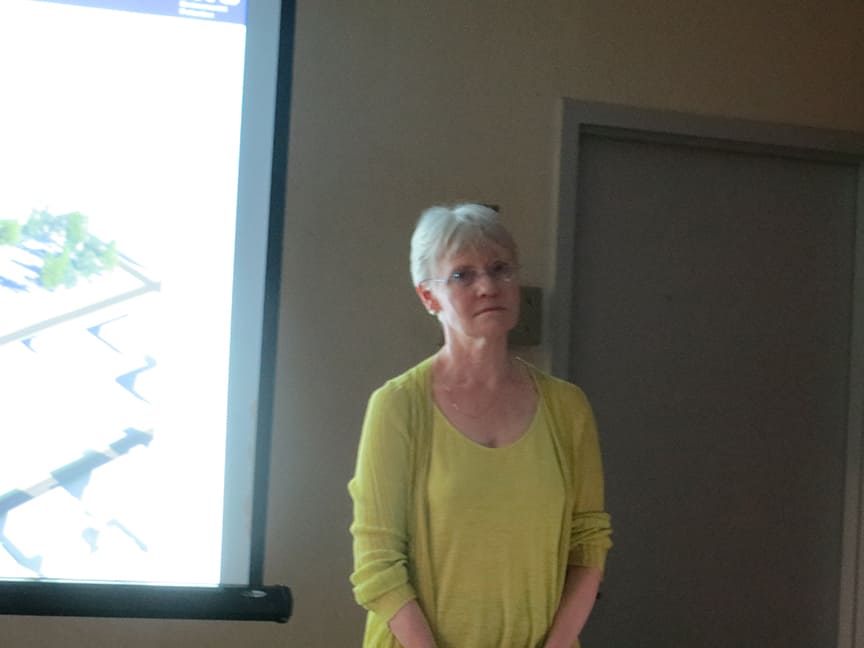
The NYC Department of Environmental Protection (DEP) promised to have a plan for the EPA by June 30th, and a huge contingent of officials from DEP and also the Parks Department, including both commissioners, showed up at the monthly Gowanus Community Advisory Group (CAG) on June 30 to present their ideas.
The EPA’s mandate has been a bone of contention with the city from the beginning – dating back to the days before the Superfund when the city believed that the whole Gowanus stink could be fixed with the repair of the flushing tunnel and the planting of trees and bushes. However, science prevailed and in 2010 the Gowanus was declared a federal Superfund site, which gave the EPA final decision on the cleanup.
Controversy over the placement of two of the placement tanks has hinged over the EPA’s recommendation of placing them underneath the public swimming pool that is in Thomas Greene Park, sometimes called Double D because it is between Douglass and Degraw Streets (between 3rd and 4th Avenues). Earlier this year, a preliminary DEP study identified that park, as a possible site. Another possibility was on two private plots of land between the park and the canal. That choice would involve using eminent domain and buying out the current owners at what would be deemed a market price for the land. The EPA tries to avoid eminent domain whenever it can.

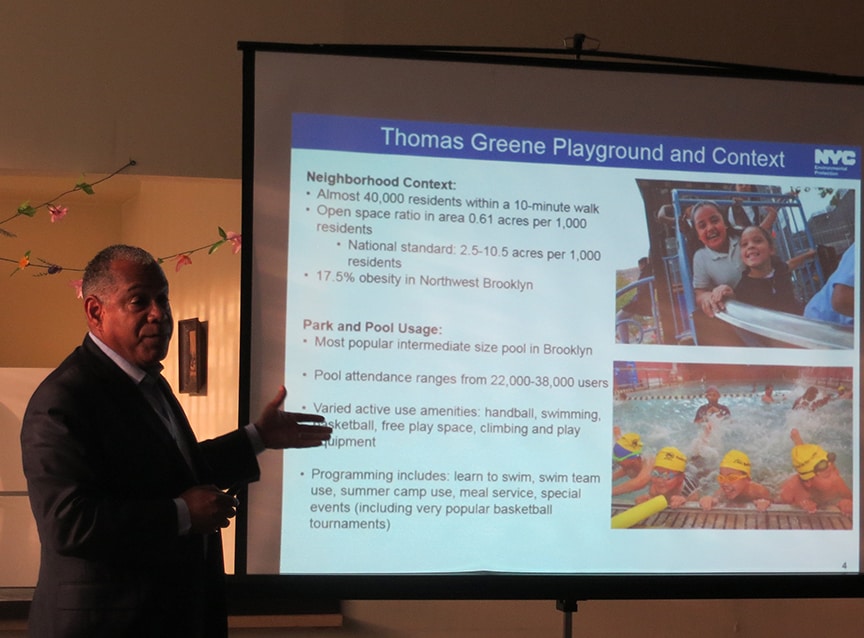
At the CAG meeting, DEP commissioner Emily Lloyd, with the backup help of the city’s Park Commissioner Mitchell Silver, made the city’s case. Lloyd presented four scenarios. The first, and the city’s preference is to build the tanks and an associated “head house,” on the private land. A head house is something the city likes to build together with overflow tanks in order to lessen smells and to help keep the tanks clean. Ms. Lloyd semi-politely referred to odor problems throughout her presentation. She pointed out numerous times that her preferred choice sent out the least odors.
All the other possibilities involved placing the tanks under the swimming pool, with various configurations of the head house. All were presented as being more costly, and involving many more years of the community going without the pool.
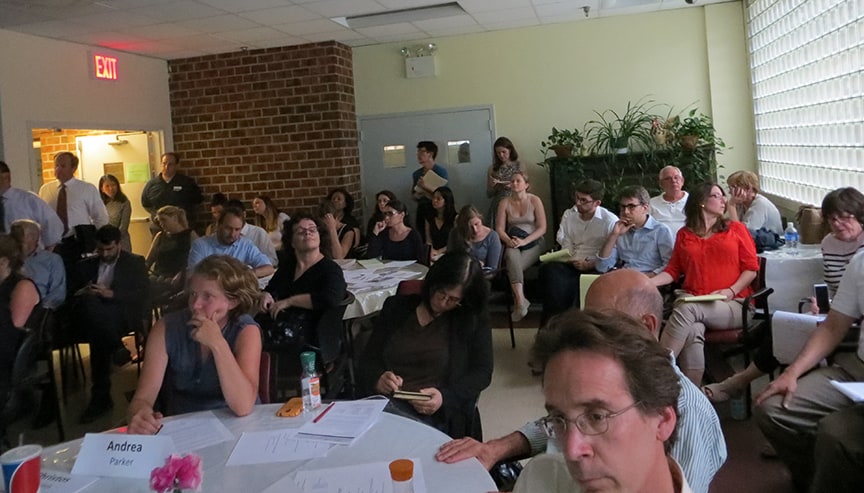
After the presentation, the floor was opened up for questions and the fun began.
Lloyd seemed uncomfortable as knowledgeable CAG members asked pointed questions about the reality of the dollar figures and timeline presented. At one point she said “We disagree with the gentleman,” referring to the EPA project manager, but refusing to use his name (Christos Tsiamis). Tsiamis made it clear that the EPA will take the city’s ideas very seriously. The work begins shortly, with his engineers working with the city engineers, checking all the facts and figures to see what really makes the most sense. The EPA has the authority to make the final decision on size, placement and operation of the tanks. “Sometime by this fall we will have a pretty good idea where we are headed,” he said.
One wildcard in all this involves the NYS Department of Conservation (DEC). The EPA has determined that the land underneath the swimming pool contains much the same toxic poisons as does the Canal. However, in the case of the park, the cleanup plan is DEC’s domain. They have not yet decided whether the toxins need to be removed. That decision is due shortly.
This meeting presented a rare opportunity for the public to see for itself some of the backroom bickering between the city and the EPA regarding Superfund. No matter how this is decided, the public will gain a revitalized canal, the reclamation of a great public asset.
Author

Discover more from Red Hook Star-Revue
Subscribe to get the latest posts sent to your email.

One Comment
Pingback: Red Hooks Environmental and Wellness Issues | MHC Seminar 3