News from the neighborhood.
Red Hook & Gowanus
Subscribe to get the Star-Revue’s newsletters throughout the month.
New York City’s first-ever Urban Forest Plan, released last month by the Mayor’s Office of Climate & Environmental Justice and a long list of partner agencies, states a commitment to cover 30% of the city in tree canopy by 2040. To achieve this, tree plantings have to accelerate, the report says.
In Cobble Hill, one organization is already working on it.
If you walk up and down Court Street between Pacific and Degraw, you’ll notice young trees rising out of beds on most blocks, held up by support posts. Most of them were planted in the past year by the Cobble Hill Tree Fund.
The organization has been around since the 1960s, but it’s ramped up efforts in recent years to fill the gaps in Cobble Hill’s tree canopy.
The trees lining NYC’s streets are technically the dominion of NYC Parks. But with an extensive planting schedule covering five boroughs and budget constraints, a significant planting backlog has built up, according to Louis Cox, Tree Planting Coordinator at the Fund.
Plus, Cobble Hill is near the bottom of Parks’s planting schedule, Cox said—and he gets it. In terms of tree cover, the neighborhood is doing pretty well comparatively. However, there is still plenty of room for improvement, as the number of new plantings along Court Street demonstrates.
“Court Street really was a desert before,” Cox said. In some stretches, he adds, it still is.
According to Cox, Mayor Michael Bloomberg’s campaign to plant a million trees drove some real progress. The issue is, trees are still cut down here and there, and their replacements aren’t coming anytime soon.
Trees are needed and not always part of city’s planning
“The city will take care of it eventually, but it might take one to five years,” he said. When he joined the Fund in 2023, a Parks forester told him that no tree plantings were planned in Cobble Hill for the foreseeable future. That year, when locals voted to commit $355,000 towards planting 100 trees in council district 39 via the participatory budgeting process, his team noticed that none were in their neighborhood. So, he proposed 25 spots to Council Member Shahana Hanif’s office, 14 of which were approved.
Those 14 trees are the result of extensive deliberation, planning, a permitting process, and a good chunk of money.
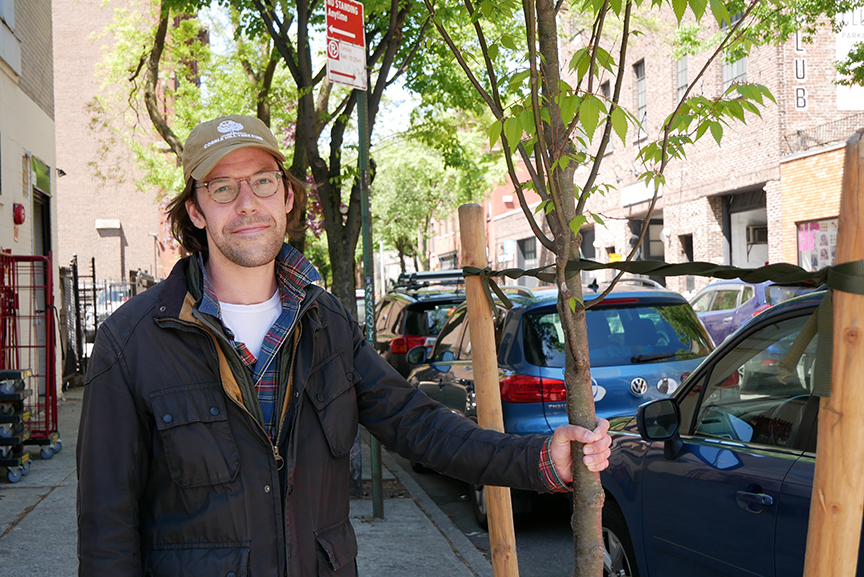
For the Fund to plant a single tree, they often must work with a slew of stakeholders, including Parks, landscaping contractors, a nursery, and sometimes homeowners, community board members, and local elected officials.
The process usually starts with Cox identifying an empty tree bed or barren stretch of sidewalk. He then calls a Parks forester—he’s gotten to know a few pretty well by now—to check out the tree bed. Together, they talk about bed size, potential barriers, and tree species. Diversity, sun exposure, and disease resistance are also considered.
Once Parks approves a planting permit for the Fund, Cox sources a tree from a nursery and calls up a contractor to prepare the bed and plant the tree. Sometimes, several contractors might have a hand in the work.
In total, the whole process can take anywhere from two weeks to nine months. But Cox keeps the same energy regardless of timeline: “I want to plant a tree and I’ll keep trying until I do it.”
A tree usually costs $1,200. Planting it costs another $1,200, and chopping up stumps and concrete can add another $1,000. If they’re working with a homeowner to replace a tree, the Fund will split the cost. Much of their funding for this work comes from individual and family donations.
The ideal planting windows fall in the spring and fall, but road bumps happen. Cox planted a Japanese Zelkova outside the Court Street CVS last December and it’s doing just fine, he said. In fact, Cobble Hill’s trees all share something in common: Resilience.
“Most of these trees should not be doing well,” Cox said, pointing to the older trees extending over Court Street
While there are bureaucratic hurdles and city regulations to overcome, each planting really comes down to a “judgement call” from Cox and the foresters.
“There are best practices and ideal conditions but I’d rather have a tree in the ground in bad conditions than no tree at all,” he said.
The urban forest
Groups like the Cobble Hill Tree Fund play a key role in building and maintaining NYC’s urban forest, Cox said.
Parks looks at trees from the forest level, making decisions that benefit the health of the greater ecosystem, Cox says, while advocates like him can commit time and energy to advocate for a single tree.
This means he takes factors like emotional attachment into account. When a resident loses the tree that’s shaded their stoop for decades, there’s often a sentimental motivation to have it replaced.
“I never underestimate the psychological benefits of a tree,” he said.
In the NYC Urban Forest Plan, city leaders like Mayor Mamdani and Parks Commissioner Tricia Shimamura stressed the crucial role trees play in cooling a city that breaks heat records each year. Lowering temperatures on Cobble Hill’s streets is a major goal of Cox’s work, but there’s another very important driver: Making them look nice.
“Parks sells trees on hard data like stormwater capture and cooling effects, and these are all real—but they’re also just really pretty to look at,” he said.
Since joining the Fund in 2023, Cox has helped plant 25 trees around Cobble Hill. A filmmaker by trade, he started his tree advocacy journey in 2015 when he began caring for the trees left behind by his father in their family’s backyard.
Each tree he plants is a contribution to the neighborhood that raised him, a source of shade and beauty for the next generation of Cobble Hill residents like his 3-year-old daughter.
“It’s a multi-generational baton-passing kind of work,” he said. He’s being mentored by Fund President Gale Synnott, and he’s training his neighbors to care for their trees too.
The more advocates he can recruit, the better.
“I just want to plant as many trees in empty beds as I can,” he said.
Locals looking to support the Fund can stop by their plant sale on the corner of Court and Amity Streets on May 16 starting at noon.
Discover more from Red Hook Star-Revue
Subscribe to get the latest posts sent to your email.