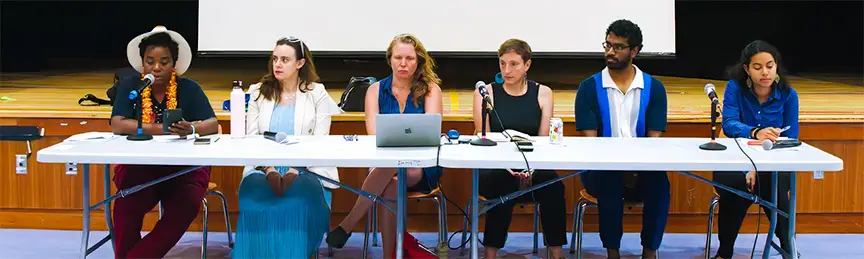
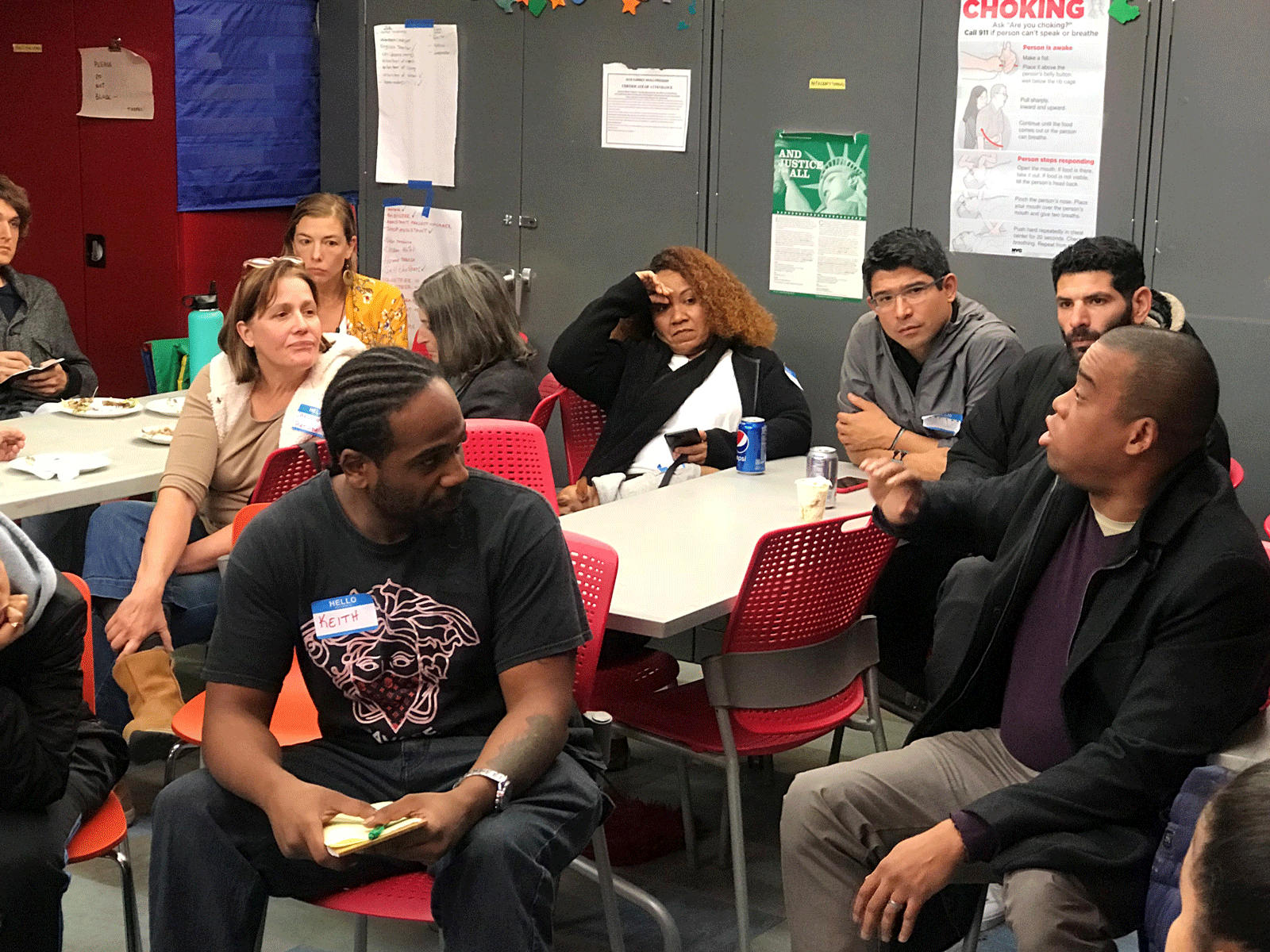
On the afternoon of November 17, leaders of local organizations, activists, and politicians gathered at the Red Hook Public Library with the goal of creating – or beginning to create – a “community-based plan” for the neighborhood. Drawing a crowd of about 25, the meeting was dubbed the Red Hook Community Leaders Summit.
“If we, as a community, are not planning for our future, then those that are not part of this community are going to plan that future for us,” declared longtime resident Wally Bazemore, who organized the meeting along with Nahisha McCoy, Tevina Willis, and Amy Dench of the Red Hook Houses.
Alyce Erdekian, who runs the Red Hook Diabetes Support and Education Program at the library, joined during the planning stages. For resources and support, the group connected with the Mayor’s Action Plan for Neighborhood Safety – a “21st century crime reduction approach” by the Mayor’s Office of Criminal Justice that has focused on lighting improvements, security enhancements, and community programming in 15 crime-plagued NYCHA developments – and, specifically, its NeighborhoodStat initiative (under coordinator Kellen Khelefu), which aims to “bring residents and agencies together” in order to “develop solutions based on combined expertise.” Erdekian ended up emceeing the event.
Bazemore began by summing up the triumphs of Red Hook’s past, including the reduction of the number of waste transfer stations from 22 to one, the construction of affordable housing, and the opening of PAVE Academy. “This community has been fighting for years,” he said. “Sometimes, unfortunately, we’ve been fighting each other, and we’re not each other’s enemies. We know who those persons are. We’re here to galvanize this community and plan a future for some of these kids that are here.”
After Erdekian and Bazemore’s introduction, representatives from PortSide New York, the Red Hook Community Justice Center, the New York City Council, the River of God Christian Church, Cora Dance, the J.A. Foundation, Falconworks, Realty Collective, the Red Hook Public Library, and the Red Hook Art Project stood up to discuss their current involvement in the community and their goals for the future.
While urging support for a new, permanent building for PortSide, founder Carolina Salguero lamented the divide between “industrial Red Hook” and “non-industrial Red Hook” and, especially, the divide between “NYCHA Red Hook” and “non-NYCHA Red Hook.” Warning of “enormous outside threats coming here to develop,” she opined that “the talent here needs to be more coordinated, so we can help our own internal needs and also deal with external threats.”
[pullquote]Though technically open to all comers, the Red Hook Community Leaders Summit had not been widely promoted – the goal had been to “define the future of Red Hook” by “connecting community experts,” as Erdekian had put it. Invitations had gone out to select parties.[/pullquote]
On the other hand, speaking on behalf of the office of congresswoman Nydia Velazquez, Melissa Del Valle Ortiz advised against reflexive hostility toward exogenous forces. “I don’t think anybody ever looks at a community and says, ‘How can we destroy this?’” she observed.
Later, Erdekian introduced Bill Knight, a former Occupy Sandy volunteer and community development expert who’s spent most of his career working in Africa, bringing principles of local participation and partnership to foreign aid projects. In the Niger Delta, a region devastated by petroleum extraction, he helped create the Akassa Development Foundation, which seeks to improve conditions sustainably, based on the recommendations of the Akassa tribe.
“We managed, working with people in this isolated area, to create a model by going into the community and listening to them and talking to them about what they had and didn’t have and then building up from the bottom a sort of model that worked for them,” he described. The model “spread out to several more communities,” gaining “the attention of various secondary stakeholders, like the oil companies, like the World Bank, like the big international NGOs, et cetera. And they began to come in and participate in this, so we’re bringing people together. It didn’t work perfectly, but it did work, and in Nigeria, anything that works is a bit of a miracle.”
Although he made no explicit comparison between Red Hook and the Akassa Kingdom, he stated, “I consider you guys a development organization, or perhaps soon to be a development organization.”
Some debate ensued as to which companies operating in Red Hook had fulfilled or neglected their communal responsibilities, with Tesla and the New York City Economic Corporation (EDC) earning particularly low marks. Tesla, which Bazemore believes should be offering internships to local youth, ignored an invitation to the Summit. EDC leases land from the Port Authority for the Brooklyn Cruise Terminal, which, to the consternation of many, has never posted information about Red Hook retail or otherwise promoted the neighborhood.
Although the Summit was premised on the idea that the Red Hook Houses and Van Brunt Street could organize around a coherent community identity and mutually held interests, disagreements were frequent, and Red Hook local (and former MAP representative) Damien Scott perceived that, before the group could make plans, it had to sort out what, exactly, it stood for. “Oftentimes, when you’re trying to do this kind of work, instead of trying to create structure, you start with purpose. The purpose will turn into the structure that your organization will take,” he explained. “Start with the values before you start to talk about the details.”
Erdekian agreed: “That’s a big gap – the values discussion – and I think it’s an oversight that we didn’t take time to do that, and I’m happy to take responsibility for that.” The much-needed conversation would take place at a later date, but for now the afternoon was winding down. “If we leave here today after four hours without anything actionable, it’s going to be very frustrating,” she warned.
In order to “get the ball rolling,” Erdekian hoped to establish committees to take on some of the essential challenges of the neighborhood. The crowd supplied an initial slate of suggestions: there could be a land use committee, an education committee, a health committee, a business oversight committee, a social services committee, a public housing committee, a police relations committee, an infrastructure committee, an environmental committee, a waterfront committee, a committee for seniors and the disabled, a committee for veterans, and more.
Salguero, however, cautioned that, for now, subjects like land use and education might best be identified as relevant themes rather than as the basis for preformed committees in advance of the group’s first truly public meeting. Though technically open to all comers, the Red Hook Community Leaders Summit had not been widely promoted – the goal had been to “define the future of Red Hook” by “connecting community experts,” as Erdekian had put it. Invitations had gone out to select parties.If the architecture of the emergent group were defined before incorporating broader public input, this “top-down” approach would generate “blowback,” Salguero predicted.
In the end, no formal committees were established, and the group determined that its focus, heading into its second, larger, more inclusive meeting – tentatively planned for January– would be on outreach and recruitment. It would also need to find a larger space.
Author

Discover more from Red Hook Star-Revue
Subscribe to get the latest posts sent to your email.