News from the neighborhood.
Red Hook & Gowanus
Subscribe to get the Star-Revue’s newsletters throughout the month.
No spam · Unsubscribe anytime · Privacy policy
Modern-day Gowanus sits on polluted land. For over a century, waste material from gas manufacturing and other industrial operations was dumped all over the watershed, where much of it remains today.
Settled deep in the ground in solid or liquid form, the toxicants are less likely to pose a threat to humans, but when they vaporize into the air or migrate through soil—as many of them easily do—the vapor can enter homes and other structures and lead to both acute and chronic health effects.
Modern-day Gowanus is also in transition. In 2021, the Gowanus Neighborhood Plan was adopted by the New York City Council with the approval of local councilmember Brad Lander and Community Board 6, opening the floodgates for an already burgeoning gold rush to an area viewed by real estate developers and some local elected officials as teeming with untapped potential.
Since then, building after building has come under construction along the banks of the Gowanus Canal; once completed, some 18,000-20,000 new residents are expected to have moved into “Little Venice.”
They will become neighbors with the many Brooklynites who have called Gowanus home for decades, living often without the knowledge of the carcinogenic chemicals in the soil below them.
There are no data on the extent to which the pollution has impacted the health of Gowanus’ residents: no serious attempts have been made to map out prevalence of cancer or other diseases linked to the area’s contamination. Complicating matters is the fact that many cancer types and chronic illnesses are so-called multifactorial disorders, meaning they can be caused by many contributing factors and are thus difficult to trace directly to any one source or specific chemical.
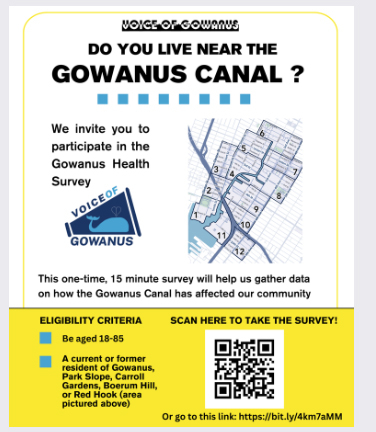
Now, however, local advocacy group Voice of Gowanus has launched a health survey in Greater Gowanus, assisted by a team of researchers led by NYU toxicologist Dr. Judith Zelikoff. The goals of the survey are twofold: gather information about past and current health issues, living conditions, and behaviors in the neighborhood, and spread awareness about some of the lesser-known risks associated with Gowanus’ polluted history.
“Whenever people speak, especially if they’re an environmental justice community, they’re often not listened to,” said Dr. Zelikoff, who is a professor of toxicology and environmental health in the Division for Environmental Medicine at the NYU Grossman School of Medicine. “There are strengths in numbers. We hope to generate a voice, which is heard, which is accountable, which is compelling, and which is based on science.”
A survey is not enough to prove causation—Dr. Zelikoff is quick to stress this—but it can indicate the prevalence of different diseases in the study area, data which can then be compared to national averages and mapped against known sources of contamination.
The results of the survey could also spur further toxicological studies, which could potentially provide stronger evidence for a connection between Gowanus’ legacy pollution and the health concerns of its residents.
As of May 3, 200 people in the Greater Gowanus area have completed the survey. The goal, according to Voice of Gowanus, is at least 500 responses.
This is the first study of its kind in Gowanus. Since the New York State Department of Environmental Conservation began its soil vapor intrusion study a few years ago, the state has received growing criticism for not studying the health impacts of the vapor. Dr. Zelikoff said that while many newcomers know about the pollution in the canal, fewer are aware that the chemicals in the soil can mobilize and seep into the lower floors of their homes.
“It’s up to the people moving in to really check out what’s there,” Dr. Zelikoff said. This is especially important, she added, for vulnerable groups like children, the elderly, people who are pregnant, or those with pulmonary, cardiac, or autoimmune diseases.
But longtime residents should also be aware of the effects of the chemical vapors. They are likely to have higher body burden—the total amount of toxic chemicals present in the body at a given time—and could, thus, be at a higher risk of diseases associated with the chemicals present in Gowanus’ soil.
“The people who’ve lived there for many years—their chance of having long-term exposure is certainly there. People moving in—they have the potential of being exposed. I can’t really say that it’s less dangerous because there are so many variables,” Zelikoff said.
However, the presence of a toxicant does not necessarily mean exposure. “ If I lived somewhere and I just became aware of it, the first thing I would do is see whether I was exposed personally, and go from there,” she said. There are a number of factors that contribute to or lower risk of exposure, including proximity to the contamination, how and where the contamination is moving underground, and if the specific chemicals are easily excreted from the body. Dose, frequency, and exposure pathway also have an impact on the effects of the exposure.
“I would not put fear into people. I would say that right now, there’s no real reason that we’ve identified to pick up and move away or have great fear. Just be aware and act on it,” Dr. Zelikoff said.
The survey can be found via voiceofgowanus.org/healthsurvey, and can be completed in both English and Spanish.
Discover more from Red Hook Star-Revue
Subscribe to get the latest posts sent to your email.