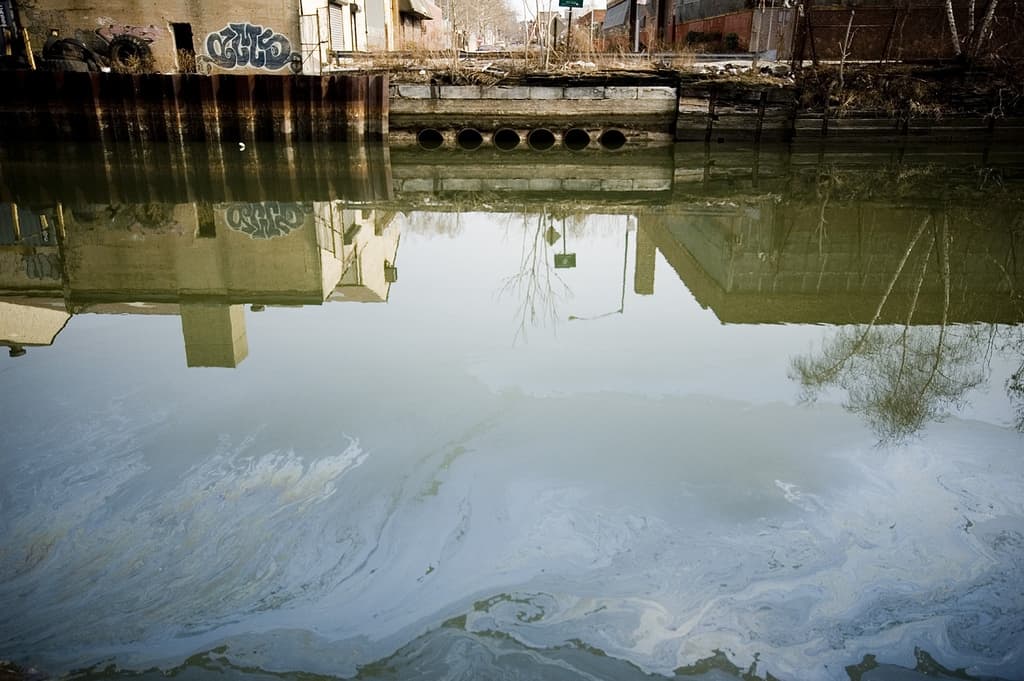
Across Gowanus, dozens of projects are currently ongoing under New York State’s Brownfield Cleanup Program (BCP). Some, like the cleanups of parts of the former Citizens manufactured gas plant, are frequently the subject of conversation and criticism in the neighborhood, while others trudge along, largely anonymously. To counter that, here is an update on the remediation efforts at three of Gowanus’s brownfield sites.
:Former Thomas W. Woods & Sons Coal Yard (252 Third St.)
One of Gowanus’s newest brownfield sites is the former Thomas W. Woods & Sons Coal Yard on 252 Third St., a 26,000 square-feet site that the owner wants to turn into a multi-story residential building with both mixed affordable housing and market-rate units.
At the end of December 2025, engineering firm Langan conducted an environmental site investigation on behalf of the site owners to gain a sense of the underground contamination. The investigation found volatile organic compounds—chemicals that evaporate into gas easily—and semi-volatile organic compounds—chemicals that tend to remain as liquids—in both the soil and groundwater, along with heavy metals and polychlorinated biphenyls, a group of cancer-causing toxicants.
Langan, in its remedial investigation work plan draft prepared as part of the BCP application, also notes that an area of concern is the proximity to the Gowanus Canal—specifically the Fifth Street turning basin which adjoined the site until infilling occurred in the 1950s. Given the proximity of the site to the Gowanus Canal, the report states, it is possible that coal tar and other harmful chemicals can migrate to the 252 Third St. site from the infilled turning basin.
Notably, the site owner applied to the brownfield program as a participant, rather than a volunteer, which means it is also responsible for contamination that has migrated off the site.
The application was submitted to the New York State Department of Environmental Conservation (DEC) in June 2026, and no signed cleanup agreement is publicly available.
294 Fourth Ave.
This is another site whose application was filed in June of this year.
Several toxicants have been found at the site, including semi-volatile organic compounds and polycyclic aromatic hydrocarbons, a class of carcinogenic compounds that are formed when things like oil, coal, and gas burn with insufficient oxygen. (They are common in car and industry emissions, among other things.)
Arsenic, copper, lead, mercury, cadmium, nickel, silver, and zinc have also been found in the soil, with the lead concentration reaching 12,200 milligrams per kilo—significantly more than the 15-40 mg/kg normally found in uncontaminated soil.
Trichloroethene (TCE) and tetrachloroethene (PCE) were also found in the form of soil vapors.
Historical maps show that between approximately 1951 and 1965, four gasoline tanks were stored underground at the site, along Fourth Avenue; no records have been found that indicate whether they were removed or abandoned.
141 Third St.
This site, located just west of the Third Street bridge, has been in the BCP for some time, but is on this list because the cleanup is nearing completion. Some excavation took place in August, and in September, the project was 80% complete, according to a report submitted to the DEC.
In 2024, permits were filed with the city for a 22-story tower, which would have about 300 apartments and some commercial space.
This article originally appeared in Undercurrents, the Star-Revue email newsletter. To subscribe for this free service, go here https://bit.ly/3Untdud:
Discover more from Red Hook Star-Revue
Subscribe to get the latest posts sent to your email.