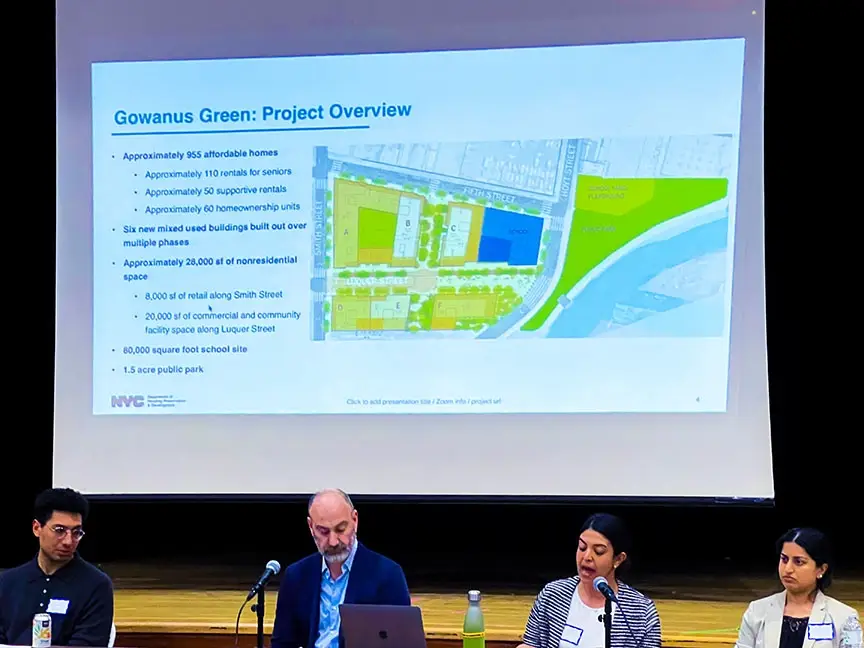
In July, the New York State Department of Environmental Conservation (DEC) announced that there is a proposal on the table for how to clean up a chunk of Public Place, the infamous Gowanus site that used to house a manufactured gas plant. The site, under which there is a coal tar plume reaching about 150 feet deep, has been divided by DEC into four parcels; the one currently in question is the southernmost parcel, titled parcel 3.
According to the DEC, an investigation into the site revealed contamination that poses a significant threat to public health or the environment. Further, in its statement the agency wrote that there is potential for “off-site migration of contaminants in the groundwater, surface waters and soil vapor.”
But the remediation proposal have been met by criticism, primarily from the community environmental group Voice of Gowanus, for not adequately addressing the site’s contamination.
The proposed remediation includes removal of some soil, in-situ solidification or stabilization of underground coal tar, and sub-slab depressurization systems below where future buildings will be located.
Three alternatives
In the work plan submitted to DEC, three potential remediation alternatives were discussed. One of the alternatives included site-wide excavation to about 15 feet below ground surface and excavation or treatment of contamination below 15 feet. However, the remedial plan chosen only includes excavation to between two and six feet to accommodate a site-wide composite cover system. The cover system will consist of pavement, sidewalks, building foundations, and other types of hard surfaces, as well as, in some places, clean soil.
To what extent in-situ stabilization (ISS)—freezing contaminants in place, often using cement—will be used is subject to further investigation, per the report. There are several challenges that come with ISS at this site, as it cannot be performed too close to the bulkhead that follows separates Public Place from the Gowanus Canal, or in proximity to the Bond-Lorraine Street sewer. Langan also cautions against extensive use of ISS as it is carbon-intensive and expensive.
But some community members, most vocally Voice of Gowanus, have contended that the remedial measures aren’t enough to protect future residents of the site, don’t adequately address how the coal tar from the site has migrated off-site, and that the site really should be in the State Superfund Program, rather than the voluntary Brownfield Cleanup Program.
“The state’s proposed cleanup for this site at Smith and Huntington along the Gowanus Canal should be withdrawn. The state has misled us with repeated mischaracterizations,” said Martin Bisi of Voice of Gowanus in an August 18 press release. “Track 4 Brownfields, which the state proposes here, do not have the same stringent requirements as State Superfund cleanups, which is what we are demanding. Community health requires this high level of care. And in a site with multiple parcels over the same toxic plume, we deserve a comprehensive cleanup plan under state superfund, not a piecemeal approach under brownfields just because developers want that.”
One of the developers of Public Place is the non-profit Fifth Avenue Committee.
EDC officials have maintained that a brownfield cleanup and superfund remediation are the same, but important distinctions exist. Perhaps most critical is that the brownfield program is a voluntary program designed to incentivize developers to clean up and build on contaminated, unused land; in the superfund program, DEC has significantly more power to enforce its requirements. Those requirements are also generally more stringent for a superfund site than a brownfield site.
Should have been a Superfund Site
Whether Public Place should have been in the State Superfund Program has been debated for decades. Last fall, when the Gowanus Canal Community Advisory Group’s land use committee convened for a meeting, EPA Council Brian Carr stated on the record that it should have been a superfund site, and that the brownfield designation was the fruit of “mere political will by the City of New York, which was trying to avoid liability in the 80s or 90s, together with national Grid.” (National Grid is the primary party responsible for paying for the cleanup of Public Place and the Gowanus Canal.)
The cleanup of Parcel 3, because the brownfield program only addresses contamination on the site, also doesn’t address the significant off-site migration of contaminated sludge. According to a 2005 report from consulting firm GEI, there is evidence that coal tar has traveled under from Public Place, under the canal into soil on the other side, a problem that neither the city, state, or federal government want to touch with a ten-foot pole.
Langan, the environmental engineering consultant that produced the work plan for Parcel 3, noted that “residual contaminants may remain on-site” but that the cover system will eliminate exposure to remaining potentially contaminated soil.”
Further, Langan stated that there are “no known complete exposure pathway exists for the migration of site contaminants to off-site human receptors for current, remediation-phase, or future conditions.”
For now, the State and National Grid are satisfied with the remediation plan in place. And as reported by the Red Hook Star-Revue in July, remediation can be done in many ways, and significant excavation is not necessarily the best option. It’s expensive and emissions-intensive, and there are remedies that adequately protect human health and the environment.
On July 29, DEC held a meeting as part of the public comment period on the proposed remediation. Jack Riccobono with Voice of Gowanus said that many community members showed up to voice their concerns, even though the meeting was held in the middle of the summer, and dozens of comments were submitted to EDC.
“It was good to see that many people came to send in comments and to push back on this plan,” he said.
It remains to be seen though whether the state agency listens to the community, Riccobono added.
And what happens at this site could reverberate beyond Brooklyn and even New York City.
“We’re very concerned that DEC is using this to try to set a dangerous precedent by using the brownfield program for sites that are completely ineligible for that designation. And if they’re able to succeed here in Gowanus, this could be a template that they use at the most deeply toxic sites all throughout the state,” Riccobono said. “So it’s really something that New Yorkers all across the state should be concerned about.”
Discover more from Red Hook Star-Revue
Subscribe to get the latest posts sent to your email.