The first half year of these columns has been about how jazz fits into and reflects contemporary American society, because the music is fundamentally and immediately about this country and expresses the ideas and means for how we could be. It is music that, collectively, expresses a set of value about America. And oh yeah, it’s just fantastic for the mind, body, and soul.
Jazz is political, just like everything else in life that isn’t cloistered (material or immaterial) research. And modern jazz has had a specific political strain for over sixty years in the form of free music. As Arts for Art’s annual Vision Festival makes explicit, free jazz is music of Black liberation, and Black liberation should matter to anyone who values freedom, because unless every American is free, America is simply not a free country. But even though time is a flat circle, things can change, and Vision this year (June 2-7 at Roulette) presented itself as an immovable object that was mostly brushed aside by the seemingly unstoppable force of contemporary social and political atavism.
Free jazz has always been a vehicle for liberation, at least in part, and often music that has been an expression of political thinking and an assertion of the value of the existence of the musicians, their own existential voices representing the peoples they come from. Again, with the pleasures of the music come important and beneficial social values. But who gets to hear and feel this? Free jazz developed during a decade, the 1960s, when jazz was overtaken by rock and soul and shunted from its status as a popular music to the niche cultural item it currently is. Free jazz, never a complete hit with dedicated jazz listeners, is a crevice within that.
Who heard those voices in the ‘60s, like John Coltrane and Albert Ayler? Who is left from that era? The music is, and even though it’s based around free improvisation, it’s just as much in danger of falling into repeated patterns of gestures and clichés as any other kind of music, in fact more so because when musicians are improvising and trying to find spontaneous form and don’t create that, there’s nothing left but gestures.
These can be crowd-pleasing, recognizable ideas that pander to listeners’ expectations. But that’s not a good thing, and that was the shocking disappointment with the opening night celebration of Roscoe Mitchell. He’s been one of the most important figures in free and avant-garde jazz and contemporary music for over a half century. He played short sets leading two different ensembles—one with pianist Dave Burrell, bassist William Parker, and drummer Hamid Drake, the other with vocalist Thomas Buckner, flutist Robert Dick, and multi-instrumentalist Scott Robinson—and the combined forces of the early music group Ruckus and alto saxophonist Immanuel Wilkins’ Quartet played a new composition from Mitchell. Everything seemed perfunctory, rote, phoned-in, the improvisations never amounting to more than a grab bag of exhausted tropes, the ensemble composition a regression to the early, awkward era of Third Stream jazz/modernist classical shotgun weddings.
For the first time, one felt like events were leaving the Vision Festival behind, and that free music was clinging to an irrelevant past. The following two nights, the spirit was there, and the vibes were positive, but too much of the music belonged firmly to an era that no longer exists. Charles Burnham’s violin playing and singing was a humanistic core in the middle of Gabby Fluke-Mogul’s misconception around a James Baldwin statement, while Amirtha Kidambi’s Elder Ones set—muscular but monochromatic music inside condescending lectures about politics—nailed how unrepresentative free music has become.
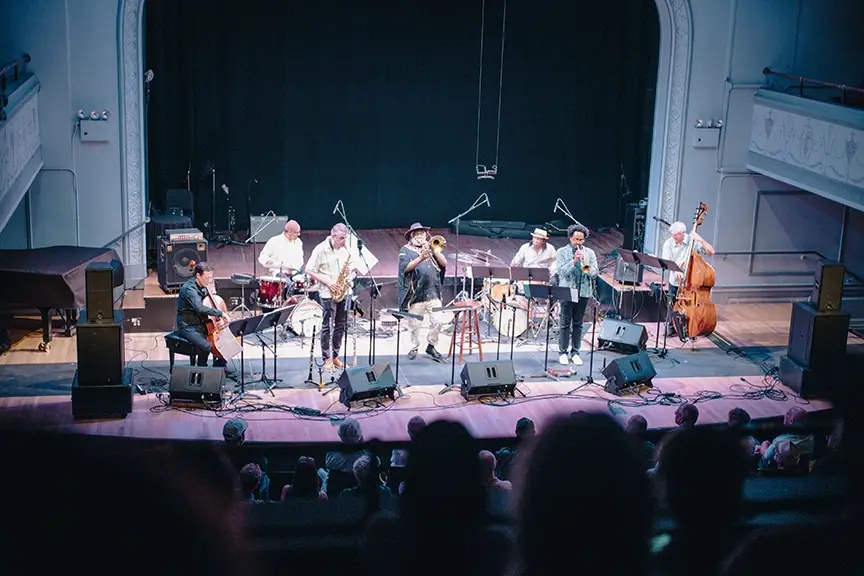
This was music that tried to recreate how things were done in the past, but if you try and stay the same while times change, you make yourself a reactionary. Glimmers of contemporary life and positive possibilities came through in guitarist Ava Mendoza’s trio with bassist Henry Fraser and drummer Chad Taylor. Mendoza is a terrific player who represent what free music can be—she came to jazz not in the traditional way but from improvising in punk rock. Her thinking is different, there’s plenty of power and elegance, even delicacy. She’s not trying to repeat and preserve the language of the past but figure out a language of the present and future. Her set also had excellent playing from Fraser and Taylor, who’s one of the best and most versatile drummers around.
There was a fascinating collision between past and possible future in the set from Radical Reversal, the young keyboardist Devin Brahja Waldman’s jazz and poetry group. Featured poet Randall Horton was dealing with a death in the family, and since this is New York City, filling in for him was Anne Waldman, one of America’s greatest modern poets and aunt to Devin. Waldman was spectacular, not just with her words, which included stretches of her large-scale Extinction Aria, but her performance. She read, chanted, sang, with an energy that had the scintillating fearsomeness of violence in the service of joy. She was unlimited by received notions in a way that free music is supposed to be, far more cutting edge than her nephew’s music, which was capable but unsurprising. Although the older generation has put us in this position, some of them, like Waldman, can show is the way out.
Another member of that generation who keeps showing us a way forward is Henry Threadgill.
Around the solstice, Roulette held a two night tribute to his legacy, with bands playing Threadgill’s repertory from four key stages of his career. Friday was the Air Legacy Trio and the Very Very Circus legacy band, Saturday it was Make A Move legacy and the Sextett legacy ensembles (the video recordings of both concerts are at https://www.youtube.com/@RouletteIntermediumNYC)
The Air trio—wind player Marty Ehrlich, bassist Hilliard Greene, drummer Pheeroan akLaff—was a slight outlier. They aren’t a legacy group in the sense that they had played in Threadgill’s ensemble in the past, but a new group playing the composer’s music. This was a beautiful set, the musicians going deeper and deeper into thought and communication, even akLaff’s roiling, tectonic drum solo was about going in and down, not out, about meaning not display.
It was exciting to hear the two electric bands, the music covering about fifteen years of Threadgill moving, Miles Davis like, through constantly evolving about ideas of form, structure, and even instrumentation. Alto player Noah Becker was impressive in Threadgill’s place, while guitarists Brandon Ross played with his usual aplomb and Miles Okazaki his usual fire. Ross also led the Make a Move band the next night, with a soulful Darius Jones on alto. This is Threadgill’s most enigmatic music, but also pretty much modern rock, making it totally compelling and open-ended.
Led by an often exasperated Frank Lacy on trombone, the Sextett band was a chance to relish how fine a composer Threadgill is. His harmonic forms and his chord voicings have a sound rich with musical expression and emotional depths, and he’s a master at the difficult and vastly undervalued craft of making melodies—his lines are gorgeous. There’s so much humanity and wit in his music, a sonic record of not only the roots of jazz in early and pre-jazz like Jelly Roll Morton, Scott Joplin, the hymns of the sanctified church, and Afro-Cuban clave, but the story of our society told through Black American culture. And so much room (even in tiny durations), for the musicians to blow, to say something. This was a tremendous set to finish off the jazz event of the year.
Threadgill is clear in his 2023 memoir, Easily Slip Into Another World: A Life in Music, that he values fundamental musical skills like being able to play idiomatically in whatever style you’re in, and also form. Being a top musician means being able to work in a cooperative way with other musicians and composers. He points out that freedom is best used as a tool to craft form, and that form makes the heights of imagination possible, the essential foundation. It’s not the gestures that make freedom, it’s making the right forms, in which we can be free, and safe, and free.
Author
Discover more from Red Hook Star-Revue
Subscribe to get the latest posts sent to your email.
One Comment
I’ve appreciated George Grella’s writing on music on numerous occasions. However, reading this piece, specifically his take on this year’s Vision Festival, I was compelled to account for a very different hearing of what took place at Roulette in early June this year. And provide a corrective, even, given the exceptionally dismissive nature of Grella’s assessment.
I can’t speak to the opening night celebration of Roscoe Mitchell, as I was not in attendance to that music. On the pair of sets during the second night which are mentioned in thoroughly tossed-off manner above, I certainly was, and consider the entire evening’s events I heard to be a highlight of the week. That it was a night comprised entirely of ensembles led by women, and spanning generations, was wonderful, and most welcome, too.
The ensemble presented by violinist gabby fluke-mogul (all lower-case being the artist’s preference) was a deeply representative assembly of gender, races, backgrounds, and generations, all whom embraced and elucidated the power & possibilities within the music. Their names: gabby fluke-mogul; Charles Burnham; Ava Mendoza; Luke Stewart; Tcheser Holmes. This quintet performed a great and compelling set; improvisation being an intrinsic part; scintillating forms indeed created which could have only come from this gathering of distinct voices. All gathered, as with the entire festival, in potent sonic resistance to the notion that the inhumane horrors presently running rampant in this country will prevail.
And How, pray tell please explain, did fluke-mogul possibly misconceive (as was stated in Grella’s half-sentence review of this set) the James Baldwin quote that gave this presentation its title and ethos? Here is that Baldwin quote, as published in the festival program guide: “The children are always ours, every single one of them, all over the globe; and I am beginning to suspect that whoever is incapable of recognizing this may be incapable of morality.”
Next up was Amirtha Kidambi’ Elder Ones – a set which received the second half-sentence of thorough dismissal above. The group: Amirtha Kidambi; Alfredo Colón; Lester St Louis; Matt Nelson; Jason Nazary. An elemental part of the performance was Ms. Kidambi’s lucidly spoken re-iteration of extreme injustices being meted upon vast populations in both this country, and abroad with our country’s thoroughly complicit support. What exactly is condescending about cogently and lucidly stating these facts to all within earshot, and as often as a platform is afforded? George – is it because you’ve heard about it already?? As for the music – muscular and intense yes it was, and dynamically far-ranging as well, by both the full ensemble & within spotlighted solo voices, displaying pain, sadness, anger, hope and love in a community communion.
All I’ve written above could be readily and plentifully heard. It is unfortunate, at best, that Mr. Grella wasn’t able to that night.
After he had left (I guess?) Ellen Christi’s Flux in Chaos quintet “delved into compassionate improvisation prompting the ideals resist; respect; remain true to your spirit”, and it was a success on all counts. And then Nicole Mitchell’s Black Earth Ensemble presented “Portraits of Sonic Freedom” which I heard later was another illuminated set (alas I had to leave prior to it in order to get requisite sleep for the next day & its responsibilities).
A few additional highlights of numerous I was able to witness during the 5-night week of this year’s Vision Festival: DoYeon Kim’s quartet + video: an incredibly powerful and moving set which addressed the pro-democracy Gwangju Uprising and subsequent massacre which took place May 1980 in South Korea; Fay Victor’s joyous & potent visitation forward back to her (& her trio’s) Trinidadian roots; Ivo Perelman & Matthew Shipp String Trio perpetually creating ever-compelling new form throughout their set of spontaneous composition..
My only complaint this year is that some of the later sets were rather shy of starting punctually, so I had to miss a number that I had really wanted to see/hear. I’m sorry Mr. Grella, that you apparently missed those and all noted above as well.
For all reading this, here is a link to what happened at Vision Festival 2025, having been the 28th (or 29th?) annual iteration thereof: https://www.artsforart.org/vision/