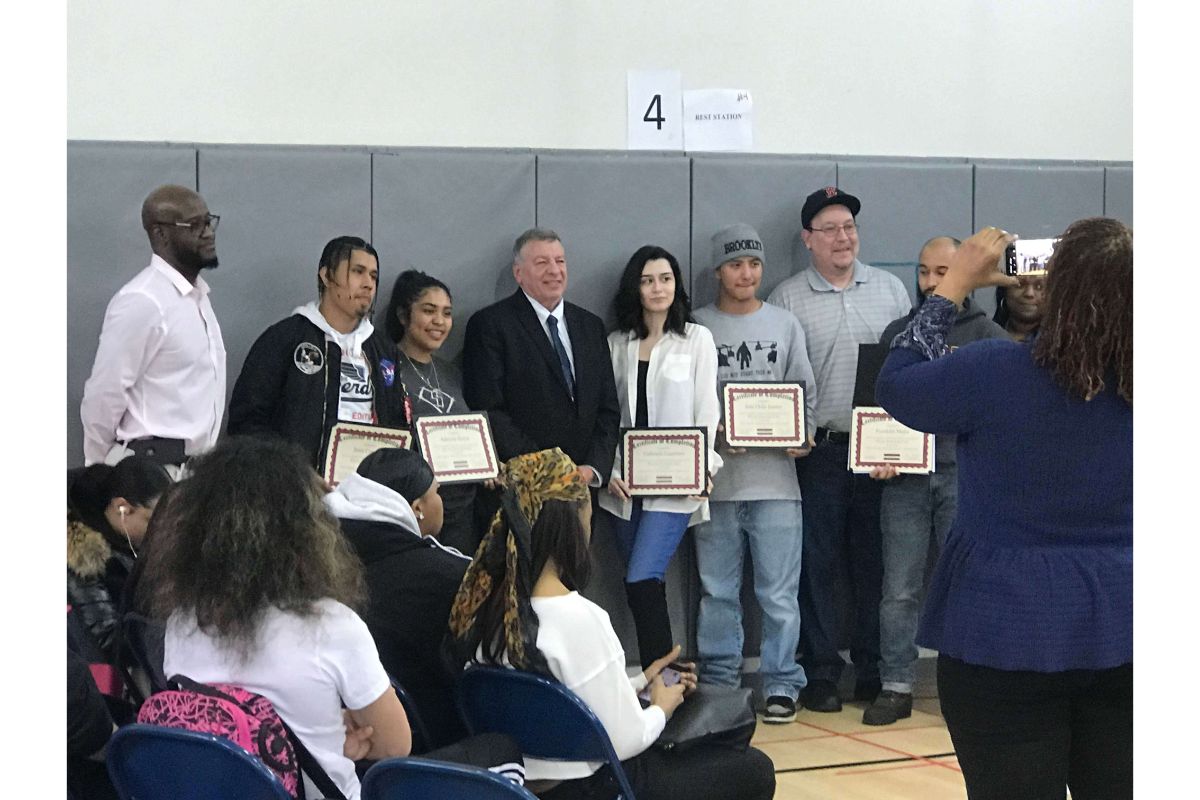
South Brooklyn Community High School, at 173 Conover Street, is a transfer high school that offers drop-outs a second chance. South Brooklyn is a partnership between the NYC Department of Education and Good Shepherd Services, which is a youth development, education, and family service agency.
The students who enter the school are overage and under credited, which leads to everyone needing different classes and having different schedules.
South Brooklyn is technically having a hybrid schedule but due to the varying schedules of the students and the credits that they come in with, all of the students are remote. Emily Schlesinger, a history teacher, said they wanted the approach taken to not be disruptive.
“We wanted to make sure that whatever we did was sustainable for the whole year whether we went remote at any point or not, which is good because when school was delayed two weeks we were already up and running in a remote capacity,” Schlesinger said.
The school itself is open and students are still welcome.
“The building is a place to get extra help in any of the subjects,” Schlesinger said. “Also, to get help with technology, to have a quiet place to work and get fed. A lot of them do not have a quiet environment at home.”
All of the students at South Brooklyn were given laptops at the beginning of the year and have the option of coming into the building two days a week.
They were given their remote schedule of zoom classes and if they are in the building or not they can access the course work remotely. They are given flexibility so it can fit their schedule.
South Brooklyn is using a house model, which means that every teacher is the leader of 12 students and makes sure that those 12 students are accessing the course work an viewing the “live” zoom classes when they are supposed to.
“We are trying to use a process based approach right now where we are doing projects which are bigger but less little work for the students who are working full time while they are trying to go to school remotely,” Schlesinger said. “We are trying to make it work synchronously and asynchronously.”
Technology can be an issue, which makes the “house system” even more helpful. Having the model where every teacher is responsible for 12 students is how they try to address technological issues as they come up.
In the beginning of Schlesinger’s day, she might have to show the kids how to log in, access different areas of ILEARN or help them reset their password.
Teachers are in the building twice a week. When they are teaching their classes live, the students will be in different rooms accessing it or could be at home or anywhere else.
This school, which enrolls 160 students, is one that is for students who have tried at other schools and it did not work for them for various reasons. SBCHS is on a trimester system, so the students can earn a year and a half of credit in one year at the school.
“Some of them are here because they were getting bullied and just avoided their classes,” Schlesinger said. “Some have struggled with reading and writing and have like no English credits. Some are English geniuses and love humanities but were like “screw math class” and never went. They are all here for different reasons. They have very different transcripts.”
They are all at the school for different reasons and a trying to accumulate credits in this semester that is unlike any other. The school gives them options for attending “live remote classes at times suitable for them.
Schlesinger has 80 students in total who she teaches US history to, but they can go live with her at different times during the day depending on their schedule, which leads her to teach the same lesson multiple times.
“They can zoom into me during period one, period three, period five or period seen, depending on what works for them,” Schlesinger said. “I also record one of those sections and put it up online in case they can not attend any of the sections.”
Author

Discover more from Red Hook Star-Revue
Subscribe to get the latest posts sent to your email.