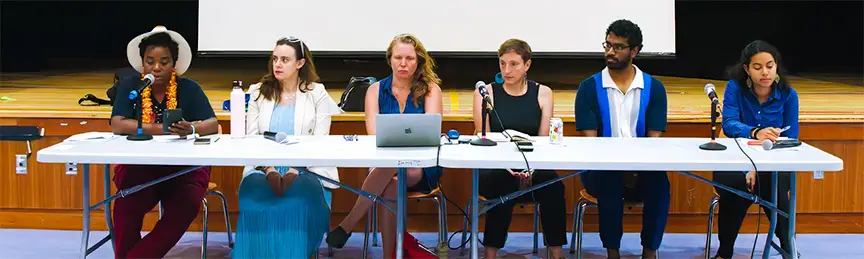
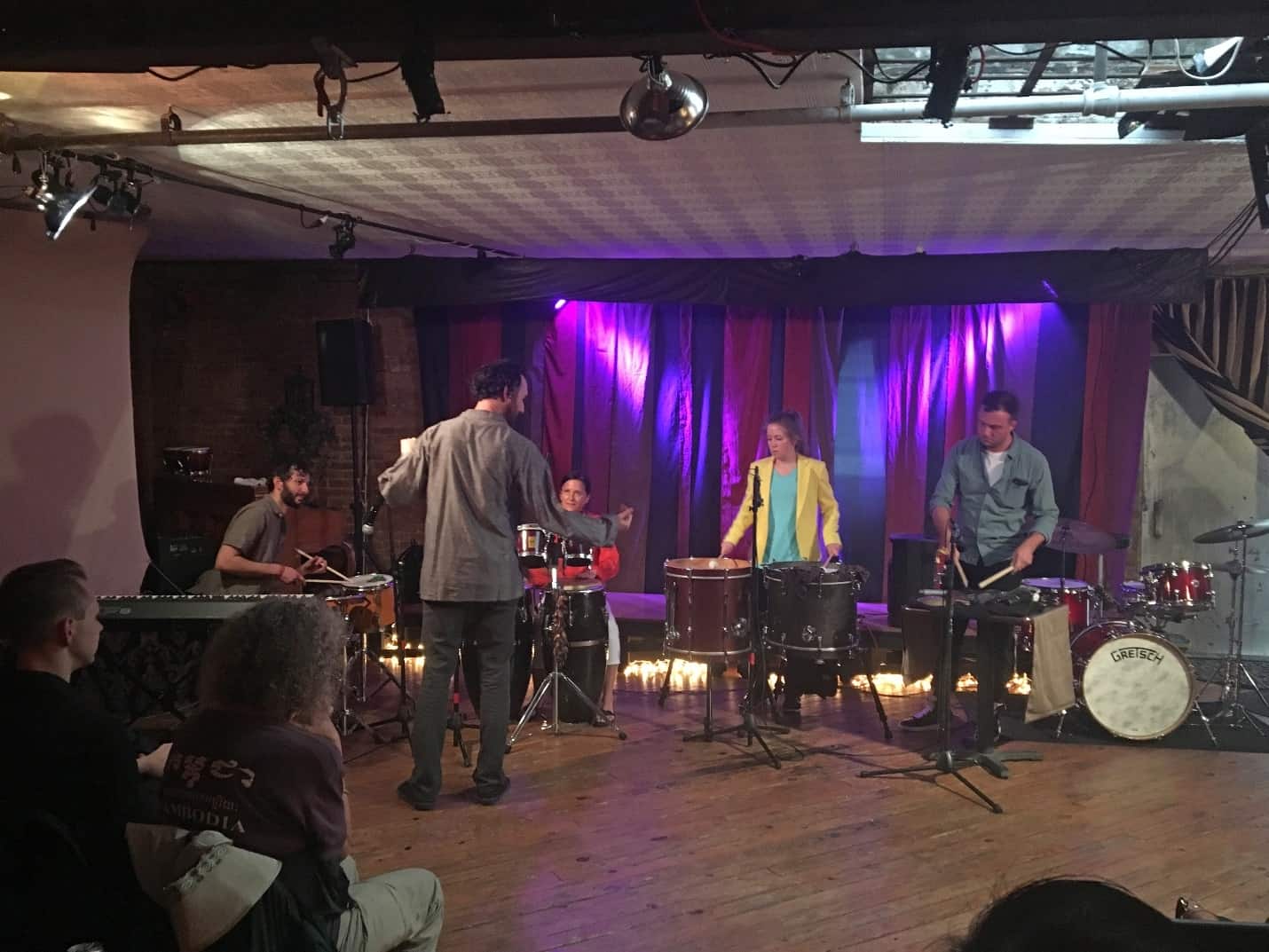
On March 29th and 30th, the Live Composition Festival was held at the Gemini & Scorpio loft in DUMBO. Over two days, 11 groups presented varying sets that presenting different approaches to “live composition” (also known as “sound painting” or “conduction”), which is a method of signs and signals communicated to a group of performers by a conductor in the traditional sense of the word. Styles varied in complexity and sophistication, and the performers included actors, dancers, and painters, alongside the musicians. Though the festival was focused on music, the addition of multi-disciplinary performers gave it a wonderful and open sensibility, often veering off into more theatrical or performance art qualities.
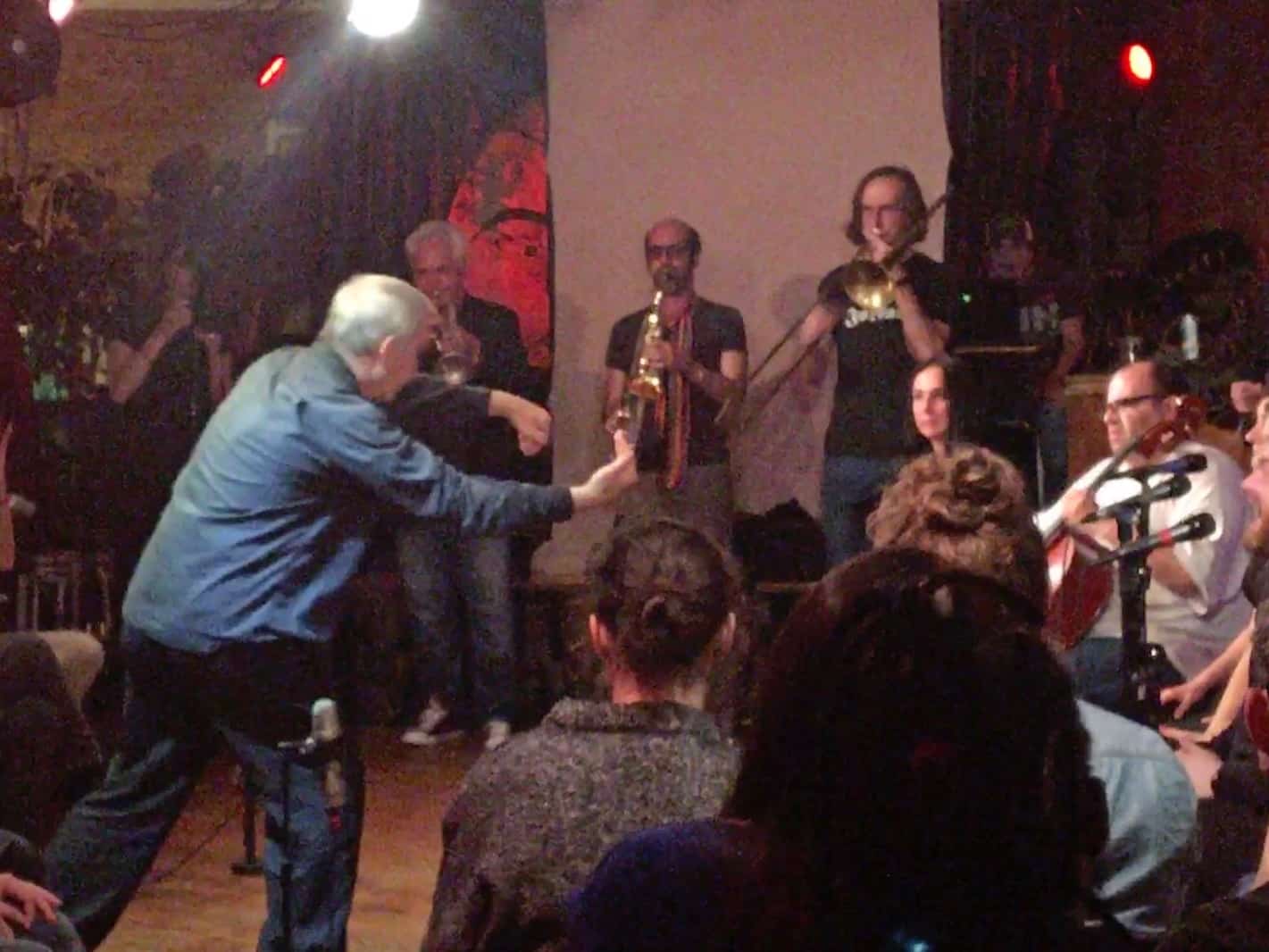
The focus of the festival was based around Walter Thompson and his Sound Painting language. This was a rare performance from Thompson, who now lives in Sweden, but used to be a regular staple in NYC’s downtown music and art world from the 1970s-early 2000s. Sound Painting is a highly complex system that acts as a fully-formed alternative approach to composed performances. The conductor is able to cue nearly anything that you could conceivably notate in a live and improvised setting. Thompson developed it in 1974, in a time and era when alternative approaches to composition were common. While overlapping, in concept, with approaches found in Butch Morris’s “Conduction”, or John Zorn’s Game Pieces, or even the organized conduction of Frank Zappa, Thompson prides himself on the open inclusiveness of Sound Painting.
Originally built for music, it has grown to incorporate dancers, actors, lighting designers, and pretty much every other aspect of performative arts imaginable. He’s sound painted circus performers, as well as construction workers. There is an annual Sound Painting think tank (held in different cities around the world), where sound painters meet to develop and grow the language. Though Thompson created and developed the system, it is now, essentially, open sourced; that is, it’s a language, that grows and changes with practitioners around the world developing and building upon it, to fulfill growing needs and stylistic changes.
The Walter Thompson Orchestra was made up of four horn players, three string players, three percussionists, a dancer, and four actors, and the pieces were quite surprising. Often with a good degree of humor and irreverence, the musicians sometimes waded into the territory of actors or “characters”, while the actors and dancer often created visual textures that seemed to fold back into the music. Other groups that performed following Thompson’s Sound Painting methods were Strike Anywhere Performance Ensemble and Letter of Marquee Theatre Co. Letter of Marquee was fascinating, as it used the sound painting language in a set that felt closer to Improvised Theater (though there were three musicians to accompany the actors as well). Strike Anywhere felt closer to performance art, with the actors and dancers creating surreal and abstract worlds.
Drummer Billy Martin (of Medeski, Martin & Wood fame) conducted a group of about 15 musicians. Strikingly, as opposed to Thompsons elaborate language of 1500 individual signs, Martin had exactly two. Start a pulse; and then, change the pulse. It was concise, and he created a beautiful and meditative textural piece that sounded a bit like an improvised Morton Feldman composition. While eschewing the elaborate and vast possibilities of traditional Sound Painting, Martin’s set demonstrated the opposite of Thompson’s viewpoint, and thus the wide possibilities of improvised composition as a tool.
Brian Adler led Human Time Machine, a group of six percussionists creating dense, drum-based compositions. Adler was influenced to start the group after working with Argentinian drummer Santiago Vazquez and La Bomba de Tiempo. Vazquez has been leading a group of drummers in a weekly performance in Buenos Aires for 15 years, and has developed his own rhythmic language of signing and conduction. Human Time Machine was fun and engaging, and created incredibly well-developed percussion pieces. The percussionists all took turns conducting the group, often switching off round-robin style, mid-groove. This quality kept the pieces moving, with each percussionist conducting in their own personal style.
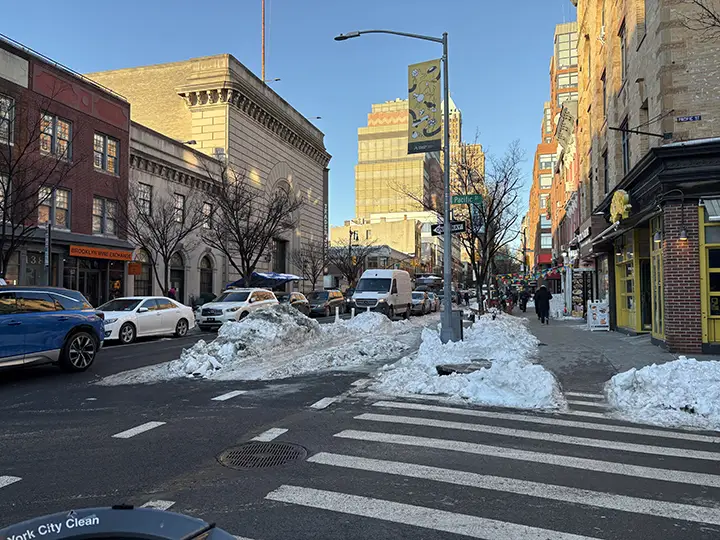
The Gemini and Scorpio loft, on Douglas St & 2nd Ave. in Gowanus, was a small and cozy space for the modest festival, and despite the comfortable atmosphere, the music and performances presented were varied enough and exciting enough that it felt as well curated a festival as New York City ever produces. The forms and tools presented seem like something that has yet to be fully embraced by a wider group of musicians, which added to the excitement. Stay tuned for next year’s festival!
Author

Discover more from Red Hook Star-Revue
Subscribe to get the latest posts sent to your email.