 On January 27, after a week in office, President Donald Trump signed an executive order placing an immediate 90-day travel ban on people entering the United States from the largely Muslim countries of Iran, Iraq, Libya, Somalia, Syria, Sudan, and Yemen.
The order also called for a 120-day ban on all refugee programs and closed the door indefinitely on refugees entering the country from Syria. In addition, the executive order gave priority to those seeking to enter the U.S. on the basis of religious persecution as long as the applicant belongs to a religion that is the minority in their country. By the very next day, airports had become mired in chaos. Protests were rampant nationwide in response to the ban.
Judicial opposition was swift. On January 29, a Massachusetts federal judge issued a temporary restraining order against the ban and U.S. District Court Judge James Robart blocked the ban nationwide on February 3. Then on February 9, a three-judge panel in the Ninth Circuit Court of Appeals ruled against reinstating the travel ban.
Although it remains blocked and the president is promising a new travel ban shortly, the initial executive order prompted a wave of public opinion and protest.
The president has also begun a deportation process of undocumented immigrants that prioritizes those involved in criminal activity but has not limited it to people convicted of crimes. This – along with the president’s plan to build a wall between the U.S. and Mexico – has caused unrest among immigrant communities all over the country.
I spoke to Rabbi Seth Wax of Congregation Mount Sinai in Brooklyn Heights about his reaction to the travel ban as well as the president’s policy towards illegal immigration. “We certainly need to balance the needs of security, but to institute an across-the-board ban in such a way that really hurts people is irresponsible and really causes more destruction and harm than helping people,” he said. “A ban that targets people based on their ethnicity or religion obviously runs contrary to American values and a lot of religious values. America is still a country that welcomes immigrants and it’s our responsibility to make sure that the doors stay open…while maintaining security for those of us who are here.”
Rabbi Wax went on to say that Congregation Mount Sinai sent a sizeable group to the Hebrew Immigrant Aid Society (HIAS) rally held at Castle Clinton in Battery Park on Sunday, February 12. Despite freezing rain, thousands turned up, as well as elected officials including Mayor Bill de Blasio. The mission of the rally organizers was to put pressure on elected officials to keep the doors of our country open to refugees fleeing persecution and violence.
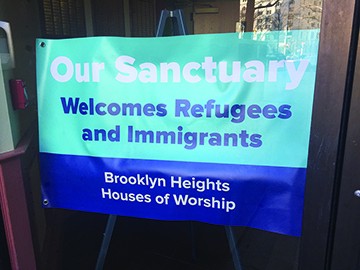
Rabbi Wax also mentioned that many Brooklyn Heights houses of worship have come together and hung banners in an effort to make a strong statement that refugees and immigrants are welcome. On March 8, there will be a program at Congregation Mount Sinai to discuss the rise of anti-Semitism, attacks on the press, and immigration issues.
Monsignor Massie Responds to Current Issues
During a powerful homily on February 25 at Sacred Hearts/St. Stephen Church, Monsignor Guy Massie listed a number of things that “gravely concerned” him. The first is the many “anti-things” currently transpiring in our country, which he feels are reminiscent of Europe in the late 1930s. He also expressed concern about those who choose to remain silent about – or somehow justify – this disturbing trend.
Msgr. Massie began his homily mentioning that he and Rabbi Wax were interviewed together on the NET (New Evangelization Television) network that past week to talk about recent events, including the travel ban, the new administration’s immigration policies, and the rise in hate crimes. Ironically, Msgr. Massie witnessed an incident firsthand while walking near Court and Bergen Streets on the way home from the interview: he heard a young boy utter an anti-Muslim slur at a woman wearing a hijab. He said it was his first experience with that type of behavior, and it left him deeply disturbed.
Msgr. Massie also reported that some churches in Brooklyn and Queens whose parishioners are largely made up of immigrants have seen a sharp decline in attendance due to the fear of being rounded up by ICE (Immigration and Customs Enforcement) officers.
In addition to being pastor of SHSS, Msgr. Massie is the Chairperson of the Ecumenical and Inter-Faith Commission of the Diocese of Brooklyn.
Despite his grave concerns, he made note of the actions of some straphangers who recently came together on a New York subway to wipe off anti-Semitic slurs and swastikas with hand sanitizer; it is the actions of people such as these who give Monsignor Massie hope, in spite of those who choose to “keep their heads in the sand.”
Author

Discover more from Red Hook Star-Revue
Subscribe to get the latest posts sent to your email.