Of all of the mystery items scheduled for extraction from the Gowanus canal at the end October, perhaps the most interesting piece comes in the form of a sunken ship at the fourth street turning basin, beside the Gowanus Whole Foods.
Locals may recognize the boat, which pokes out from the canal’s dark waters when water levels are low, along with the remnants of a floating art piece that became caught in the ship’s wreckage in the summer of 2015. The boat’s history, unknown to the average passerby, is extensive.
The 63-foot vessel, most recently known as the S.S. Gay, is said to have met its watery grave in July of 2009, but dating back to 1943, the boat first set out to sea as a crash boat for the U.S. navy, rescuing the crews of downed military planes during both World War II and the Korean War.
Decommissioned sometime around 1963, the Point O’Woods Association modified the boat for use as a ferry from the south shore of Long Island to Fire Island. In 1976, the ship, now known as Point O’Woods V, played a role in the evacuation of people from the island prior to the arrival of Hurricane Bell.
Then, in 1989, the vessel relocated to Westchester creek in the Bronx for use as a houseboat, named Kokkomokko. In 2003, the boat’s residents abandoned it after ice damaged the ship.
Sold for $1 in 2005 to a group of Brooklyn artists, the boat soon became home to the Empty Vessel Project (EVP), a floating meeting place and performance hall moored in the Gowanus canal, just north of the Carroll Street Bridge.
The project hosted a range of events from 2005 to 2006, ranging from anti-globalization documentary screenings to poetry readings by tour bus guides.
However, due to the number of parties hosted on the boat, which often spilled into neighboring parking lots, disputes with landlords, eventual involvement by the Coast Guard and intervention by city officials, the group was evicted three times in less than a year.
Homeless and in desperate need of finances, the EVP was forced to put the boat up for sale.
Rechristened SS Gay
Beginning in 2006, the boat’s final owners aimed to make the old vessel a “queer and trans-friendly” artistic community, referring to the vessel as the S.S. Gay.
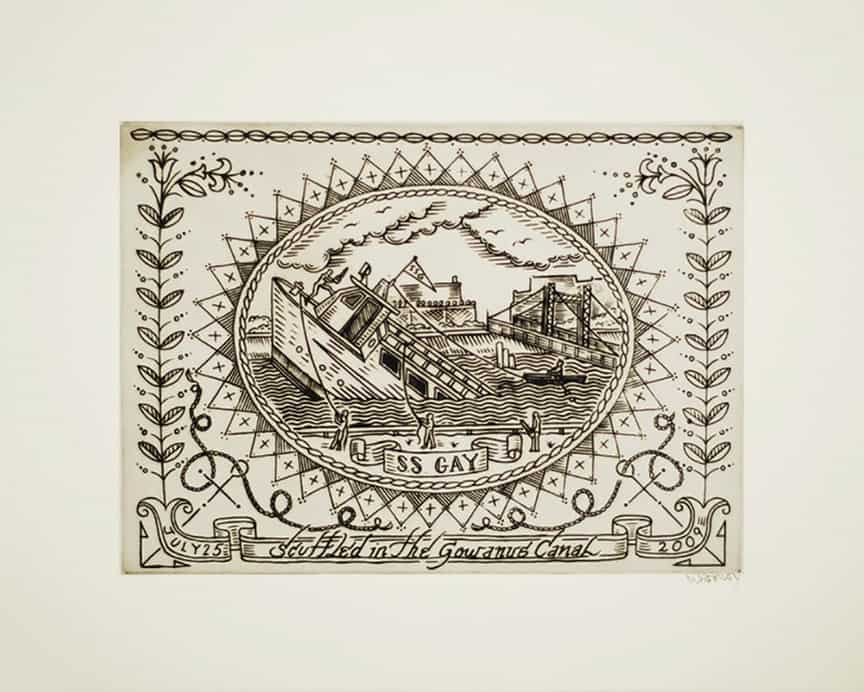
Duke Riley, Brooklyn artist whose works have appeared locally through places such as the Brooklyn Museum, Proteus Gowaus and Gowanus Ballroom, depicted the ship sinking in a print work called “The Scuttling of the S.S. Gay.” Of the boat and its crew, Riley wrote, “The SS Gay rekindles my faith that all soul hasn’t been stripped from the city. If Walt Whitman were alive he’d still be revising Leaves of Grass to include them.”
By 2008, despite fundraising attempts, maintenance became too much of a financial load for the artistic community. The boat was once again put up for sale, but no buyer was ever found.
The boat, rumored to have sunk after being set on fire at a party, has been sitting at the bottom of Gowanus canal since 2009.
Alas, no historic value,
An extensive report by Archaeology & Historic Resource Services found that the sunken ship, in its current state, has no archeological value as a crash boat, ferry, or shipwreck. After 73 years at sea, the S.S. Gay will emerge from the water as just another one of those mysterious pieces of junk getting cleaned out of the Gowanus canal.
Discover more from Red Hook Star-Revue
Subscribe to get the latest posts sent to your email.
One Comment
Very interesting. Thx.