
Heart attack survivor Trymaine Lee, 40, is a Bed-Stuy resident and a primetime correspondent for MSNBC. He’s also a recent first-time marathon runner, having participated in last month’s Brooklyn Spring Half at Prospect Park. He uses the sport as a means to recuperate, be healthy and inspire other heart attack survivors.
In July 2017, Lee unknowingly had a major heart attack at the age of 38. He was young, considerably healthy and had no family history of heart disease or early death. He said he first felt chest pressure on a Monday and more extreme pressure the next day; it was hours later that same day he called 911. He was told by Dr. George Fernaine, chief of cardiology at NYU Langone Hospital–Brooklyn (formerly known as NYU Lutheran Medical Center), that he had a heart attack caused by complete blockage in his main coronary artery.
“We think symptoms are supposed to present in a certain kind of way, like I’m thinking of a crushing pain or a spike in your chest. It wasn’t that kind of pain at all,” Lee told this paper. “It was extreme pressure, so it didn’t really click to me that I was having a heart attack.”
Upon hearing such news from the doctor, Lee’s first instinct was to smile with gratitude because he did survive, when many others sometimes don’t have that same fortune.
“But to finally hear that … if I didn’t get to the hospital when I did – that I might not have made it – it was really a shock to me,” he said. “It was like ‘Oh my goodness, if I got here an hour later, I might’ve been rolling in on a gurney.’”
There were many tough moments during the healing process, with Lee often worrying about having a second heart attack. But he also said that his journey’s been enlightening and has allowed him to find ways to become stronger and give himself a fighting chance.
“The first few months were going through cardiac rehab, which was really a blessing to help me get my feet back under me and realize that my heart wasn’t just going to stop or explode,” Lee added.
Nearly two years later Lee’s still undergoing physical rehabilitation, doing lots of cardio and running to upkeep a healthier lifestyle. He’s also more focused on his emotional and mental health, and being more present in the moment and with his family.
“I’ve been able to get myself in a place where I feel really good about life and I see myself as a survivor and not a victim at all,” Lee said.
Half marathon
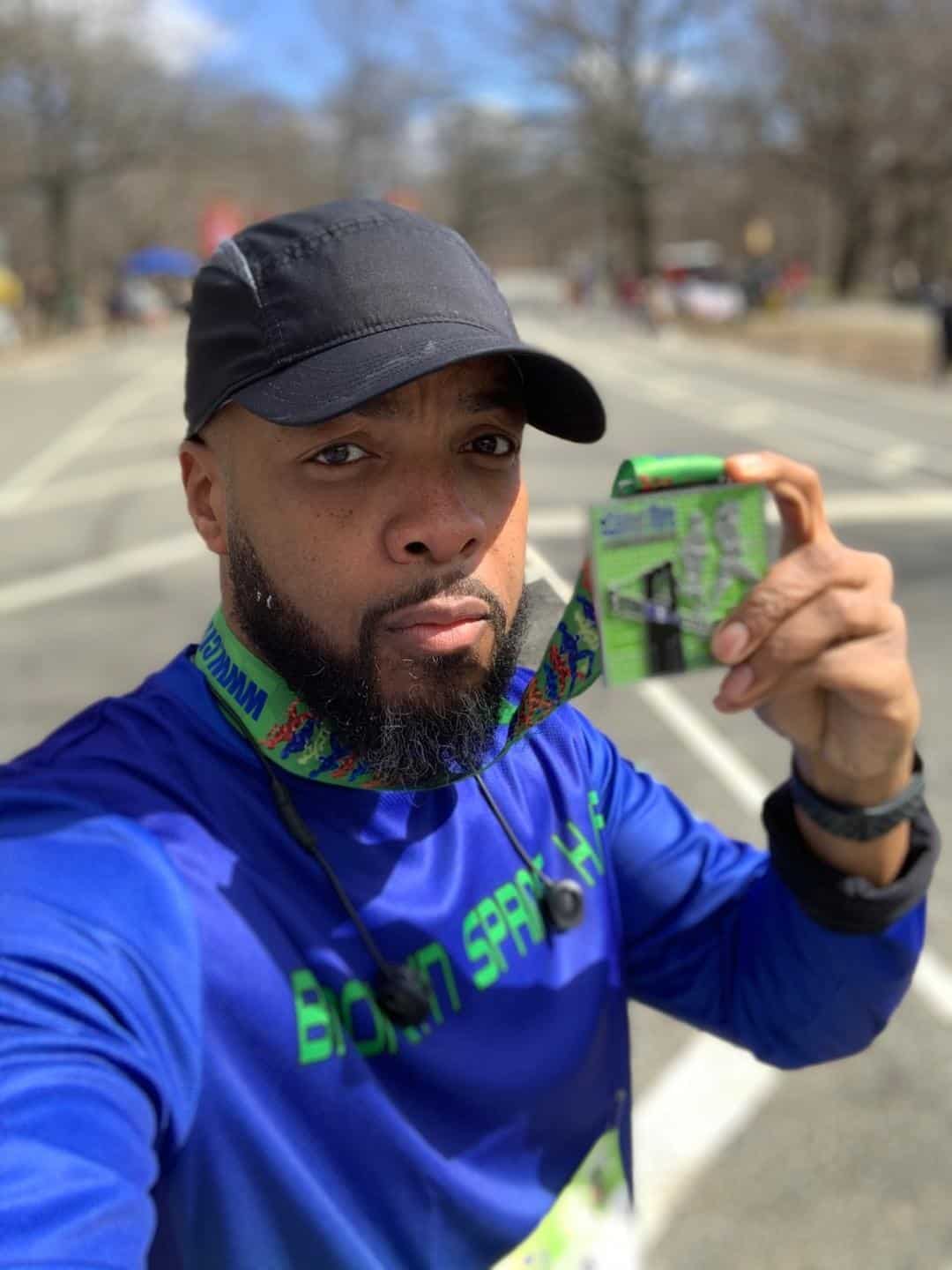
About six months after his heart attack, Lee decided to pursue outdoor running after talking it over with Dr. Fernaine. He said that even though he played college football, he wasn’t really a runner beyond doing 15-20 minutes on a treadmill. With Fernaine’s approval and encouragement, Lee had the confidence to pursue it. Lee began to run through new neighborhoods he had never spent much time in and progressively racked up the miles – going from two-and-a-half to three, to five, and then seven miles.
It wasn’t until fall 2018, that a friend suggested he should run a half marathon (13.1 miles). Lee said he initially dismissed the idea but figured he could accomplish it since he was already running 10 miles. So he signed up for the 2019 Brooklyn Spring Half, presented by Citytri, that would take place at Prospect Park on March 16, 2019. With not very much time to train he ran three times a week, including 10 to 11 miles on Sundays.
“Hopefully it inspires other people who have survived heart attacks or other people who are going through physical or medical issues, that you can come back and come back stronger,” he said.
Coming into the half marathon, Lee’s goal was to run a sub-two-hour race. He ran with 384 other participants and completed the course just under his goal at 1:58:14.
Heart attack facts
An American will have a heart attack approximately every 40 seconds, according to the American Heart Association’s statistics from January 2019. The report also says heart disease (including coronary heart disease, hypertension and stroke) remains the number one cause of death in the U.S. Coronary heart disease accounted for approximately 13 percent of deaths in the U.S., causing 363,451 deaths.
Fernaine said cases like Lee’s are not common, but do happen. While individuals can’t control their genetics or family history, they can control healthier habits like eating properly and partaking in regular exercise.
One of the classic signs of a heart attack is a discomfort in the chest or a squeezing pain, as if somebody was sitting on your chest. Other symptoms include dizziness, shortness of breath, nausea, and diaphoresis (the kind of sweating where your shirt is soaked). That compilation of symptoms would warrant a 911 call. Fernaine said people should seek immediate medical help when they start noticing a difference in their ability to exert themselves or even if they “feel off.”
“The common thing that people misunderstand is it’s not pain – pain is probably the wrong word for it,” he added. “Everyone perceives pain differently, so you have to be careful with the definition of pain. That’s why I always say ‘discomfort, ache, pressure’ because it’s a different feeling for different people.”
He also recommends exercise, regular doctor’s appointments, and having blood tests done for cholesterol at least once a year (starting as early as 20 years old) to help prevent a heart attack. Those who have survived a heart attack, Fernaine said, need to redouble their efforts in paying attention to diet and exercise, in order to lessen the odds of having another attack.
Top photo of TODAY Show Hosts with Trymaine Lee and Dr. George Fernaine on Feb. 7, 2019. Photo courtesy of Lee.
Author

Discover more from Red Hook Star-Revue
Subscribe to get the latest posts sent to your email.