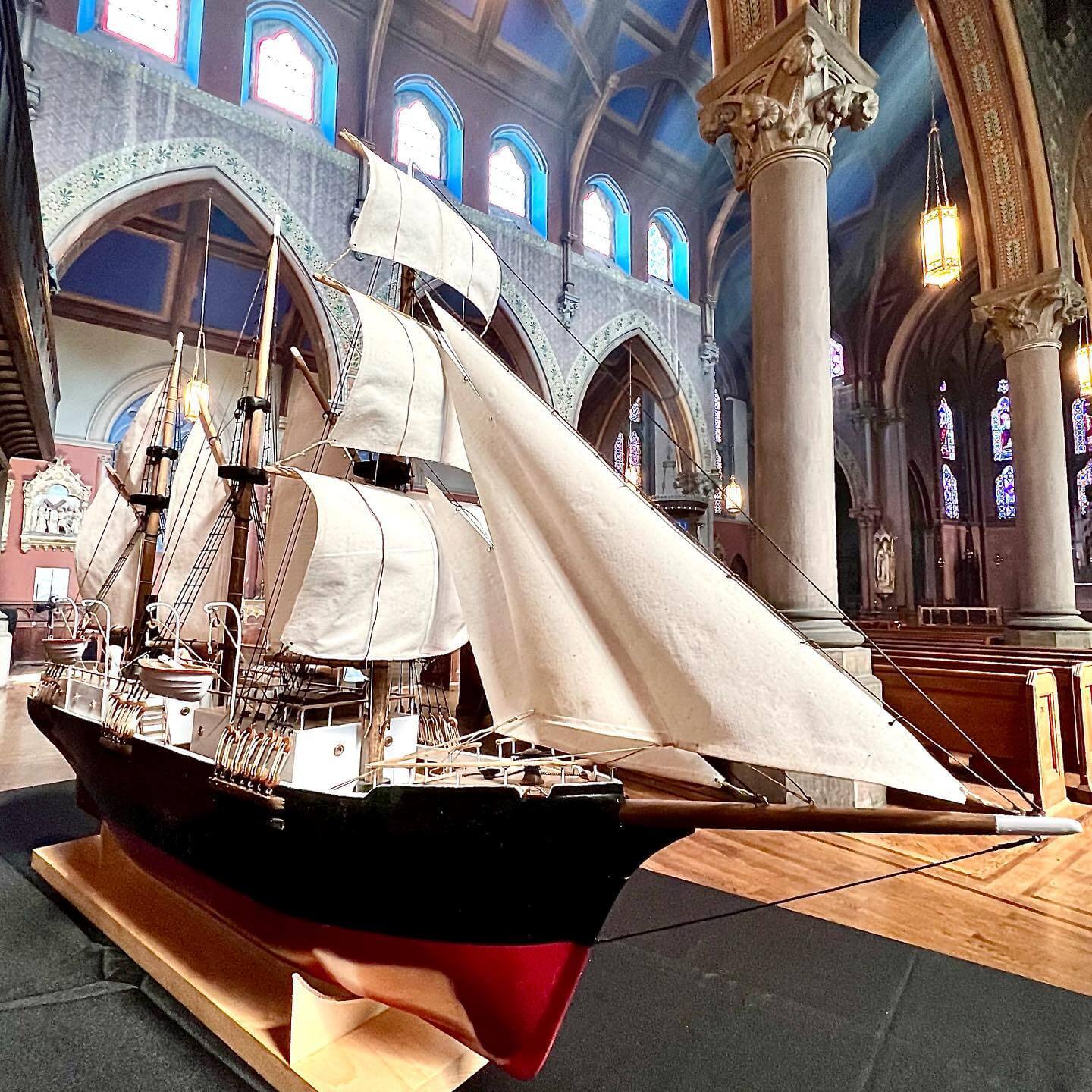
Carroll Garden’s St. Paul’s Episcopal Church extended an old tradition and sail-ebrated a new addition to its 171-year-old church via a handcrafted, wooden votive ship.
A dozen votive ships dating from the first World War that hung in the church were cut down and stolen in 1978, leaving one broken and left behind during the robbery.
That broken ship — which was given by three mothers whose three sons survived the torpedoing of The President Lincoln on May 31, 1918 — was repaired and rehung 10 years ago in the northwest corner of the church, under the guidance of now-retired Father Peter Cullen.
[slideshow_deploy id=’14647′]
“I found that to be inspirational,” Father Ogburn explained. “So, when I was thinking about what we were going to do to mark coming through COVID-19, I said, ‘The last thing we need is another plaque.’ My idea was a new votive ship.”
“The COVID-19 pandemic has given us new reasons to ask for God’s merciful protection and to honor the memory of the four and a half million people worldwide who have died from this sickness,” he added. “There is also ample opportunity for us to give our thanks to God for coming through this great ordeal safely in our own day. Like votive ships of the past, these are the reasons inspiring Saint Paul’s new votive ship, so beautifully made by Mike Miller, assisted by Sandy Miller.”
The new ship is modeled after Sir Ernest Shackleton’s Endurance. Though the Endurance became trapped in pack ice and sank during Shackleton’s Imperial Trans-Antarctic Expedition in 1915, the entire crew survived and was saved. “We thought that was a good symbol for what we’ve been going through since COVID hit,” Father Ogburn said.
Michael Miller, who is the church’s unofficial handyman/carpenter and has his own workshop space underneath the church’s rectory, was willing and able to take on the biggest project of his life thus far — the new ship.
The Artist, His Craft, and the Process
“As a kid I used to make models — mostly model airplanes — but they all came in kits. You had the materials and the instructions, and you made it,” Miller said. “But this was a whole different ball game. It was challenging and I liked the challenge.”
Apart from making the ship from scratch with very little photographic evidence for reference, Miller said he learned the “fascinating” history of votive ships along the way. “During my search, I only found three ships in the whole country that were hanging in churches and that took my breath away,” Miller said. “It blew my mind that I was involved in something special that wasn’t happening anywhere else in the country.”
After three months in the workshop, the ship was completed at the end of summer and put on display in the back of the church. During that time, parishioners could see the ship with three masts up close and at eye level. “It’s full of amazing details that many people won’t ever see again, but we did take a lot of pictures of it,” Father Ogburn noted.
For example, when Miller and Father Ogburn discovered that a cat belonging to the ship’s carpenter as well as 70 dogs were on board the Endurance, Miller decided to feature them by including two small figurines of each animal on the modern-day votive ship.
The new votive ship — which is pointed in the direction of the High Altar and Blessed Sacrament to acknowledge Jesus’ real presence among us — was suspended from the ceiling, blessed, and dedicated during a Mass held on November 14. It floats high above in the nave at about 15 feet, in the same spot where a previous ship once hung according to Father Ogburn who discovered an old hook hole in the ceiling.
“As I was pulling [the ship] up, I thought ‘Wow, this is something.’ And when it was all hooked up and we took the scaffolding away, it was just magnificent,” Miller said. “The thought that it will just stay there forever is amazing.”
A Brief History of Votive Ships
Since the Middle Ages, throughout coastal parts of Europe — particularly in Spain, France, England, Denmark, Norway, Sweden, and Finland — models of ships were commonly given to churches by sailors and their families. These were gifted out of devotion (ex votos) and in seeking God’s protection for an upcoming voyage or in thanksgiving to God for having overcome some great ordeal at sea. They have been made from precious metals, carved into simple images in wax or wood, and have even been fashioned as incense burners.
Votive ships are so rare in the United States that Father Ogburn and Miller said they could only find a handful currently on display. Aside from one of the original ships from 1918 that still hangs in St. Paul’s, Father Ogburn says the only other existing ships are on display in California, Iowa, and at the Seamen’s Church Institute of New York.
“It is encouraging to find that this new century is marked by several votive ships now sailing aloft in churches—recently renovated ones which had previously languished on storage shelves, as well as newly crafted ones like ‘The Endurance’ here at St. Paul’s Church,” wrote V.K. McCarty, who teaches and writes on Ascetical Theology with special focus on Early Christian Women and currently lectures at the General Theological Seminary in Manhattan, in an essay. “It is an inspiring sign of the Holy Spirit invigorating people with prayerful intentions; and it acknowledges, too, beautiful maritime details from the heritage in our Church life together.”
Author
Discover more from Red Hook Star-Revue
Subscribe to get the latest posts sent to your email.