It always takes a village! I’ve learned that this applies in the formation of our families, but also in teaching government to respond faster and better. When neighbors unify and lead community projects, the outcomes are just so much better.
Red Hook is a perfect example of this idea. Our community learned how to lead government decisions and processes during Superstorm Sandy. After the storm, unified residents and businesses accomplished greater and better results than government could ever muster on its own.
Red Hook Senior Center
The Senior Center on Wolcott Street proves the point. Left destroyed as floodwaters receded, the Center became just another backburner project lost in paperwork delays and agency confusion in a communication vacuum – marked with a distinct lack of any meaningful progress.
In response, I began leading bi-weekly meetings to reset the entire project scope, design, budget and timeline. And that helped, but what really got the project on track was a group of organized seniors demanding one simple thing: the truth – the good, the bad, and the ugly news. They pushed, they spoke up, and held their government accountable.
They also built personal relationships with individuals inside the agencies that had been previously so unresponsive to them.
I learned from them, as I had observed during Sandy, that people working directly with people can break long-set cycles of impersonal and neglectful government relationships.
When Ms. Martinez at the senior center and so many others worked directly with Mr. Rosen from NYCHA, things started getting done. Sure, we are still facing a disappointing delay in the opening date of the new senior center and that’s a real setback. And sure, we may face other setbacks along the way. But we face them together and overcome them with relationships where people know they are heard and respected and where people working in agencies can no longer simply look away from constituents who may have been previously nameless, faceless constituents.
Participatory Budgeting
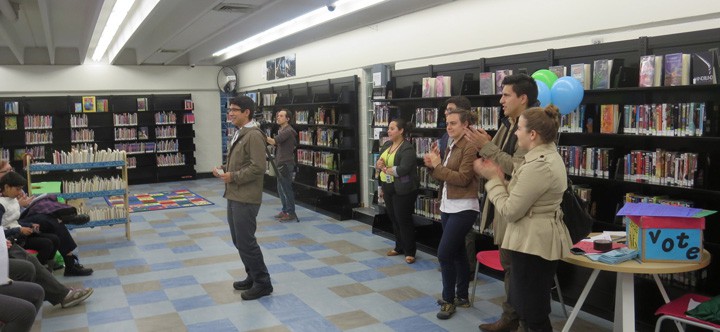
Participatory Budgeting (PB) is another example of engaged residents using grassroots democracy to radically change the way we form government budgets. I adopted PB as I came into office with faith that it would change tired, unfair, old New York City budget habits. It has worked beyond my expectations. The ultimate goal of PB is to have the people themselves determine the budget process and ultimately drive new ways to engage government. After 5 years since PB first came to NYC, more Council Members have decided to employ PB, giving their residents the ability to determine how to allocate over $30 million dollars of capital funding in their neighborhoods.
This month Red Hook residents will have its third annual round of PB. Hundreds of our neighbors have shared ideas for making our community better. They’ve considered among many other things, building new playgrounds, making old facilities more accessible and buying new technology for schools.
Two principals guide the PB process:
1 – People know their own neighborhood’s needs and can form solutions better than anyone else.
2 – Even well-meaning government representatives cannot do the best job possible, unless residents teach them how.
What I love about PB is that it brings new people into a leadership relationship with government. Many PB participants are more involved with issues and solutions than government agencies and institutions. Yet, it’s traditionally the government agencies and institutions that are operating with authority, guiding capital spending and influencing good decision making. PB participants teach government to operate better because the outcomes directly impact their own community, their families and themselves.
My goal is to continue to spread PB beyond the capital budget and to reach into the city expense budget, allowing residents to have an even greater say in the budget process. I also want to make sure that we sustain the growth of PB – and our democracy – by developing neighborhood curriculums where young people can teach each other about the value of participatory democracy, while challenging an establishment that continues to hold onto power. The results: a sustainable grassroots democracy that will be shaped by the people that are directly impacted by the allocation of funds year in and year out, generation after generation.
The increased adoption of PB in our City Council is a clear sign that our government is under revolution. Join us and become entrenched in the exciting process of determining how taxpayer dollars are spent. Voting takes place between from March 26 to April 3, 2016 at the Red Hook Initiative, Red Hook Community Justice Center, Red Hook Library, Miccio Center and at other pop-up sites throughout the NYCHA campus.
Our district was the leading district in participation with 3,000 people turning out to participate in PB the first year and 6,000 the second year. Can we continue this trend and show the rest of the city how we choose to govern?
I’m calling on you, Red Hook. Let’s prove that this formula for better governance does work. We wear the mantle of leadership here in Red Hook! Let’s continue to show our city and cities around the nation the power of community participation!
Let’s not stop with what we did yesterday, but rather use it as a building block for what we can do today and tomorrow! Invite your friends and family to join in this exciting way of local government, by the people, for the people in the truest sense of the word.
Author

Discover more from Red Hook Star-Revue
Subscribe to get the latest posts sent to your email.