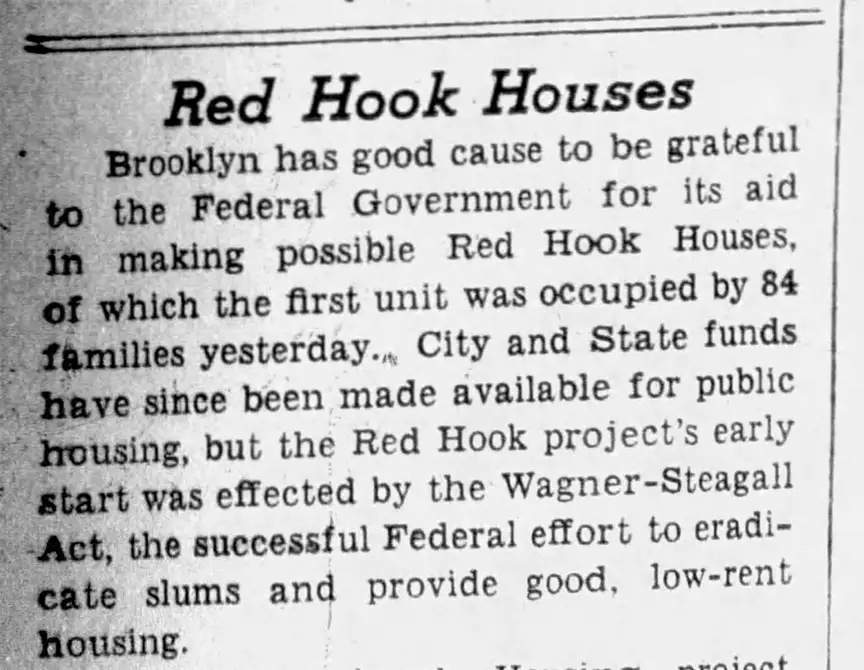
I am going to say right off the bat that a lot of these words are the result of an AI Google search. It does a good job of explaining that a century ago, we had a housing crisis which put poor New Yorkers at risk of their lives. The solution, which took a Depression to implement, was largely due to the work of Louis H. Pink (the same guy who the Pink Houses are named after) and the friendship of NY Mayor LaGuardia and US President Franklin Roosevelt. That solution resulted in the building of the Red Hook Houses, which opened in 1939 and was revolutionary in how a government could take care of the endangered poor.
This is the AI part:
In the 1920s, New York City was characterized by a sharp contrast between a massive, city-wide housing boom and the continued, squalid existence of “Old Law” tenements. While the decade saw over 760,000 new housing units constructed, hundreds of thousands of residents—particularly on the Lower East Side—remained in overcrowded, dangerous, and unsanitary conditions.
Many families still lived in “Old Law” tenements, constructed before 1901, which were often dark, damp, and lacked proper ventilation or indoor plumbing.
Multiple families were often crammed into small apartments, sometimes sharing a single room, which facilitated the spread of diseases like tuberculosis. Fire hazards were constant due to flammable materials and a lack of proper exits.
Buildings often had shared toilets in hallways or outhouses in courtyards. Garbage was frequently dumped in narrow air shafts.
Approximately 75% of tenement housing was managed by “lessees” rather than owners, who would rent buildings and then cut services while raising rents, creating further, often dangerous, neglect.
The 1920s Housing Shortage and Rent Crisis
Post-WWI Shock: Immediately following World War I, a severe housing shortage led to a 1920 housing crisis where rents spiked, resulting in mass evictions and homelessness.
In response to the crisis, 1918–1920 saw massive rent strikes, with thousands of tenants in the Lower East Side, Bronx, and Harlem organizing against poor conditions and exorbitant rent increases.
The strikes forced the first rent laws in the US to be passed by New York State, and in 1920, Governor Al Smith signed a law that granted tax exemptions to new construction in an effort to boost supply.
The 1920s saw a record-breaking housing boom, driven by the tax exemptions. This allowed some, but not all, to move out of the oldest slums.
Now back to me:
So you see that today’s housing crisis is not a brand new thing. What solved the problem eventually was socialized housing for the poor funded in part by the US federal government.
The first residents of the Red Hook Houses were poor whites. By the 1980s it was people of color. The US shifted from The Great Society to the Me Generation starting with the Reagan presidency.
That’s when federal funding for NYCHA started dropping.
The answer, starting with RAD legislation in 2011 and converted to PACT in NYC in 2015, is a return to private ownership of low income housing, due to the changing priorities of our voting citizens. The new companies that will run public housing bring back the “lessee” era.
One might have hoped that the election of a more people minded mayor, a member of the Democratic Socialists, might have wanted to change this privatization of a public good, but the unfortunate fact is instead of seeking to improve NYCHA, he seems to be more interested in getting rid of it in favor of essentially for-profit real estate companies, which in case you weren’t aware, is what PACT does.
Author

Discover more from Red Hook Star-Revue
Subscribe to get the latest posts sent to your email.