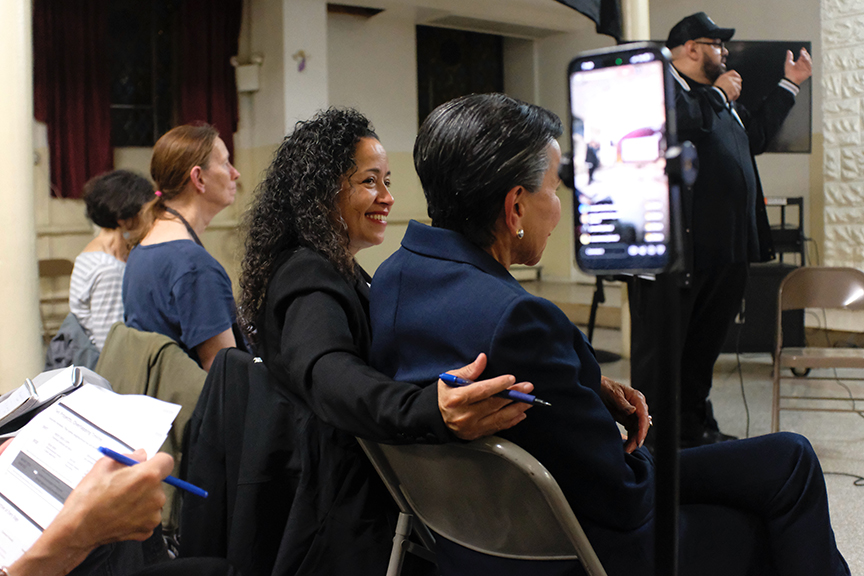
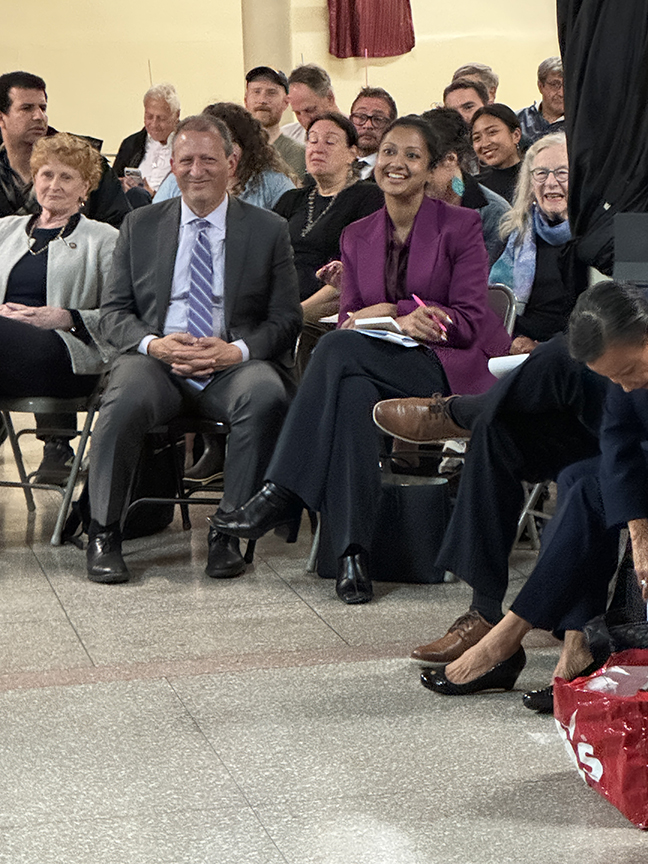
A forum on how the Brooklyn Marine Terminal (BMT) can serve all of Brooklyn—and the city at large—drew a full house at the Sacred Hearts Church in Carroll Gardens on Monday night, Sept. 28.
It was rather star-studded, too, at least as far as local celebrities are concerned: Democratic nominee for Congress Brad Lander made an appearance, and a quartet of local elected officials—Council Members Shahana Hanif and Alexa Avilés, alongside State Assembly Members Marcela Mitaynes and Jo Anne Simon—sponsored the event, which was headlined by retiring US Rep. Nydia Velázquez.
Staff from City Hall and the Economic Development Corporation (EDC), the quasi-public entity that is leading the redevelopment of the BMT, also attended.
The main draw of the evening was a panel of experts—Jim Tampakis, Phaedra Thomas, and Geoffrey Uttmark—who were invited to share their ideas for a redeveloped marine terminal and reinforce the importance of a sustainable, working waterfront.
Tampakis, a veteran in the maritime industry and owner of Marine Spares International in Red Hook, continued his advocacy for the BMT as a hub for New York City’s burgeoning Blue Highways program.
For years, Tampakis has been a steadfast champion for a green Blue Highways system, with electric barges and cargo bikes transporting packages and goods across the city’s waterways and streets. And for good reason: polluting trucks deliver nearly 90% of all goods to and around New York City—including some 2.3 million packages daily—while the city’s 520 miles of waterfront sit underutilized for things like on- and offloading goods.
Current transport routes also often make little sense. A box of bananas from South America delivered to the Red Hook Container Terminal—millions of pounds of tropical fruit and other commodities arrive weekly to the container terminal—must be barged to New Jersey before it can be driven back into the city on a truck, because the BMT doesn’t have a cold storage facility. Not ideal in a city that prides itself on progressive climate policy.
Thomas, former executive director of the Southwest Brooklyn Industrial Development Corporation, argued that the city is seeing something of a maritime resurgence—despite little government support.
Thomas noted that more than 438 million tons of goods touches the New York Metropolitan Transportation Council’s (NYMTC) planning area annually (NYMTC’s planning area covers New York City, Long Island and the lower Hudson Valley), a number which will increase by 47% until 2055. (In terms of money, the value of all these goods will grow from $715 billion to a whopping $1.4 trillion.)
“The whole conversation about housing versus industry is a really dumbed-down conversation,” Thomas said to enthusiastic applause. “This is the epicenter of the biggest consumer market in the world. We deserve a freight transportation plan that includes a hub like Red Hook at its center.”
Rep. Velázquez, who has long fought to preserve a working waterfront in Brooklyn, proclaimed that the borough “should remain a place where maritime industry can thrive, where union jobs can grow, and where our harbor is an economic and transportation asset, not just prime real estate.” (The vision plan includes preserving 60 of 122 acres for port operations, the same footprint that Red Hook Container Terminal currently has, but this is subject to approval of the state-led General Project Plan; critics have called for expanding the port and question if 60 acres is enough for long-term financial viability.)
She’s correct, of course. As were Thomas and Tampakis. The Brooklyn Marine Terminal is unique: as the only container port east of the Hudson River, it is at once a lone bastion for New York City’s maritime legacy and a beacon for a greener future, in which transportation of goods is a zero-emission business.
And with his 15-page presentation of ports around the world that the Brooklyn Marine Terminal redevelopment could draw inspiration from, Geoffrey Uttmark showed that it is far from impossible to have a self-sustaining, sustainable working port in the 21st century.
But it is a point that has been made ad nauseam, by both proponents and opponents to the current vision plan: redeveloping the Brooklyn Marine Terminal is a once-in-a-lifetime opportunity, and we have to get it right.
And yet, for all the hard-hitting one-liners—Simon: “The future of New York is on the water”; Velázquez (again): “Residents and container cranes don’t always mix”; Avilés: “I am not interested in giving public land to luxury real estate”—what do we, after two years of fighting this project, have to show for it?
Has the public engagement conducted by the community been any less hollow than the EDC’s public engagement process that we lamented and criticized for two years?
What’s the point?
Virtue Signaling
At some point we’ve got to ask ourselves: what’s the point of all this? What will this forum—or events and advocacy efforts like it—accomplish?
Almost nothing of substance in the plan has changed since the public engagement process began. The EDC made some concessions to the BMT task force, but they were largely quid pro quo rather than admissions of wrongdoing or faulty planning.
Many of the data points in the initial plan—like the number of housing units—were likely also inflated to allow for task force members to “negotiate” them down to a more “reasonable” amount.
If anything, things have gotten worse. Recently, at a board meeting for the BMT Development Corporation, EDC announced that it will be up to the future port operator to decide whether it wants a cold-storage facility on site, despite the State pledging $15 million for such a facility in 2024.
So, are all these “social justice” cocktail parties nothing more than a group of lawmakers looking to gain favor with their electorate with words and the appearance of effort?
I reached out to the offices of Hanif, Avilés, and Simon, and neither Hanif nor Simon provided a statement on what specifically they will do now to protect the interests of the community (the Star-Revue tried reaching them multiple times via email and text). Avilés told the Star-Revue, “I will continue to work with local stakeholders to set up meetings with the mayor and key members of his administration regarding BMT.”
Or is it a desperate attempt at maintaining an illusion of control, a way to feel like meaningful action is being taken, for a group of local residents and businesses who feel their voices have gone unheard and overlooked?
I’ve reported on the Brooklyn Marine Terminal redevelopment for more than two years. I’ve attended most meetings, and spoken to decision-makers, maritime experts, elected officials, and neighbors both for and against the vision plan. I’ve heard probably every opinion there is on this project.
I’m not against community organizing; we’ve seen it work across New York City and beyond. And I don’t have a silver bullet to stop this boneheaded vision plan, in which no serious thought was given to flooding risk, soil stability, increased future traffic, integration with other capital infrastructure projects happening in the area, alternative funding plans, or real public engagement.
Avilés’s effort to get the mayor to sit down with community leaders is admirable, and an important step in the right direction.
But at this juncture, all we—as in the people opposed to the current vision plan—have accomplished are some comments on the scope of the forthcoming environmental impact study, which may or may not be taken into consideration.
At the end of the meeting, community organizer John Leyva recounted how the striped bass stopped the Westway project in the 1980s. Maybe if we plant some fish eggs along the piers of the BMT…
Author

Discover more from Red Hook Star-Revue
Subscribe to get the latest posts sent to your email.