
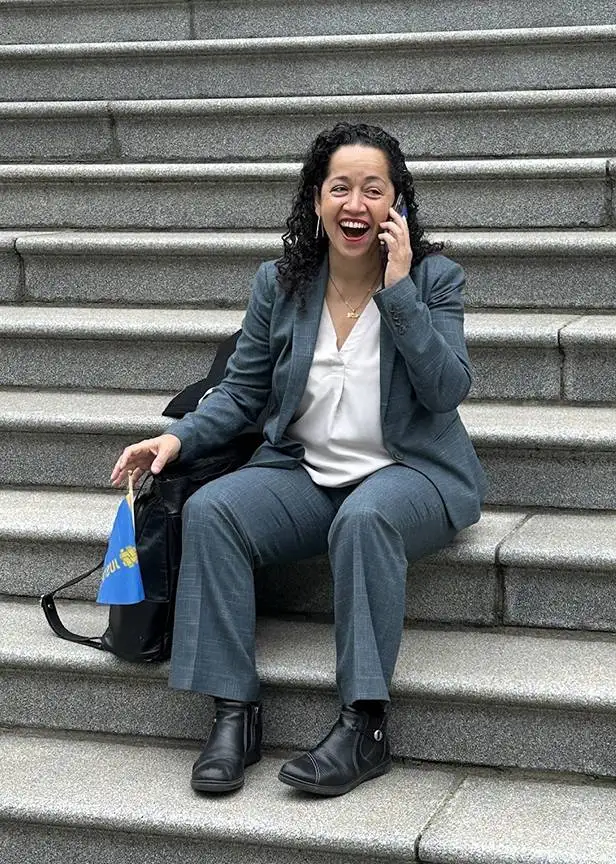
It’s just past 8 a.m. on a rainy Thursday morning in Sunset Park. City Council Member Alexa Avilés finds herself in a position not unfamiliar to most New Yorkers: rushing out the door, preparing for an early meeting while taking calls with her daughter’s school, and racing to make the morning train.
While City Council members are often among the most visible people in the city, for the average person who only engages with politics during election season—or when trying to resolve a personal gripe—the daily work of these representatives, who are actually people like you and me, is not well known. To shed light on how our leaders spend their days, I tagged along with our Council Member Alexa for a day around City Hall.
Coffee and news
Avilés typically starts her day around 6 a.m. with coffee and a buffet of news articles. She also uses this time to check emails and review her schedule: a dizzying Google Calendar packed from end to end with meetings managed by Avilés and her staff.
“I’ve been on this job for five years and not two days have been the same,” Avilés said. “You never know what kind of emergencies will come up, or what kind of political insanity awaits. It’s all very fast-paced.”
Council members have a diverse array of responsibilities they must address on a daily basis, but for Avilés, perhaps none are more important than constituent services.
These services form the basis of local government and are the process by which residents bring concerns to their representative’s office, which then works to either resolve the problem directly or connect them with the appropriate agency.
“There’s a lot of well-placed skepticism about government,” Avilés said. “But the truth is we need government. Government should be a mechanism for doing good. If we’re going to birth a multiracial democracy—something that has never existed anywhere at any point in time—people have to believe in it. So, particularly for communities of color, who have been left out by our government for decades, rebuilding that trust starts with constituent services.”
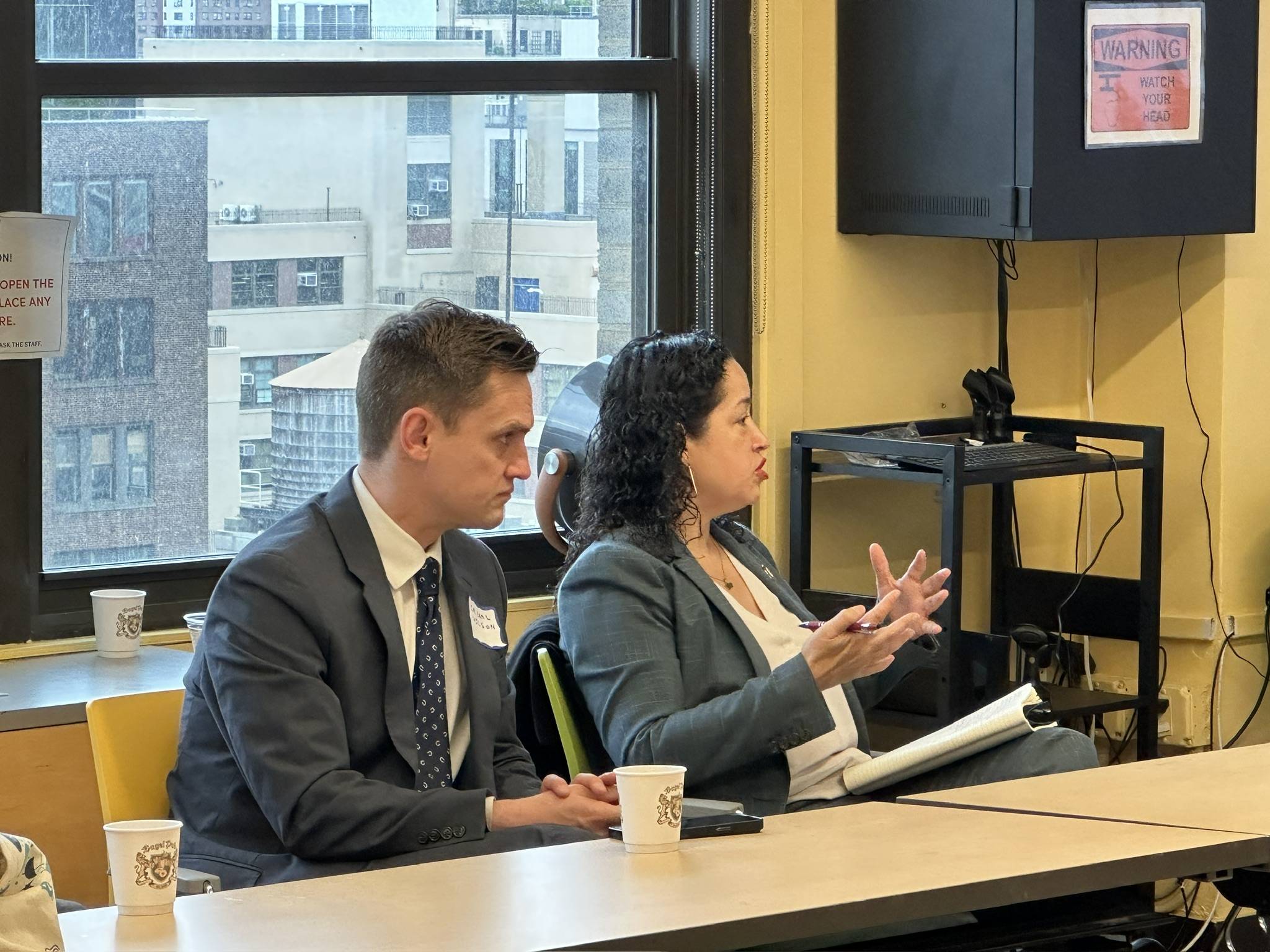
In many ways, City Council members are students of the city in the most literal sense. Throughout the day, Avilés took notes while meeting with representatives from the SAGE Center and the Human Services Council of New York, memorizing names, organizations, and pieces of policy much like a student studies vocabulary before an exam. At one point, Council Member Lincoln Restler joined Avilés as the two bounced from rally to rally, offering a piece of wisdom on how best to avoid awkward situations when interacting with so many people.
“My trick is always to say ‘nice to see you’ and never ‘nice to meet you,’” Restler said.
This day happened to fall on one of the Council’s biweekly stated meetings, a gathering of the full body where legislation is introduced and bills that have emerged from committee are voted on. These days typically draw large crowds outside City Hall. Some come to advocate for new legislation, others to celebrate holidays or causes, while still others are staffers and reporters commingling or searching for lunch.
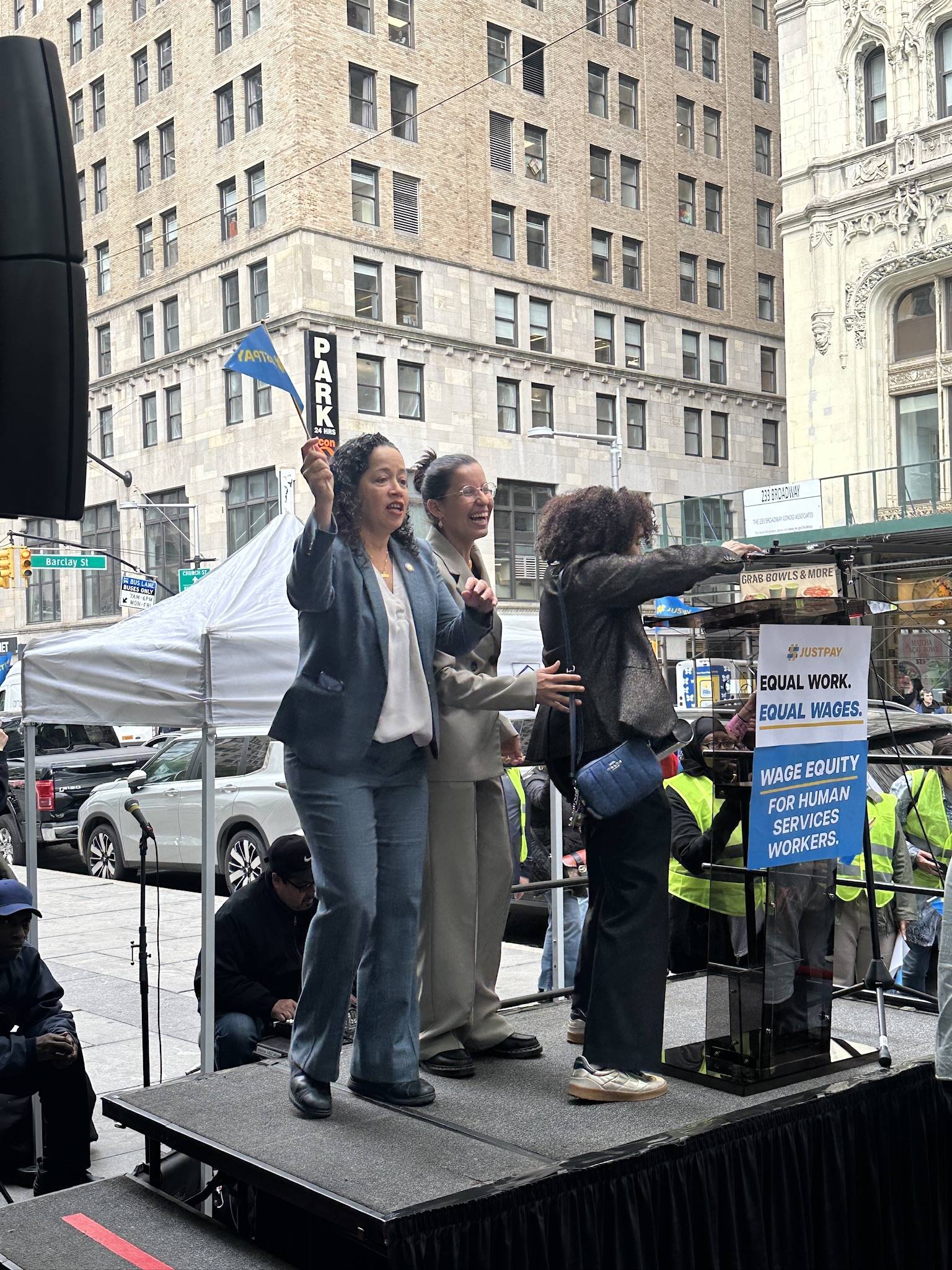
Avilés joined fellow Council Members Tiffany Cabán and Althea Stevens at a rally organized by the Human Services Council of New York to demand passage of a bill that would close a 30% pay gap between nonprofit workers and city employees who perform similar duties.
“It is a damn shame that we are out here having to rally for just pay,” Avilés told a raucous crowd outside City Hall Park. “But our commitment to you is to stand with you and to fight with you.”
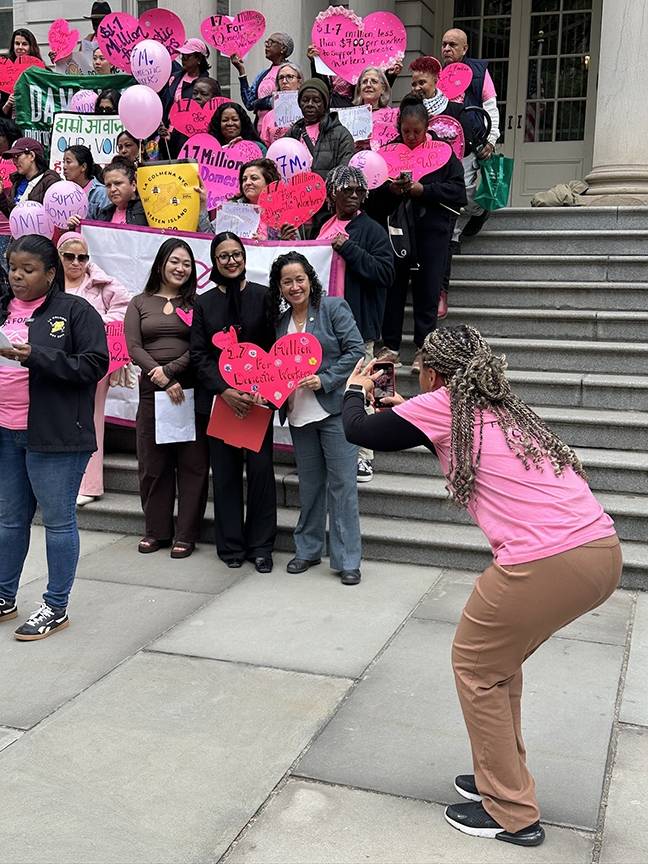
It was the first of three rallies Avilés would speak at that afternoon. Another took place on the steps of City Hall, where she stood alongside domestic workers to advocate for the Council to allocate $1.7 million in new funding to support the Domestic Worker and Employer Empowerment Initiative.
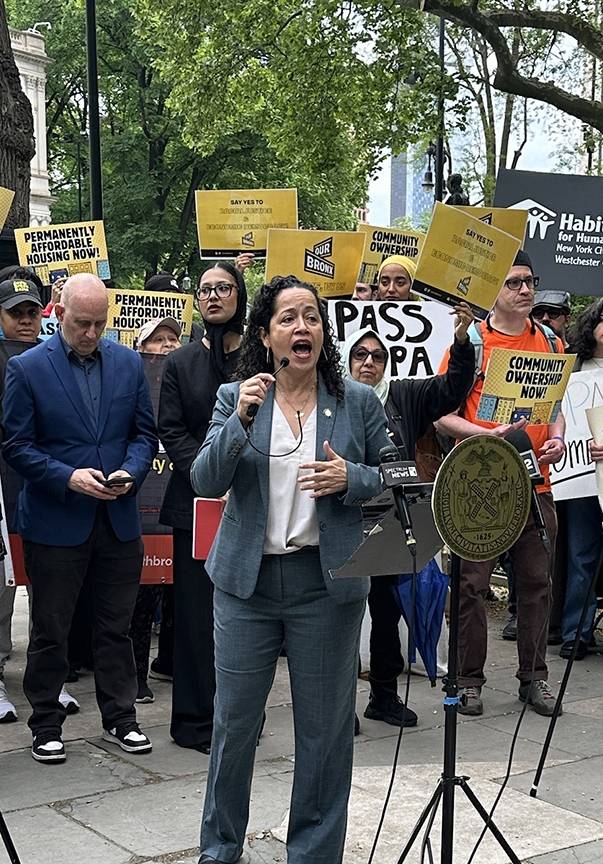
Finally, she moved back to City Hall Park for a rally with housing advocates supporting the Community Opportunity to Purchase Act (COPA), a bill designed to give select local nonprofits priority opportunities to purchase multifamily homes when they come on the market.
“These are directly impacted people who’ve been fighting for their homes, fighting in their workplaces, who have experienced all manner of indignities and wage theft, and who have come to understand that in order for systems to change, they have to be involved,” Avilés said. “My role here is to lift up their voices and their demands and to work with them for change.”
After three back-to-back-to-back rallies, Avilés sat down for a brief respite on the steps of City Hall and reflected on how much had changed since she first entered office in 2021. Avilés was part of a cohort of members of the Democratic Socialists of America—including Tiffany Cabán and Marcela Mitaynes—who capitalized on the momentum generated by Alexandria Ocasio-Cortez’s upset victory over Joe Crowley in 2018 to become some of the first members of the organization elected to the City Council and State Legislature.
Today, DSA is ascending in New York City politics, represented by four members on the City Council, five members of the State Assembly, three members of the State Senate, a member of Congress, and a mayor, with more seats likely to come after this June’s Democratic primary. For Avilés, who spent much of her tenure battling with the Adams administration, working alongside a friendlier executive branch under Mayor Zohran Mamdani has been a welcome adjustment, though not one without its own challenges.
A work in progress
“There’s a lot of grace we need to extend each other in this situation,” Avilés said. “During pivotal moments like the budget release, things can be tense. Staying in communication about where we’re aligned and where we’re diverging, and figuring out how we present that publicly and navigate our disagreements internally—it’s very much a work in progress.
I don’t think we’ve found our groove quite yet.”
In City Hall, maintaining healthy working relationships with colleagues—both allies and adversaries alike—is just as important as maintaining open lines of communication with constituents, according to Avilés.
“Government is a team sport, for better or worse,” Avilés said. “You have to be able to build relationships and convince people to work with you, or at the very least not block what you’re trying to do.”
Another core function of the City Council is, of course, introducing and passing legislation. In an average year, a council member may introduce 10 to 15 bills and vote on hundreds more, a small fraction of the legislation that is proposed and considered.
On this day, the Council was set to vote on a resolution introduced by Avilés. The measure called upon the New York City Department of Education to establish May as Labor History Month in city schools. As both a socialist and a former president of her children’s school Parent-Teacher Association, the issue was a particular passion project.
The Council was gaveled into session as members took their seats, flanked by a gaggle of reporters and aides. After a short time, Avilés’ resolution came to a vote.
“New York City is the wealthiest city in the country,” Avilés said, rising to address the chamber. “New York is also a working-class city, where workers from all backgrounds have done the work that produces that wealth.… This is a proud history, and yet the story of organized, working-class power is rarely mentioned in our history books. Hopefully today that changes.”
It passes!
Fittingly, seated in the viewing gallery and looking down upon the chamber, a group of students from the YMCA of Greater New York’s Civic Leadership Program watched as the vote was called. It passed without objection.
While the Star-Revue’s time with Avilés ended after the vote wrapped up, her workday was far from over. More meetings, phone calls, constituent concerns, and political negotiations still lay ahead for her.
But for all the speeches, rallies, and social media posts that draw the bulk of public attention, the day also offered a reminder that much of city government happens away from the spotlight—in hurried conversations between meetings, local slice shops on a working lunch, and in the quotidian labors of assisting residents navigate a city that never slows down.
News from the neighborhood.
Red Hook & Gowanus
Subscribe to get the Star-Revue’s newsletters throughout the month.
Author

Discover more from Red Hook Star-Revue
Subscribe to get the latest posts sent to your email.