Sinners made $280 million during its run in movie theaters in America and Canada last year. At a rough average price of $14 per ticket, that means 20,000,000 saw it before it began streaming on HBO. That’s 20,000,000 people who, among other things, heard some real blues music—including “Pick Poor Robin Clean,” written by Geeshie Wiley, one of the most important and also obscure figures from the beginnings of the blues—and saw an actual living legend, Buddy Guy.
Along with those viewers, an additional 18,000,000 households tuned into the 2026 Oscars, where they saw Guy and Miles Caton, one of the film’s stars, play “Magic What We Do,” the piece from Ludwig Göransson’s score that sets out the blues as roots and follows it backward, forward, and sideways through times and cultures to weave in elements from rock, funk, hip-hop, African, Asian, and other music, all this accompanied by dance from all those cultures and eras. That was one thing on stage, and even more so on film where it was the most spectacular and moving sequence in a complex story about cultures, subcultures, their communities, how they survive, how others exploit them.
With all those people seeing the movie and the Oscars performance, all the praise and excitement for both that I saw on social media, it’s both surprising and also very, very American (in the worst sense) that it led to approximately zero new interest in the blues.
The people who saw the movie and already loved the blues felt the beautiful resonance of the music, the people (mostly and especially white liberals from Gen Z and after) who were amazed and enthralled by the movie and wore their appreciation of it as a fleeting badge of ally-dom, forgot it quickly, and moved on to the next effervescent discourse and back to the comforts of what has been, for about thirty years, the hamstrung and stunted immaturity of contemporary American popular music.
The fictional character of Delta Slim, an amalgam of Sonny Boy Williamson, Little Walter, Memphis Slim, Slim Harpo, and others played by Delroy Lindo, says, “White folks like the blues just fine, they just don’t like who makes it.” Rewatching the movie while working on this column, that line rang true. Perhaps it’s not an active dislike, more of a neglect, the neglect that comes from incuriosity, from calling something “art” but treating it like a commodity.
In my experience, people get angry when it’s pointed out that relying on streaming isn’t loving music, it’s using a service as a lifestyle accessory, and the streaming medium has an LLM effect in limiting the imagination of the listening brain. It’s a mile wide and a micron deep. And if you think you can “discover” music through it, then I’d love to hear if the blues ever popped up in your algorithm. Because I am sure it hasn’t.
Take Buddy Guy. He turns 90 this month and put out a very good album last year, Ain’t Done With the Blues. Thank you for that, Buddy. But, are you saying you didn’t hear about it? Well, there’s not a mention of it on Pitchfork (Guy has never appeared on the site). No review in The New York Times, just an item on Slate about the Oscars. The New Yorker did a profile on him in 2019, but he’s been otherwise ignored by them, The Atlantic, all the mainstream middlebrow publications, with the meaningless exception of noting that he still lives in the context of obituaries for B.B. King.
Guy is no anachronism—his playing is vital as ever—nor is he the sole representative of contemporary jazz. There have been many strong albums this past year from younger generations, great songs, playing, and spirit, from rural/folk style to meaty blues rock and contemporary beats: the hip, ironically titled Dead Blues Volume 1 from Luther Dickinson and Datrian Johnson; Robert Finley’s tough, rocking, worshipful Hallelujah! Don’t Let the Devil Fool Ya; the all-star group True Blues and their sly, forceful Fight On!; the complex, beautiful One Mississippi by Eric Bibb; and Liam St. John’s impressively harrowing debut Man of the North. Then there’s Benjamin Booker whose third album, Lower, is another step on what’s been a scintillating exploration of how the blues can be adapted on 21st-century terms. All are great albums. The music is alive and well, even though it’s a shame that it’s hard to hear about and find.
This country turns 250 years old this month, a fairly mature age but still youthful relative to the rest of the planet. There are parts of the globe that may have newer names or borders, like the Democratic Republic of the Congo or Moldova, but the peoples there have ancient roots. As a country, America was not only peopled later than others, but is supposed to always be in the process of taking in people who become Americans. America is a modernist nation, politically and culturally, inventing itself as it goes along by incorporating, by acceptance or force, elements from everywhere.
The parent of jazz and rock
American culture, especially musical culture, has dominated the globe for 100 years, and the blues is the single most important genre of music in modern times. Nothing else comes close. Blue is the parent of jazz and rock and ska, with branches that developed into soul and funk, with hip-hop coming in the third generation. That’s mostly the electric branch, which itself comes after the acoustic and often rural roots of the music, which led to country and bluegrass. Without the blues, without an America that enslaved Africans, would there even be modern popular music? Would it be dominated by French chansons and Latin music? Well, Afro-Cuban music was also a byproduct of the slave trade, and salsa and merengue have elements of jazz and R&B and other styles. Maybe we’d all just be whistling tunes from Schubert and Rossini.
Another way to put it is that the Rolling Stones and Eric Clapton would not exist without the blues (not that I would ever promote either as good blues). Do you dig Talking Heads, Yo La Tengo, Ween? Thank the blues. Aretha Franklin, D’Angelo, Nas, Bob Marley? A Tribe Called Quest? Tom Waits? Fishbone? Joni Mitchell? Same.
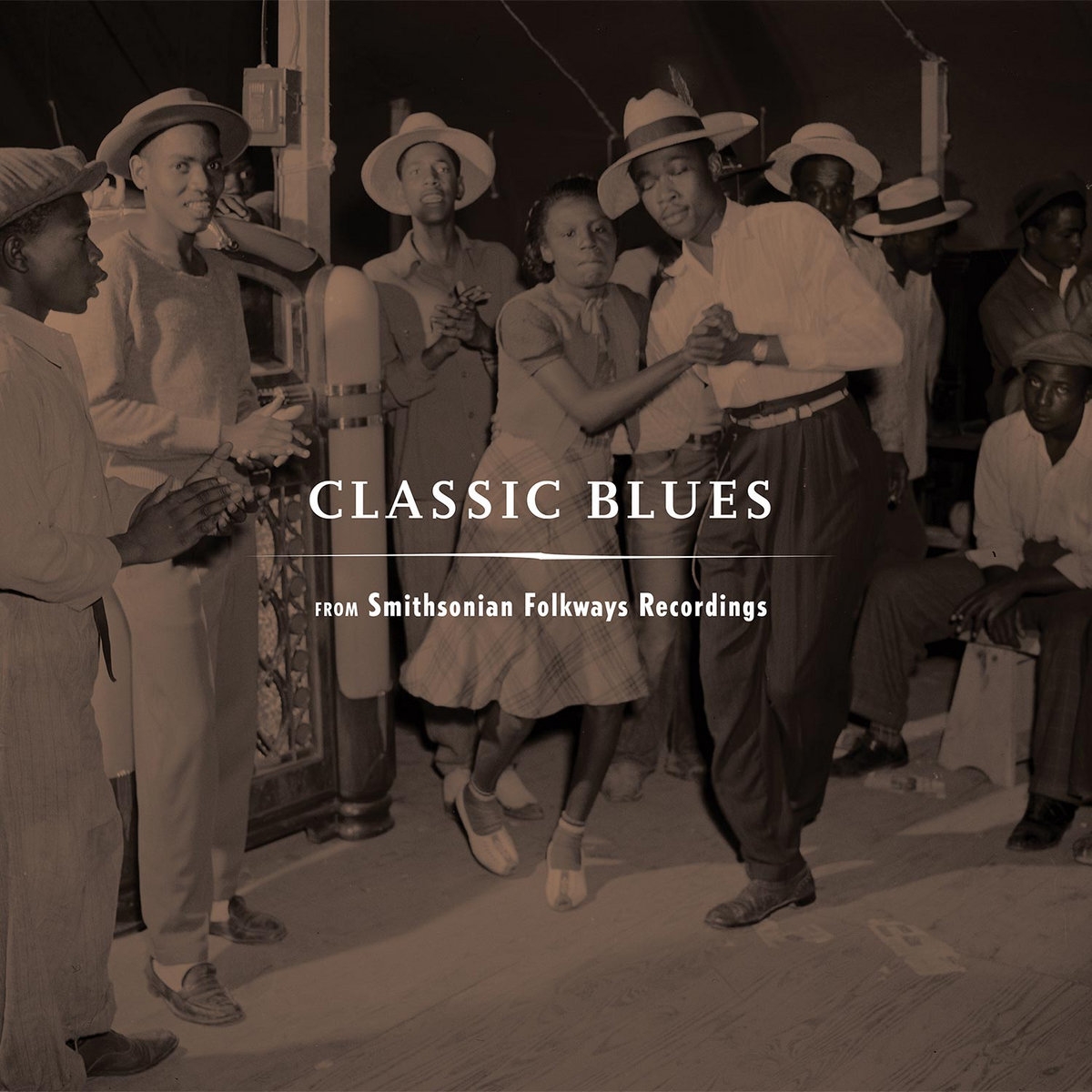
In 2003, the Smithsonian—which through the Folkways label has preserved important blues from the Mississippi Delta, Appalachia, the Piedmont, and other regions—put out a great first collection that covers a wide range of the blues from musicians just a little younger than the extraordinary first wave of Charley Patton, Robert Johnson, and Blind Willie Johnson. In June, Folkways reissued it for the first time on vinyl, in a beautifully made 2-LP set with a booklet that has liner notes for each track on each side; cuts from Lead Belly, Son House, Lightnin’ Hopkins, the duo of Sonny Terry and Brownie McGee, Reverend Gary Davis, Etta Baker, Lonnie Johnson, Josh White, and more. That’s twenty-six tracks that give you the foundation of songs that have endured, like “Boll Weevil” “Candy Man,” and “Pony Blues,” and you can hear the beginnings of so much other music: folk, boogie-woogie, rock. The music is fun, sad, rueful, tragic, good for dancing and drinking and gettin’ down.
This is an indispensable document of American culture and important to have back in print, not just streaming. If the blues is new to you, this is a great place to start, and also great to get to at the end of the modern albums. Blues is a mature music, always has been, because it’s about the people in this country, about taking personal experience and letting the listener know that it’s part of the human experience, and even loneliness doesn’t mean we’re alone. A recent blues lyric goes, “I was drinkin’ black coffee from a papercup.” If you’ve lived a little, you know what that feels like and what it means, and it’s time for the blues.
Author

Discover more from Red Hook Star-Revue
Subscribe to get the latest posts sent to your email.