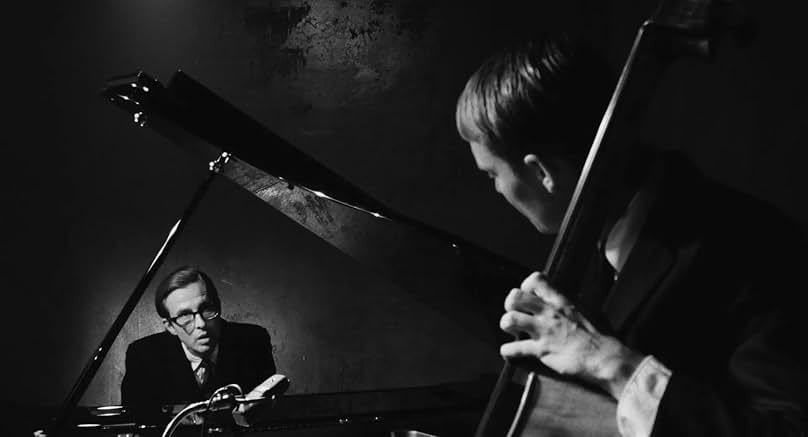
When Bill Evans died in the late summer of 1980, age 51, he was already the most influential pianist in jazz history. He wasn’t the first pianist to create the idea of modern jazz piano; Duke Ellington, Thelonious Monk, Ahmad Jamal, and Bud Powell (the last two important influences on Evans) were all playing and building the ongoing context and history of the music. But if you hear modern jazz piano playing of the last sixty-plus years, you’re almost always hearing extensions of Evans ideas and sound; his style, a dialogue with the voice he left behind.
This isn’t an insider-ish, jazzhead thing. Evans is essential to Miles Davis’ Kind of Blue, the most famous jazz album of all time, the one jazz album that people who don’t like or even listen to the music have and adore. Evans and bassist Paul Chambers are the first voices you hear on the opening track, “So What,” and his gorgeous, enthralling playing on “Blue in Green” is the centerpiece of the album (it’s also one of the most important examples of his composing, though Miles long claimed responsibility and copyright for it, a nefarious habit that he justified by editing every new piece one of his younger musicians brought to him).
“Blue in Green,” and Evans’ style, integrate rich harmonic sonorities and a melodic line that rings out with a luminous, singing tone. That was Evans’ virtuosic touch on the keyboard, and his ear for adding richness to chords with judicious dissonance and an aesthetic that, like Debussy, was about color just as much as it was about creating a formal structure through harmony. That’s the Evans sound, which has been fundamental to jazz history. Arguably even more important, though, was that he built the bedrock of the piano trio in jazz. Taking how Nat “King” Cole, Jamal, and Red Garland integrated their playing with bassists, Evans reworked the leader-plus-rhythm idea of the jazz ensemble into a highly interactive, conversational unit where piano, bass, and drums were constantly negotiating each point.
This innovation, which can be heard flowing down through Keith Jarrett’s Standards Trio, Fred Hersch’s piano trio, and Brad Mehldau’s own (although Mehldau has long and justifiably complained about being lumped with Evans simply be cause of both being white, his playing does come out of Jarrett’s, and both Jarrett and Mehladau’s own piano trio concept thus come straight from Evans), is impossible to imagine without Evans meeting and hiring young bassist Scott LaFaro. LaFaro was a genius with a beautiful tone, incredible dexterity, and a new approach to the bass that added melodic lines and agile interaction to the foundational walking (time-keeping) bass lines. Like Evans, he wasn’t the first to do this—that was Charles Mingus—but the two together, with the great drummer Paul Motian, used these tools to build the new direction for the piano trio.
They were together for just four glorious albums. (and one unauthorized but thrilling bootleg recording transcribing 1960 broadcasts from Birdland): Portrait in Jazz, Explorations, and the live albums Sunday at the Village Vanguard and Waltz for Debby, all on the Riverside label. These are essential for any jazz library. Then LaFaro died in a car accident in July, 1961, aged 25, and Evans stopped playing for several months (this is the subject of the 2013 novel, Intermission, by Welsh writer Owen Martell, now adapted into the film Everybody Digs Bill Evans, which opens in the UK in September and does have a US distributor, even though no domestic release date was available at the time this was written). These records are beautiful, and immersion into them shows the trio working their way through the possibilities and implications of their ideas. Taken as a chronological sequence, the 1960 bootleg and the two Riverside live albums prominently show the group’s development. From Birdland to the Vanguard, Evans increasingly frees up LaFaro from time keeping, the bassist playing more, and more creative, melodic contrapuntal lines with the pianist, and LaFaro increasingly takes over responsibility for the bottom note of each chord in a sequence, freeing up Evans’ left hand to float and extend the harmonies without any added weight. And LaFaro does this not through walking but by spinning out melodic lines. Motian, meanwhile, is honing a highly verbal style of drumming that would turn him into a singular voice in jazz. It is the height not just of jazz, but any small ensemble playing, and some of the most distinctive music of the 20th century.
An elite group
Evans himself had one of the most distinctive piano sounds from the recording era. It only takes the fingers of one hand to count the number of pianists for whom all it takes is one single, static chord to know who they are: Glenn Gould, Vladimir Horowitz, Monk, Evans. The piano is a monochromatic instrument, the keys produce the same sound no matter who plays them. That’s where we get into the mysterious and rarified air of touch and how it can be virtuosic and unique. A lot of touch is athleticism, the ability to play at rapid tempos while still articulating each note clearly and evenly in time. All the best pianists can do that. The select few can do things like play a chord or contrapuntal lines and apply different dynamics to different notes from different fingers, simultaneously. This is an incredibly subtle technique of modulating force in the nanosecond between first pressing the key and then bringing it all the way down to actuate the hammer inside the piano’s body that strikes the string. It’s an astonishing skill, and Gould was a master of this in Bach, Horowitz also in a different way through the complexity of his massive, loud chordal playing.
Monk and Evans also did this with chords. They each were interested in different explorations of dissonance. For Monk it was the serrated conflicts between close notes that made a structural angle to bounce a theme or an improvised line off of, and for Evans it was a way to create his distinctive colors, dissonance not as a structural element but a pigment or a shadow. As rich as his harmonies sound, they’re that way not because of density and mass—and heaviness—but instead through imagistic blends of sound and timbre (the Debussy way). Evans always sounds full and expansive, but never heavy, like a cloud that somehow also has the quick-stepping agility of a dragonfly. To bring this together with classical music, Evans had been an important influence on composers as disparate as Gavin Bryars and György Ligeti, and great contemporary pianists like Igor Levi and Jean-Yves Thibaudet regularly play their own transcriptions of Evans’ improvisations.
LaFaro made that influence possible, and the 1960-61 trio made this a standard in jazz, one that ran parallel with the development of modal jazz and free improvisation in the decade. Evans might incorporate modal elements, but he was a harmony man and the vertical arrangements of notes and their ultimate resolution was his main tool. It’s a fascinating feature of Kind of Blue that he and pianist Wynton Kelly, who plays on “Freddie Freeloader,” are sticking with vertical tonality, while Miles and the horns are following the exploratory irresolution of modal improvising—along with Evans’ playing and the tune itself, what makes “Blue in Green” such a central point on the album is it sets modality against tonality, and John Coltrane, who was still not done with running through the possibilities and variations of chords, plays one of his greatest recorded solos simply by fitting notes into the harmonies.
Three months after LaFaro’s death, Evans returned to playing, and he reconstituted his trio with bassist Chuck Israels. Some of the most notable bassists in modern jazz would follow, like Eddie Gomez and Marc Johnson, along with drummers Jack DeJohnette and Joe LaBarbera. These were great groups, and Gomez especially is the finest developer of LaFaro’s style. But they couldn’t reproduce what had been new, and as familiar as old albums can be, they still capture musicians in the process of discovery. That only happens once, and there can never be another LaFaro or Evans.
But everybody digs Bill Evans.
Discover more from Red Hook Star-Revue
Subscribe to get the latest posts sent to your email.