I think it’s hard to be just a little interested in aliens. Either they don’t register, or they become an obsession. My first serious boyfriend was in the latter camp. Kevin believed he’d been abducted as a child, an experience he found terrifying. Sometimes he was afraid to go to sleep. He was an artist. Aliens made their way into many of his drawings, like UFOs flying over the Manhattan skyline. I didn’t know how to relate to any of this. It was completely outside my experience. I rejected aliens, aesthetically. Little green men just didn’t do it for me.
Rewatching Close Encounters of the Third Kind stirred this all up for me. Reading about Steven Spielberg’s latest film, Disclosure Day, in theaters this summer, I found myself drawn to the 1977 classic. The only thing I remembered was the music—doo doo doo doo doo—and the mashed potatoes.
Roy Neary is an ordinary husband and father. After an alien encounter, he becomes consumed by what he’s experienced. He loses his job. He alienates his wife and children. Watching it again, I was struck by how frightening this all is. Compelled by a vision, Roy shapes his mashed potatoes into a mountain at the dinner table. Seeing his father’s single-minded mania reduces his eldest son to tears.
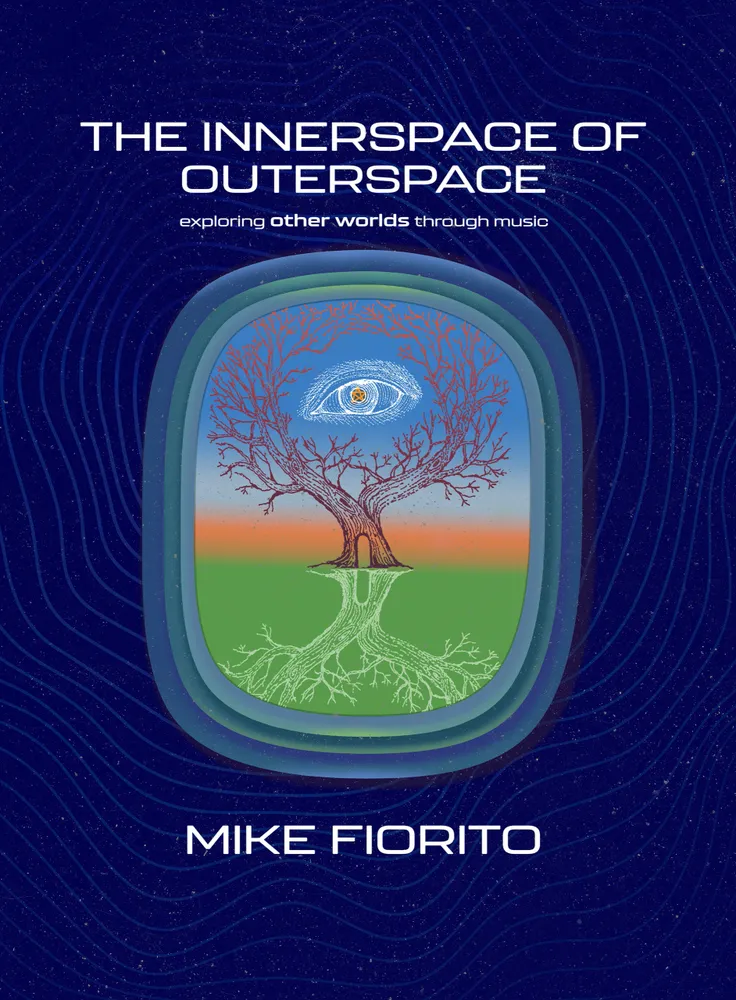
Brooklyn author Mike Fiorito and I spoke about this movie when I interviewed him about his last book, UFO Symphonic. He described the film as a “touchstone” for people interested in the topic. His latest book, The Innerspace of Outerspace, scrapes the mashed potatoes into the recognizable shape of obsession.
Equal parts memoir, music history, and spiritual inquiry, the book makes connections between electronic music, Jungian psychology, Tarot, mythology, science fiction, and UFOs.
Early on, Fiorito asks, “But what does the future sound like?” Whether looking ahead or inside himself, he uses music to venture into the unknown.
Each chapter is built around a Tarot card Fiorito drew for a musician or band who expanded the possibilities of sound, including Sun Ra, Pink Floyd, Brian Eno, John Coltrane, and Yes. Fiorito uses the meaning of the cards as a prompt to reflect on each artist’s creative vision. He calls Sun Ra “a modern shaman” and writes, “Imagination was his spaceship.” A Pink Floyd laser show at the Hayden Planetarium isn’t just a night out, but a rite of passage. Decades later, his teenage son Travis introduces him to the hip-hop tracks he likes, pointing out that Sun Ra and Coltrane are sampled in the music. Fiorito calls this a “full circle” moment.
Born in 1966, Fiorito had a space age childhood, when popular culture was consumed by events like the moon landing. Noticing his interest in Greek mythology and science fiction, his father gave him a life-changing gift: a subscription to Omni magazine. It introduced him to writers like Philip K. Dick and affirmed interests that few others around him shared. He writes, “There are those of us who are called, it seems.”
A chapter called “The Hanged Man” takes its title from the card he pulled for himself. Fiorito writes about a medical emergency in his early thirties, when he flatlined during a heart procedure and heard a UFO speak to him in a Brooklyn accent: “This is your chance to learn, to grow.” He also reflects on pivotal childhood experiences and recurring UFO dreams. Readers of Fiorito’s earlier books will recognize many of these themes.
The final section gathers stories from other people who answered the author’s prompt: “Can you tell me a story about something inexplicable involving music or sound?” One contributor, Renee Reeser Zelnick, writes, “What fascinates me most about the UFO subject isn’t the blinking lights or grainy footage—it’s the stories of the sacred weird.”
In Close Encounters, everyone acts like Roy is crazy. Yet it turns out aliens are real. The mothership lands at the end, and Roy is given the chance to climb on board.
Looking back in a 1997 documentary marking the film’s 20th anniversary, Spielberg noted he’d made it before he had children. Fatherhood changed him. Roy’s abandonment of his family was no longer conceivable. “I have a family that I would never leave,” he said.
But imagine that’s you standing there. The ship descends. The door opens.
Would you step aboard?
News from the neighborhood.
Red Hook & Gowanus
Want more news and features like this straight to your inbox? Subscribe to our newsletter below.
No spam · Unsubscribe anytime · Privacy policy
Discover more from Red Hook Star-Revue
Subscribe to get the latest posts sent to your email.