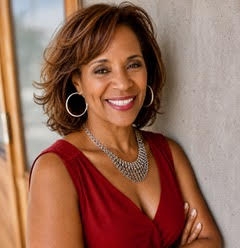
As a professional actress, Yvonna Russell thought she was used to rejection. But when she made the transition to writing, she faced some even harsher critics. After submitting a query about an early version of her novella Unfinished Business to a publisher, the editor wrote, “I don’t care if these characters eat, pee, or die.”
Russell had started writing the story on a Commodore 64. Crushed by the feedback, she set it aside. Decades later, with other writing credits under her belt, she picked it up again and discovered just what it needed: the perspective that comes with age.
Unfinished Business centers on Leanne and Derek, who meet in New York in the 1990s on the set of an all-Black soap opera. Twenty years later, when the cast reunites for an anniversary special, the former lovers meet again. The story is a meditation on the distance between youthful dreams and middle-aged reality.
Russell writes with an actor’s eye for detail and a director’s sense of pacing. Vivid scenes play like a movie in your mind. Despite being only 112 pages, it doesn’t skimp on depth—Russell has a knack for sketching a character in a line or two. When Leanne’s mother lectures her about her dashed dreams, Leanne thinks “there was no point interrupting her soliloquy of sadness. The story she always repeated, she was just about at the end.”
I met with Russell to discuss the long journey to publication, her transition from actress to author, and why she’s committed to writing 20 books.
Why does this book have a particular place in your heart?
I started this story around the time Vanessa Williams was dethroned as Miss America. I got so much horrible feedback that I didn’t want to write anymore. I was already an actress, and there was a lot of rejection with that. I talked to a wonderful writer friend who said, “Well, that’s just their opinion.” But I thought, I’m not any good.
At that time my favorite writers were Judith Krantz and Jackie Collins. I loved an enjoyable, entertaining book you could just tuck into. That was my aim, and I thought, I can’t even do that, so I just shelved it. But when I revisited it, I liked the idea of these characters meeting again many years later.
Was their midlife reunion part of your original conception?
Not really. Now that I’m older, I can see how things play out over time: how a life can go south very quickly, and how someone can pull it together—which is something you learn about yourself, especially when you live in New York for a long time. You have to reinvent yourself constantly. But there’s so much random wonderfulness when you walk out the door.
From bananas foster to cherries jubilee, the food references in Unfinished Business are very specific. What do those details bring to the story?
Whether it’s a slice from Joe’s or dinner at Jean-Georges, New York gives you the best of everything. Food becomes a way of telling the story of where the characters are in their lives. If it’s a beautiful spread at a Lincoln Center gala, that says one thing. If it’s Charles Chicken in Harlem, that says another.
Talk to me a little about your transition from actress to writer.
I always wanted to be an actress, a writer, and a producer—always, always, always! It just never came together. Then I had two resets that kept me home more: my mother developed Alzheimer’s and moved in with me and then the pandemic happened. I looked at all these writing pieces sitting in my Dropbox and thought, are you going to just let them sit there, or are you going to make a move? I tend to take the safe route, but I thought, I’m going to go out on a limb and try something new. So, I went with self-publishing.
What advice would you give to other writers thinking about self-publishing?
You just have to pull the trigger and do it, which is really hard because you’re putting yourself out there. I mean, I’m embarrassing myself all the time. I go to everyone I know, “Can you throw me a book party?” I look at people I admire and try to take a page from what they’ve done.
Your writing has a real emotional depth. How did you come to feel the novella was the right format?
I figured I couldn’t compare myself to writers who had 20 or 30 books under their belts—I needed room to grow. So, I set a goal of writing 20 books. And that goal needed to be bite-sized: I will finish it, I will feel satisfied, and I will move on to the next one. Sometimes you read something and you can tell the author is stretching to hit a word count. I don’t have to add filler. When it’s done, it’s done.
Are most of your books set in the entertainment industry?
I feel strongest when I stay in the world of theater, film, and television. I’ve written about a ballerina—I even interviewed Megan Fairchild before she retired—but I felt like that story had to be shorter because I wasn’t really living that world day to day. Another of my books was originally set in an office, but since I’ve never worked in one, I called a friend who was in Beauty and the Beast and used some of the stories he told me to drive the plot.
What are you working on now?
I’ve been writing something inspired by the “alpine divorce” hashtag—when someone leaves their partner stranded in a remote terrain—set at the Hamptons Film Festival.
New York is forever changing and always giving me material. I’ll walk down the street and see something has closed or moved, and it jogs a memory, a feeling—something I want to write about.
Do you ever feel a pull back toward acting?
If something came to me, I’d definitely consider it. I don’t miss getting up at 5 a.m., but I love movie sets. I worked on Carlito’s Way, in the Copacabana scene. The outfits were incredible. It was so much fun I almost didn’t want to get paid.My work as a cultural writer takes me to some nice events, but there’s something funny about going to an actual gala—it’s never as glamorous as the movie version.
And of course I would love to see my projects as movies.
Yvonna Russell’s books are available through her Amazon Author Page: amazon.com/author/yvonnarussell.
Author

Discover more from Red Hook Star-Revue
Subscribe to get the latest posts sent to your email.