
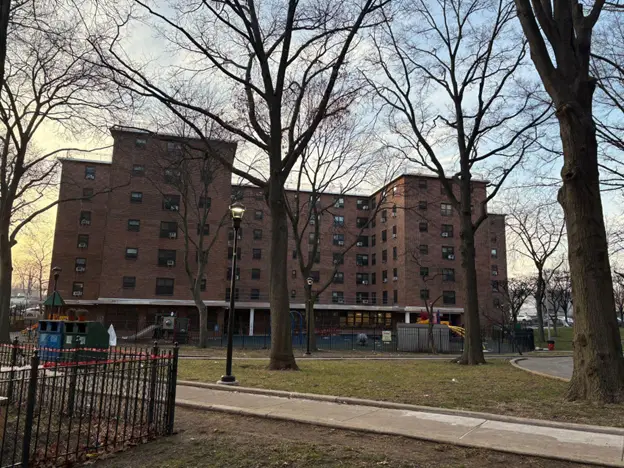
As Red Hook West considers the federal Permanent Affordability Commitment Together (PACT) program to revamp the complex, residents in other NYCHA buildings that voted for PACT are sending warnings.
Derrick Haynes, a longtime resident of the Manhattanville Houses which officially converted to the Project-Based Section 8 program in December 2024, says that the new program, which outsources renovations and maintenance, was marked by miscommunication, conflicting information, and a lack of coordinated leadership, with issues persisting a year into the change.
Haynes tells us that before the conversion the PACT development team assured tenants that apartments would not be downsized, the opposite has turned out to be true. The PACT team at Manhattanville is Apex Building Group, Gilbane Development Company, and West Harlem Group Assistance.
“Tenants are starting to receive downsizing letters, and in the letter, it states that if you do not accept the downsize, your [housing] voucher is being taken from you,” said Haynes.
According to NYCHA, all households that are not right-sized are required to move into an apartment that reflects the household’s actual size, once an appropriately sized unit is available. It is not clear whether this was the case with Manhattanville residents who received downsizing letters.
NYCHA Deputy Press Secretary Andrew Sklar said in an email that the selected PACT partner handles placing residents into appropriately-sized units in coordination with the household and NYCHA’s Leased Housing Department.
The renovation of Manhattanville was supported by the $28 million sale of an empty lot on the campus in 2022. After that lot was sold to a private developer, a luxury tower quickly went up, according to Haynes, who said he was skeptical about how the public housing complex would benefit from the sale.
“It really didn’t seem like any of that money went towards the Manhattanville development because after that site was sold, we had not started the PACT program,” said Haynes, noting the two-year gap between the sale of the lot and Manhattanville’s official shift to PACT.
Sklar contends that current NYCHA residents receive priority for 25% of the apartments in the new luxury tower, which includes 147 rent-restricted apartments inside.
“The building also features a new ground-floor supermarket and retail space, a dedicated community space for Manhattanville residents, and an indoor parking garage with 28 spaces reserved for NYCHA residents,” said Sklars, responding to an email query.
Where are the Jobs
Haynes spoke about promised jobs with the new companies.
“We were told that jobs would be available, training would be available but for whatever reason, there was low attendance,” said Haynes, who speculated that conflicting information about the training from various PACT partners could have been responsible.
The expression “too many cooks in the kitchen” could be applied to the Manhattanville conversion, Haynes said, as each partner offered different details about what PACT would entail.
“Nobody wanted to be a junior chef; everybody wanted to take the lead,” said Haynes.
The federal program not only offers renovations to apartments, but also a shift to private management. ELH Management is the company that now heads up Manhattanville. While Haynes says it’s too early to give them a fair assessment, they haven’t been well-received by other residents
due to poor communication about water and gas outages.
“When the water situation developed, I’m pretty sure nobody had a heads up on that—it took them
quite a while to fix it,” said Haynes.
Our attempt to communicate with ELH by email was unsuccessful by presstime.
For other developments considering PACT, Haynes advised that they rely on local organizations and other resident leaders, including himself, to guide them through the process. His experience liaising information to residents goes back to Columbia University’s initial expansion plan for the area in the 2000s.
“There are a lot of tentacles in this process,” said Haynes. “If you’re not careful with the information that you’re giving to residents or the information that you’re receiving from the PACT program, you’re going to have more problems.”
More problems close to home
Closer to Red Hook West are the Boulevard Houses in East New York, which also underwent a PACT conversion. Some residents there said that they’ve experienced issues since the renovations and conversion.
Boulevard Houses resident Quantasia, who only gave her first name, has lived at 725 Stanley Avenue for 30 years and said she was relocated from her first-floor unit to the fourth floor when renovations began in 2022. She says that since the revamp was completed in April, she hasn’t been able to move back to the first-floor apartment she grew up in and is having difficulty getting her name onto a new lease, among many other problems.
“Every time we give them the documents, they’re not renewing it,” said Quantasia, whose stepfather, Lawrence, is on the original lease.
Sklar from NYCHA said that before conversions occur, all authorized residents are offered a new lease to the property manager. At Boulevard Houses, the property manager is People Restoring Communities (PRC), a White Plains-based management company.
First reported by THE CITY, Boulevard has racked up over 900 violations issued by the Department of Housing Preservation & Development since its conversion in 2021.
“Households that are temporarily moved will sign a temporary agreement that guarantees the right to return to their apartment once the renovation is complete,” said Sklar. “The temporary move agreement also provides additional benefits, including free packing and moving support.”
Quantasia said that in order for her name to be added to the lease, her stepfather has to renew the original one. The problem, she said, is that NYCHA refuses to renew it, despite her stepfather providing the necessary documents.
“We’ve basically been living here for two years with no lease,” said Quantasia, who showed us a lease recertification from 2024 that was still under review.
Since renovations were completed in April, Quantasia said her water has been shut off at least once every month and in one instance, her oven was broken for three weeks.
“We kept going back to submit tickets and no one would come,” she says.
The 30-year-old mom said she’d often wake up with no running water to shower with, which forced her to stay home from her job as an autopsy assistant at Long Island Jewish Hospital.
“The water outages have been the most I’ve ever seen since living here, to the point where it made me lose my job,” she told the Star-Revue.
Quantasia said that for developments considering PACT, she recommends that residents outline their needs and make sure PACT partners can meet them.
“Make sure that they actually have the ability to maintain such a large housing development,” she said. “I feel like these people don’t have the tools or knowledge to take care of buildings with thousands of people in them.”
Boulevard Together, the partnership team that represents PRC, also did not respond to our request for comment at press time.
Author

Discover more from Red Hook Star-Revue
Subscribe to get the latest posts sent to your email.