In Arthur Miller’s 1955 play, A View from the Bridge, the narrator Alfieri describes our Brooklyn waterfront as “the gullet of New York, swallowing the tonnage of the world.” And the New York Dock Railway was the spoon that kept it fed. We could use such a spoon again, now that United Parcel Service has come to town.
In 1982 the New York Dock Railway, already awash in red ink, partially financed Ken Burns’ magnificent PBS documentary on the Brooklyn Bridge. A year later the Railway went toes-up. It is little remembered today except among train buffs. But once its tracks interconnected miles of warehouses with a marine railroad that made Brooklyn’s waterfront accessible to the rest of America.
The Railway’s birth pangs can be traced to a warm day inside a Sheriff’s auction hall at 9 Willoughby Street. It was June 11, 1901 and the New York Dock Company had just placed the winning $5 million bid for the holdings of the bankrupt Brooklyn Wharf & Warehouse Company, formed only six years earlier by a combination of 28 independent warehouse firms.
There were so many buildings, wharves, piers, bulkheads, elevators, cranes, machines, water rights and franchises being foreclosed, it took the auctioneer a full 50 minutes to read through the list. But aside from a crush of reporters, there wasn’t much of a crowd in the hall that day because there was only one bidder. In fact, New York Dock, or NYD as it would soon start branding everything it owned, was merely a corporate reorganization of the failed company, featuring new forward-thinking managers.
The collapse of Brooklyn Wharf & Warehouse – the largest monetary foreclosure and real property transfer in the history of Brooklyn – had been attributed by its fossilized directors to the shipping disruptions of the Spanish-American and Boer Wars (!), and the “utter collapse” of the grain trade. HaHaHa! THEIR RATES WERE TOO DAMN HIGH! For example, an arriving barge or steamer laden with grain had to quickly transfer its rat-tempting cargo to an elevator and Brooklyn Wharf owned all 16 elevators in New York Harbor. Can you spell monopoly? Ka-Ching! Then there were the “lighterage” laborers offloading and reloading the grain. Ka-Ching! But the coup-de-grace was the delay (double Ka-Ching!) in transferring the grain to railheads for regional distribution.
Philadelphia, Baltimore and Boston had direct overland connections from their ports to the major rail freight carriers, while Brooklyn sat on the edge of a very long island, separated by two and a half miles of water from the continental railroad terminals in New Jersey. The new NYD management team however, had a plan to make the business competitive again: an expanded marine railroad that could efficiently move goods back and forth from ships to elevators to warehouses – and especially to three float bridge terminals along their 2.75 mile waterfront expanse.
And so, once the Sheriff delivered the voluminous deed, NYD quickly served eviction notices to the Swedish dock workers living along a three block stretch of Furman Street below Atlantic Avenue, then demolished their wood frame houses, cleared the land and built rail yards for a new fleet of freight cars that would service those three terminals.
The terminals, known as Fulton (at the foot of Montague Street), Baltic (Baltic Street) and Atlantic (King Street), each featured a float bridge – railroad tracks extending onto a pier at the end of which a pontoon or rail barge with tracks would be loaded with up to a dozen freight cars, nudged forward by a locomotive. Once unmoored, the barge would be steered by a tug to the float bridges maintained by all the major carriers in and around the Jersey City waterfront.
[slideshow_deploy id=’11575′]
The float bridges used winches to lower and raise the end of the pier, depending on the tide, to enable linkage with the car floats. Some of the winch equipment for those bridges would have been provided by Lidgerwood Manufacturing on Coffey Street – given Lidgerwood’s long history of churning out marine winches in the plant that UPS has now er… remodeled.
In 1917 the Hell Gate Bridge finally connected our loooong island to the Bronx, opening a freight train route to the mainland. But even today that path involves a 120-mile trek northward to find a freight bridge that crosses the mighty Hudson River. Then 120 miles south again to reach all the rail heads in New Jersey. Train vets point out such long hauls take an average of 24 hours, often much longer. Madness! A better solution remained: pushing snub-nosed barges loaded with boxcars back and forth across Upper New York Bay, 30 minutes each way.
But alas and alack, after World War II Robert Moses, who never met a motor vehicle he didn’t like, got busy. Many more tunnels and bridges accommodated Detroit’s trucks rumbling over and under the waters separating us from the continental United States, gobbling up the freight business. The opening of the Verrazano Bridge in 1964 provided the final nail in the maritime coffin. Now there is only one functioning rail float in the City, at the foot of 65th Street near the Brooklyn Army Terminal and there is no connection to it from Red Hook. State funds for an elevated “Brooklyn Marginal” freight railroad had been allocated in 1916 to link the New York Dock Railway with the 65th Street rail yard – and wipe out lower Conover Street in the process – but the Great War interrupted those plans and the money was later reallocated or pocketed. Take your pick.
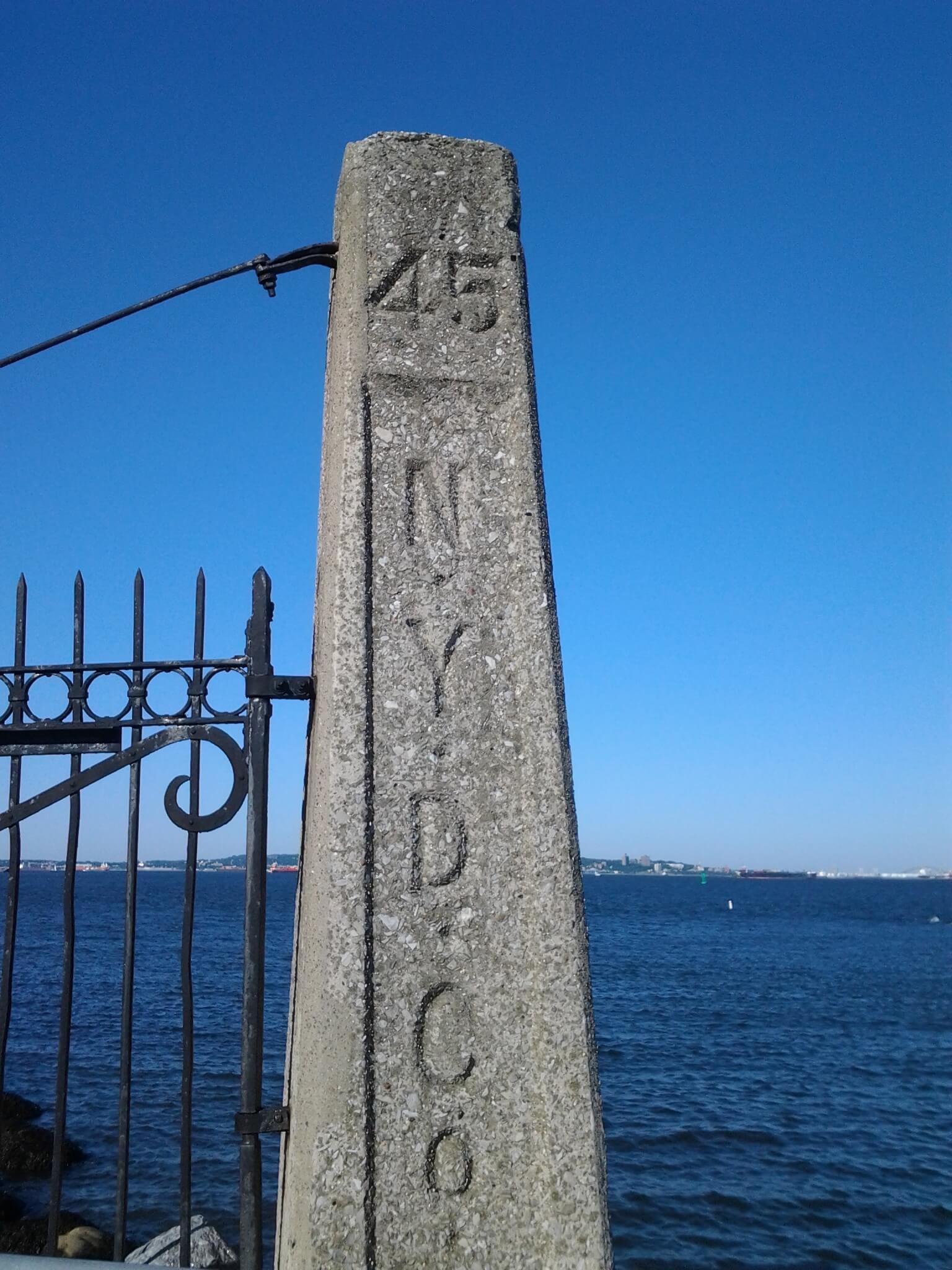
Today, savvy history buffs can still find vestiges of the New York Dock Company: a stone pillar behind Fairway marking what was once Pier 45 (that’s right, they owned 44 other piers north of there); converted warehouses along Imlay Street with the name embedded in masonry; and a metal plate on a building at the corner of Joralemon & Furman Streets marking the company’s administrative offices, abandoned with the 1983 demise of NYD. Decades later, that decaying three story brick building was handsomely renovated. It now serves as the information center for the Brooklyn Bridge Park, which has replaced all of that once-bustling commercial landscape north of Atlantic Avenue. And the New York Dock Railway was the glue that that held all that commerce together.
One final note. An insurance map in 1916 shows railroad tracks extending from Pier 39, at the foot of Vandyke Street, across a vacant stretch of what is now Valentino Park and running along Coffey Street past the UPS Lidgerwood site. Since 1916, car floats have gotten bigger, of course, and can now accommodate 18 boxcars. And one boxcar can hold the equivalent of four truckloads. So, each incoming barge from New Jersey to a new float bridge servicing UPS could eliminate 72 trucks rumbling into Red Hook. And a lot of wasted time on the damn BQE.
Author

Discover more from Red Hook Star-Revue
Subscribe to get the latest posts sent to your email.