
News from the neighborhood.
Red Hook & Gowanus
Subscribe to get the Star-Revue’s newsletters throughout the month.
On a rainy weekday evening in Carroll Park, activity and mounting anticipation. Volunteers drag chairs into place across the plaza stones. Actors, not yet in costume, leap about on stage, practicing their swordfight choreographies. A three-person all-percussion band, huddled under their tent, starts up, syncing their warmup to the beating of a nearby car alarm.
Showtime draws nearer. The volunteers—local high school students—usher attendees to seats. Some strike up conversation with passersby: the show is free, community theater, it’s Shakespeare, yes, really free, it’s Julius Caesar, it’s about to start, 7:30, weather permitting. A gray-haired man with a stately bearing paces behind the seats, by the water feature, loudly performing vocal warmups. His face, the face of Caesar, hangs on banners behind the stage.
Everyone is watching the sky over the Robert Acito Parkhouse. In front of the parkhouse is the stage, which two stagehands come out to inspect. Too slippery? No, but any wetter and we’ll have to call it. So it goes with outdoor theater. The lights come on.
When Director (and Smith Street Stage Co-Founder) Jonathan Hopkins takes the stage to introduce the show, even he seems unsure what the theatrically darkening sky has in store for the intrepid troupe. All he can promise, he says, is that they will try. And the play begins.
Julius Caesar in the park
Julius Caesar details the assassination of a man who has succeeded in converting republic into dictatorship, securing himself a perpetual position as autocrat. Negative omens surround him, but he waves them away. He is betrayed by a group of senators assembled by the conniving Cassius but figureheaded by noble-minded Brutus. After the classic “Et tu, Brute?” scene, rather than a return to order, a civil war breaks out. Neither the conspirators nor the republic survive.
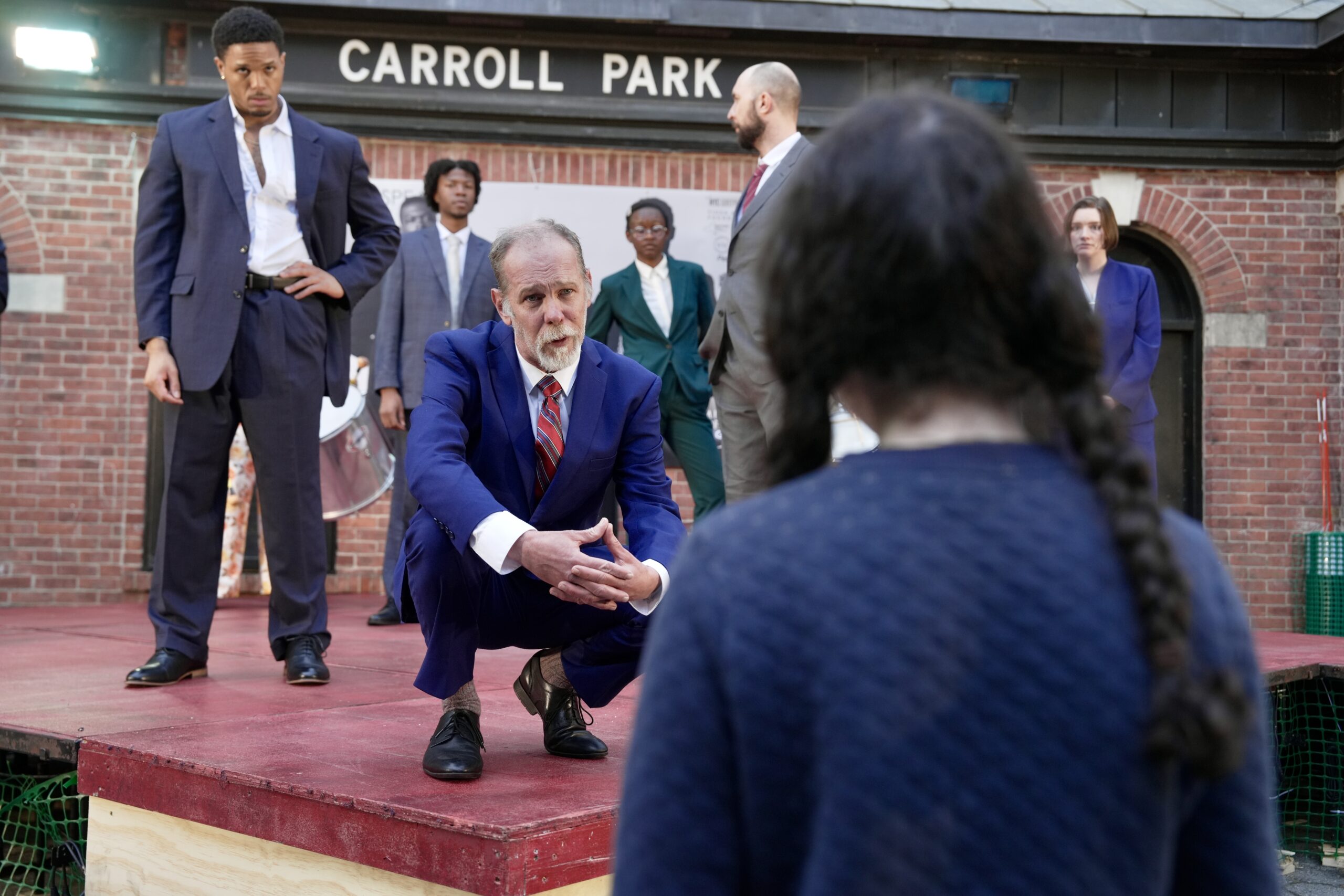
This spring’s Smith Street Stage production has been gently updated for a modern staging. Rather than togas, Caesar and his senators wear suits and ties. When the war breaks out, they don military vests or guerilla fatigues. The body language and intonation, too, is out of the present day. The language and swords, of course, have been left intact. Smith Street Stage also changed the gender of a number of the characters, creating more roles for women in a play which would otherwise have only two women, the wives of Caesar and Brutus, in roles peripheral to the main action.
When the play opens and Louis Butelli’s Caesar appears in his suit, smiling and waving at the assembled supporters, the audience quickly understands the play as a parable against our own times. Such a tradition goes back to the play’s original political context (an aging queen, a threatening power vacuum), and includes, at least in New York’s past, Orson Welles’ famous 1937 adaptation to the visual world of fascist Europe.
Since it’s Shakespeare, there are also many delights beyond the allegorical. There are meaty roles, full of contradictions: the unusual tragic hero of conflicted Brutus (Amara James Aja); the at-once loyal and disloyal Cassius (Katie Willmorth); the slippery, silver-tongued Mark Antony (Bryce Foley); and, of course, a Caesar (Louis Butelli) who is powerless, even as he sets the standard for earthly power. Each actor is attuned to the contradictions.
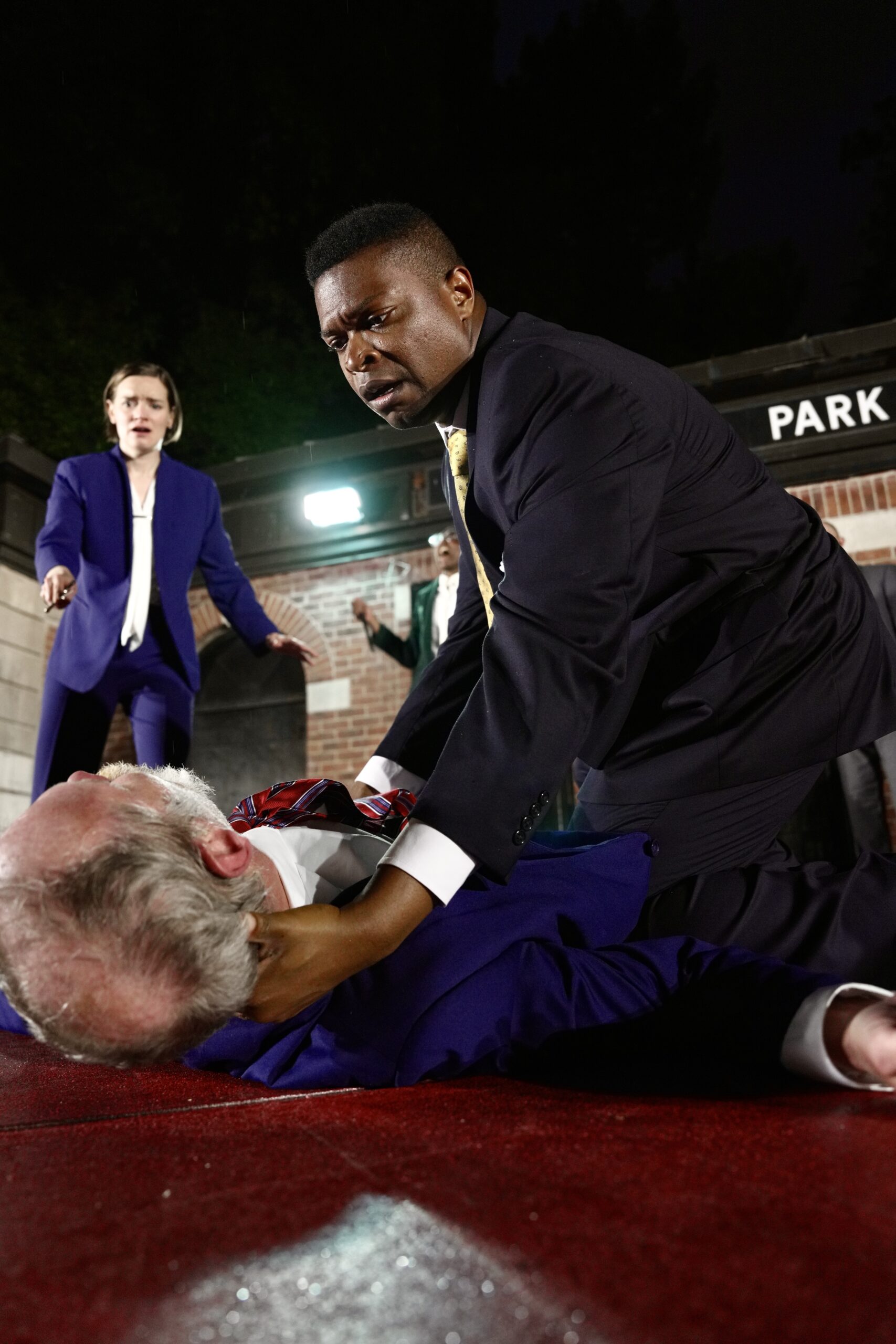
The production brings out a roiling city chaos that will be familiar to any New Yorkers in attendance. For Caesar’s death scene, supporting members spread to the edges of Carroll Park, passing the news around in shouts as the drums beat. The fervor was realistic enough that a few passing evening walkers stopped at the fence to look in, maybe wondering, for a second, if they would need to call an ambulance. These energizing touches, along with the swordfights, worked to keep the children in attendance in their seats for the entire hour and a half runtime.
That night, the rain held to a merciful drizzle, Caesar fell, and everything was carried through to its tragic end. In Smith Street Stage’s 16th year at Carroll Park, it’s clear they’ve learned to have fun with the space, bringing the energy of the modern public square into contact with Shakespeare’s Rome.
Performances, free to the public, will continue Thursday through Sunday at 7:30 pm until June 7. For those unwilling to commit to an evening of Shakespeare but tied to the responsibilities of dog ownership, consider routing your evening dog walk past the park, where the shouting crowd is sure to draw you in, as it has drawn in other viewers for the past 400 years.
Discover more from Red Hook Star-Revue
Subscribe to get the latest posts sent to your email.